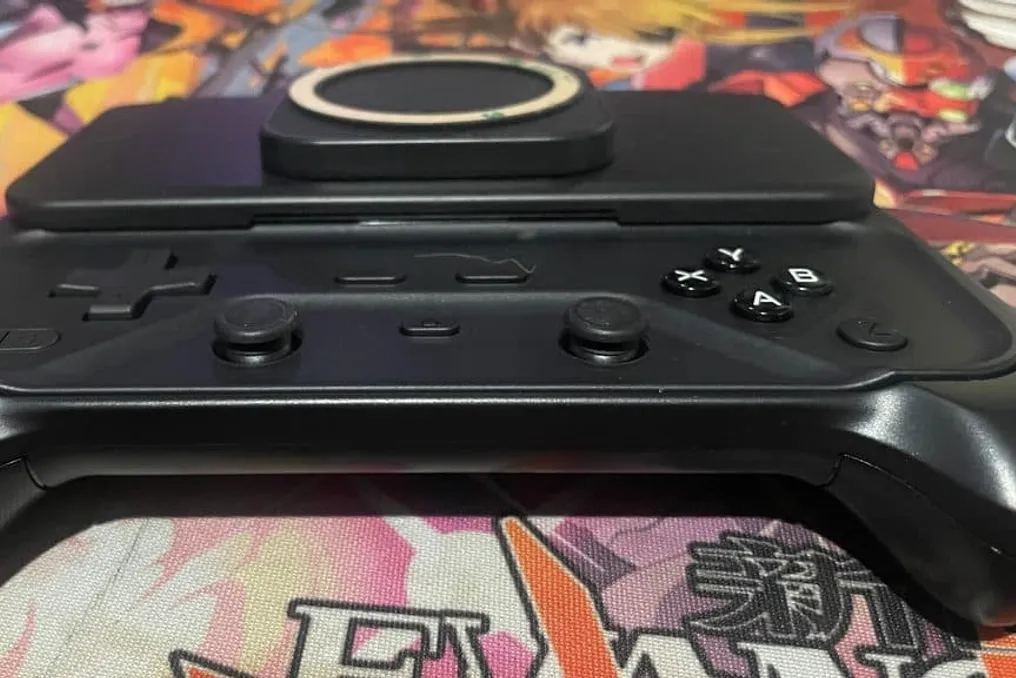
The abxylute M6 is presented as a magnetic controller designed to attach to the back of the phone and slide laterally, exposing a complete set of buttons. This concept recalls the Sony Xperia Play idea but adapted for MagSafe technology. When closed, it resembles a robust case; when opened, it transforms into a gamepad equipped with two analog sticks, a D-pad, ABXY buttons, linear triggers, and vibration functionality.
The main advantage proposed by the M6 is solving a common problem among mobile gamers: the discomfort of carrying traditional telescopic controllers or the need to transport two separate devices. The M6 allows the controller to remain constantly attached to the phone.
abxylute dedicated almost three years to developing this format, which succeeded the M4 model, considered smaller and more portable, but inadequate for prolonged sessions. The M6 is larger, features larger analog sticks, removable magnetic grips, and vibration, while remaining compact enough to fit in a jacket pocket.
It is important to note that the unit tested is only an engineering sample (T2), and all described specifications apply to this phase. The manufacturer itself has already listed planned adjustments for the assembly line, detailed below.
When releasing controllers, it is crucial to differentiate concepts: the M6 uses Hall Effect technology in the triggers, not in the analog sticks. The sticks employ capacitive technology, a non-contact alternative. Both technologies eliminate the need for potentiometers, which cause classic 'drift,' but they are distinct approaches.
The most complex construction challenge of the M6 is not electronic, but rather the rail. abxylute claims to have developed this mechanism with a partner who has already supplied rails for Nokia and Sony, capable of supporting approximately 300 grams, ensuring the controller can support a modern phone with a case. In practice, the rail has dampening on both sides and a movement that initially locks and completes autonomously after a few centimeters.
The manufacturer advises against using the M6 with foldable smartphones, as these are larger and require greater magnetic fixing capacity, and the company chooses not to guarantee compatibility. Furthermore, the capacitive sticks were developed in collaboration with K-Silver, the same line used in the abxylute One Pro. This choice was motivated by the magnetic nature of the controller, as resistance to magnetic interference was an essential criterion.
The practical benefit of a non-contact stick is the absence of potentiometer wear, which is the origin of classic drift. However, short tests do not prove the non-existence of drift, as this is a wear issue that arises after months. What can be stated is that, in factory condition, there is no perceptible drift or dead zone.
Despite its compact size, the stick achieves a 20-degree tilt, close to the 23 degrees of a full-size analog stick, and supports L3/R3 clicks. The stepped cut around it facilitates thumb access without the raised edge causing obstruction.
A distinction often ignored in quick reviews is that the M6 has four controls on the top section, divided into two pairs of different natures. The triggers maintain a fast actuation mode, registering total pressure from the first touch, which is advantageous in shooter and action games but superfluous in racing. The ABXY buttons and D-pad use membrane, and abxylute considers this a positive feature, allowing play in shared environments without the noise of mechanical microswitches, although this implies less tactile feedback for those accustomed to mechanical controllers.
The layout follows the Xbox standard (A at the bottom, B on the right, X on the left, Y on top), and in PlayStation mode, the mappings correspond to the DualShock equivalents. In tested games, no difference in accuracy was observed between the four buttons. The D-pad operates in 8 directions out of the box and can be configured for 4 directions using M + left directional, with this configuration persisting even after powering off. The sticks can also switch between square (default) and circular output.
Two genres requiring precise control were chosen for opposite reasons: fighting, which demands exact synchronization in command sequences, and racing, which requires subtle pressure modulation. In The King of Fighters, the Bluetooth response was agile, which was a concern given that fighting games are sensitive to frame-level delays. No perceptible latency hindered gameplay or sequence execution. However, abxylute itself points out that excessive pressure or lateral sliding on the D-pad can trigger adjacent buttons, a constant movement in fighting games, and the company plans to adjust several components in the production version.
For racing games in GRID, the linear triggers demonstrated good precision for acceleration and braking, allowing intermediate intensity levels, which enables throttle metering. The 5.5 mm travel is significant for a controller of this thickness. Despite this, the trigger calibration function was not fully implemented in the sample's firmware, which could generate reading inaccuracies, but the modulation in the game remained consistent.
The analog sticks showed no drift or dead zone, which is expected from a newly released device, reinforcing the promise of durability from non-contact sticks, although the latter is only confirmed with continuous use. The M6 includes a dedicated Z button, which functions as the left analog click (L3) by default and can be converted into a macro. By holding M + Z for two seconds, the controller enters recording mode, accepting sequences of sticks, ABXY, shoulders, triggers, directional pad, and system buttons.
The 6-axis gyroscope also simulates stick movement: pressing M + L3 or M + R3 for two seconds directs the aim to the sensor. The controller's position at the time of activation serves as the initial reference, and this setting is lost upon powering off. For games without native support, the M6 performs virtual mapping through the firmware, translating physical buttons into screen taps, a feature exclusive to Android; on iPhone, touch-only games remain unsupported.
Mode switching is manual and depends on the game. Vibration operates in all modes, which is unusual for mobile controllers, and has four adjustable levels accessible via M + up or down directional. There is also a proprietary abxylute application, planned to manage local games, centralizing remapping, stick and trigger adjustments, macros, lighting, and vibration, although this was not available during testing.
It is essential to reiterate that the analyzed unit is a T2 series engineering sample, and abxylute provided reviewers with a list of pending corrections. This ensures transparency about what is being evaluated.
Regarding hardware and firmware, none of the points raised are structural, dealing with finishing and software refinements. However, the D-pad and insufficient vibration directly impact the gaming experience and require resolution before the final launch.
The M6 was funded through Kickstarter, whose campaign ended on November 15, 2026, raising US$ 264,535 from 2,713 backers, far exceeding the goal of HK$ 10 thousand (equivalent to about US$ 1,300). The campaign received the Project We Love seal. During the fundraising period, the M6 cost about US$ 69, while the M5, a thinner version with USB-C connection, was around US$ 65. Deliveries are scheduled for November and December 2026, and the project page remains open for late orders. There is no official distribution in Brazil; buyers will need to import, which implies international shipping costs and taxes.
The M6 successfully fulfills the role that mobile controllers often fail at: it eliminates the need to choose between using a dedicated controller or relying on the phone's native controls. The sliding rail represents the product's most notable engineering, and the 5.5 mm linear triggers are a luxury differentiator for a device of this thickness, providing a real difference in racing games and any title that detects pressure. The Bluetooth response proved adequate even for fighting games, the genre most rigorous regarding latency. The capacitive analog sticks mitigate the drift problem by design, although full durability depends on usage time.
What prevents this prototype from being a definitive recommendation are two points recognized by the manufacturer itself: the D-pad that can trigger neighboring buttons under lateral pressure—a typical movement in fighting games—and the weak vibration. If the production version resolves these two aspects, the M6 would establish itself as a highly complete option in the category. The choice of membrane buttons is seen as a profile decision, benefiting those seeking silence, while those who prefer mechanical feedback will feel the absence of the click.