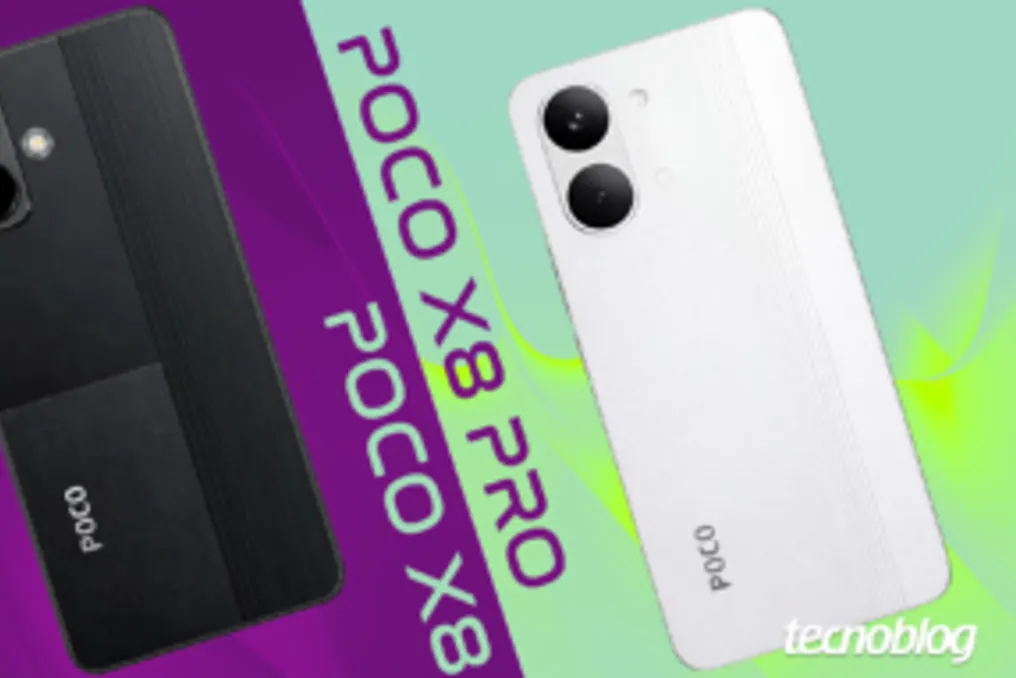
Comparison between Poco X8 and Poco X8 Pro: specifications and performance analysis
Read more
Tecnoblog
tecnoblog.net

Comparison between Poco X8 and Poco X8 Pro: specifications and performance analysis

The Poco X8 and Poco X8 Pro models are mid-range smartphones from Xiaomi known for their good balance between cost and benefit. Although the Pro version is aimed at superior gaming performance, the basic model is distinguished by having a large capacity battery and greater resistance to damage such as water and drops.

Tecnoblog conducted a detailed comparison of the tests performed on both devices to help decide which one is most suitable for the user. Below are the main distinctions between the Poco X8 and the Poco X8 Pro.

Contrary to expectations, the Poco X8 has larger dimensions and a heavier weight than the Poco X8 Pro. There are also variations in the rear design: the base Poco X8 model features a small camera module integrated into the smooth casing, sporting a segmented line look inspired by robotics, available in black, white, or orange.

The Poco X8 Pro, on the other hand, has a smooth rear finish in black or mint green versions, although the white variant incorporates a divided line design similar to the Poco X8. In the Pro version, the rear camera lenses emerge directly from the structure, without a specific module.

In terms of construction, the Poco X8 Pro uses premium materials, including fiberglass on the back and edges made of aerospace-grade aluminum alloy. On the other hand, the Poco X8 was built with a reinforced plastic back, complemented by plastic frames with fiberglass and cast aluminum.

Despite the material differences, the Poco X8 demonstrates greater robustness in terms of protection. It has full certification against dust and water (IP66, IP68, IP69, and IP69K), capable of withstanding immersions of up to 2 meters for up to 72 hours, in addition to protecting against drops of up to 3 meters, making it ideal for those who are frequently exposed to rain or prone to accidents.

The Poco X8 Pro also has water and dust protection, but its resistance is lower, supporting dives of up to 1.5 meters for only 30 minutes, and Xiaomi does not specify drop protection for this model.

Regarding the screen, the Poco X8 Pro has the advantage of supporting Dolby Vision and HDR10+, allowing for a more faithful reproduction of brightness, color, and contrast in compatible content. The Poco X8 does not have this support, resulting in less faithful images. However, the Poco X8's display is equipped with Gorilla Glass Victus 2, which is more resistant than the Gorilla Glass 7i found in the Poco X8 Pro.

Both phones offer a wide viewing area, satisfactory brightness even under strong lighting, high-definition images, and excellent graphic fluidity. In terms of processing, the Snapdragon chip in the Poco X8 is recommended for simpler tasks, such as social media, browsing, and low-demand casual gaming. The Poco X8 Pro, on the other hand, uses the MediaTek Dimensity 8500-Ultra chip, ensuring advanced performance for heavier activities, such as video editing and Artificial Intelligence workloads.

RAM efficiency also differs: the LPDDR5X present in the Poco X8 Pro is more efficient and has a higher bandwidth than the LPDDR4X in the Poco X8, optimizing and accelerating multitasking. Regarding storage, the Poco X8 offers 128 GB (UFS 2.2) or 256 GB (UFS 3.1) options, while the Poco X8 Pro is available in 256 GB or 512 GB in the UFS 4.1 standard, which provides superior read and write speeds, allowing the Pro version to save files and open applications faster.

Although cameras are not the main focus of this comparison, the Poco X8 Pro presents a more complete set with better results than the Poco X8. Despite both main cameras having 50 MP, the Poco X8 Pro's has a larger sensor and a superior lens aperture, which facilitates light entry and improves photo quality, especially at night. Additionally, the Pro version's ultrawide lens allows capturing photos at wider angles, and the Poco X8 Pro's selfies capture more detail.

In video, the Poco X8 Pro records in 4K at 60 frames per second, offering more margin for cuts and smoother footage, while the Poco X8 is limited to Full HD (1080p) at 30 fps.

Considering capacity and autonomy, the Poco X8 is the leader in battery, equipped with an 8,340 mAh silicon-carbon component that lasted 59 hours in tests. However, the Poco X8 Pro also has a good 6,500 mAh (Si-C) battery with autonomy for more than a day in normal use. Furthermore, the Pro version offers faster charging, up to 100 W, and wired reverse charging of up to 27 W, surpassing the Poco X8, which has charging limited to 67 W and reverse charging of up to 22.5 W.

The Poco X8 Pro stands out with an advanced dual-layer cooling system, called Poco 3D Ice Loop, which helps dissipate heat and can reduce the SoC temperature by up to 3ºC. The Poco X8, on the other hand, only has thermal protection that can disable functionalities to prevent overheating. These specifications confirm that the Poco X8 Pro was designed to manage intensive processing, as high temperatures require a dedicated cooling system to maintain performance without overheating; without this advanced system, the Poco X8 may interrupt tasks when overheating, limiting its performance in demanding activities.

Both models support 5G, NFC, and infrared sensors. The difference lies in the communication protocols: the X8 uses Wi-Fi 5 and Bluetooth 5.1, while the X8 Pro adopts Wi-Fi 6 and Bluetooth 6.0. In practice, the Poco X8 Pro achieves higher data transfer speeds when using Wi-Fi and maintains a more stable connection with multiple devices connected to the router. The Pro model's Bluetooth 6.0 ensures features such as more accurate distance measurement and more efficient connection with nearby devices.

Both smartphones come with the HyperOS 3 operating system, based on Android 16, and both have four years of system update support. The interface is described as simple and intuitive, despite including several pre-installed applications. Most system features are available on both, such as various themes, custom widgets, and HyperIsland, a function analogous to the iPhone's Dynamic Island.

However, the Pro version is compatible with WildBoost optimization, which enhances the overall device performance, and includes various artificial intelligence features, such as automatic translation, transcription, and writing assistance. Such features are not present in the Poco X8. The base model has some AI tools, but these are restricted to image editing, allowing object removal, optimizing bokeh effect in portraits, or expanding photos.

The Poco X8 is a advantageous option for those who prioritize a durable smartphone with long battery life, without needing high raw performance, being suitable for daily use and promising longevity. It is important to note, however, that the cost-benefit decreases considerably when the price exceeds R$ 2 thousand (8 GB + 256 GB configuration).

The Poco X8 Pro is a powerful device for those seeking high performance in gaming and demanding graphics tasks, while also having a screen with HDR support, without needing to invest in a premium phone. In this price range, around R$ 2,700, it competes with devices like the Galaxy S25 FE (which has more advanced cameras) and the Motorola Edge 70 Pro (with 12 GB of RAM and superior cameras).

In summary, the Poco X8 Pro surpasses the Poco X8 in performance, screen quality, cameras, and connectivity.
Similar stories

Review of the Best Xiaomi Smartphones of 2026: Model Recommendations
Read more
tecnoblog.net

Review of the Best Xiaomi Smartphones of 2026: Model Recommendations

Those looking for the best Xiaomi smartphone in 2026 can find suitable options for any budget and need, ranging from the most affordable models to flagship devices.

The company offers clearly structured product lines. The Redmi series is known for its high price-to-quality ratio. The Poco series is aimed at users who require high performance at a lower cost. The main Xiaomi line combines the most advanced devices in terms of cameras, displays, and overall performance.

This guide provides recommendations for choosing the best Xiaomi smartphone to buy in 2026, specifying options depending on the category, price range, and intended use.

Xiaomi Redmi Note 15 5G vs. Motorola Moto G86 Comparison: Which Mid-Range Smartphone is Better for the User?
Read more
olhardigital.com.br

Xiaomi Redmi Note 15 5G vs. Motorola Moto G86 Comparison: Which Mid-Range Smartphone is Better for the User?

Xiaomi and Motorola offer good options for those looking for advanced features without needing to purchase a flagship device. The Redmi Note 15 5G focuses on large battery capacity and a 108 MP main camera. Meanwhile, the Moto G86 attracts attention with its 1.5K resolution pOLED display, MediaTek Dimensity 7300 processor, and enhanced dust and water resistance.

Both devices feature an 8GB RAM and 256GB internal storage configuration in the compared model, but there are differences beyond technical specifications. Both smartphones are equipped with displays with up to 120Hz refresh rates, ensuring smoother scrolling and animation, though the difference lies in the technology and resolution.

The Redmi Note 15 5G is equipped with a 6.77-inch AMOLED display with a resolution of 2392 x 1080 pixels and a stated maximum brightness of 3200 nits. This combination is very interesting for watching videos, navigation, and using the device outdoors.

The Moto G86, on the other hand, uses a 6.7-inch pOLED panel with a 1.5K resolution, a maximum brightness of 4500 nits, and Gorilla Glass 7i protection. This combination provides higher detail and, according to manufacturer data, greater brightness in intense lighting. In this aspect, Motorola has an advantage in technical specifications, although Xiaomi also offers a high-class screen for this category.

Different solutions are used for the platforms. The Redmi Note 15 5G runs on the Snapdragon 6 Gen 3, manufactured using a 4nm process, featuring an octa-core CPU and a frequency up to 2.4 GHz. The Moto G86 is equipped with the MediaTek Dimensity 7300, which is also produced in 4nm. This platform comes with 8GB of RAM and 256GB of internal storage. Motorola additionally claims the ability to increase memory up to 16GB via RAM Boost, which uses part of the storage as virtual memory.

Both sets are suitable for social media, navigation, streaming, productivity apps, and gaming. However, the Dimensity 7300 will likely provide a more powerful platform for demanding tasks, putting the Moto G86 in a favorable position for users prioritizing performance. It is important to remember that user experience also depends on system optimization, memory management, and application behavior, and the claimed amount of virtual RAM does not equal physical memory.

Xiaomi emphasizes impressive figures. The Redmi Note 15 5G has a 108 MP main camera with Optical Image Stabilization (OIS), an f/1.7 aperture, and a 1/1.67-inch sensor. This setup is complemented by an 8 MP wide-angle camera and a 20 MP front camera. Rear video recording reaches 4K at 30 frames per second.

Motorola takes a different approach. Its main sensor uses Sony LYTIA 600 with a 50 MP resolution, also featuring optical stabilization. It also includes an 8 MP ultra-wide/macro camera and a 32 MP front camera. A key difference is the ability to record video in 4K from the front camera, according to the manufacturer's information.

In practice, 108 MP from Xiaomi does not automatically guarantee better photos than Motorola. Sensor size, aperture, image processing, and stabilization directly affect the final result. Redmi offers a higher resolution main lens, while the Moto G86 relies on the Sony sensor and AI functions for image optimization.

Battery life is another standout feature for the Redmi Note 15 5G. The device is equipped with a 5520 mAh lithium-carbon battery and 45W turbo charging. Xiaomi also includes 18W reverse charging, allowing the smartphone to power other compatible devices.

The Moto G86 has a 5200 mAh battery and 33W TurboPower charging. Motorola claims up to 41 hours of use, but this figure depends on testing conditions and usage profile. A higher-power charger is sold separately, according to the manufacturer's information.

On paper, Redmi has an advantage in both battery capacity and charging speed. Reverse charging is also a useful extra feature for users of wireless headphones, smartwatches, or other accessories.

If durability is important, Motorola demonstrates a significant advantage. The Moto G86 has IP68 and IP69 certifications and has passed tests based on military standard MIL-STD-810H procedures. The screen is also protected by Gorilla Glass 7i. This means increased protection against dust, immersion in fresh water within specified limits, and jets of water under controlled conditions. However, this does not mean the device is invulnerable or can be used in water normally.

The Redmi Note 15 5G has an IP65 certification, which provides protection against dust and water jets, but does not allow for immersion. Xiaomi also highlights drop tests from heights up to 1.7 meters under specific laboratory conditions. For those who work outdoors, engage in active recreation, or simply seek more peace of mind in daily use, the Moto G86 offers a more comprehensive protection package.

The Xiaomi Redmi Note 15 5G and Motorola Moto G86 are well-equipped mid-range smartphones, but each excels in different areas. The Redmi Note 15 5G is a good choice for those who value large battery capacity, faster charging, a 108 MP main camera, and the ability to charge other gadgets. It also offers a wide AMOLED screen and a balanced set of features for daily use.

The Moto G86, conversely, attracts attention with its 1.5K resolution pOLED screen, Dimensity 7300 processor, 32 MP front camera capable of 4K recording, and most importantly, IP68/IP69 protection. This is an attractive option for those seeking a device better prepared for various situations throughout the day.

Conclusion: If autonomy, charging, and high-resolution photo capabilities are priorities, the Redmi Note 15 5G is worth considering. For those who value a more advanced screen, performance, and physical protection, the Moto G86 appears to be the more complete option. Since prices vary significantly in stores and during promotions, the final decision must also take into account the price difference between the two models. If they are in close price ranges, Motorola offers a very strong technical package; if Redmi is significantly cheaper, it might offer a very interesting price-to-quality ratio. The article appeared in Olhar Digital.

Moto G86 Analysis: Review of the Motorola Mid-Range and its Cost-Benefit Ratio
Read more
tecnoblog.net

Moto G86 Analysis: Review of the Motorola Mid-Range and its Cost-Benefit Ratio

The Moto G86 is one of the most popular mid-range smartphones offered by Motorola in the Brazilian market. This device was seen on promotions around R$ 1,500 at TB's Achados and stands out for having a 120Hz POLED screen, which provides vibrant colors and high brightness, as well as a battery designed to last more than a day without needing a recharge.

However, the device has limitations in terms of gaming performance, and Motorola's update policy for this model was considered disappointing. Therefore, Tecnoblog conducted tests on the model over the last month to determine if purchasing the Moto G86 is still justified in the current scenario.

Upon unboxing the Moto G86, the user finds the device, a 33W TurboPower charger, a USB-A to USB-C cable, the SIM tray ejector pin, the manual, and the warranty term. It is important to note that Motorola does not include a protective case in the box.

Regarding the design, the G86 shares similarities with the Edge 70, another phone analyzed by the publication. However, there are noticeable differences in handling: the G86 is thicker, weighs 185 grams, and has a simpler plastic construction. In the tested 256GB version, graphite and red colors were available. The analysis author did not highly appreciate the faux leather back finish, as small scratches become easily visible.

Like other models, the camera module is raised, causing the lens area to come into direct contact with the surface when the phone is placed face down. After a few days of use, small marks were observed on one of the lenses, reinforcing the absence of a case in the packaging. The device features volume and unlock buttons on one side, while the other side houses the SIM and microSD card slot, allowing for file storage of videos and series, freeing up internal space.

The G86 maintains the IP68 and IP69 ratings of the Edge 70, guaranteeing resistance to immersion in fresh water up to one and a half meters for 30 minutes, in addition to protection against pressurized water jets. During the testing period, the device was used with keys in the pocket without showing structural or screen damage, although the only issue noted was a scratch on the edge of the rear lens due to prolonged contact with surfaces.

The screen is a significant strong point of the G86. Its colors are vivid, the contrast is well-defined, and the brightness supported outdoor use. The definition quality of this display in a phone with a more accessible price than the Edge 70 was a big surprise, and in practice, the author perceived no difference between the two models. Thanks to the maximum brightness of 4,500 nits, it was possible to read content and use social media under the sun without difficulty.

The panel is a 6.7-inch POLED with 1.5K resolution, supporting HDR10 and HDR10+. The resolution helps maintain sharp text and subtitles at this screen size, while the 120Hz refresh rate makes system animations smoother, depending on settings. The screen features Gorilla Glass 7i protection, and the fingerprint reader is located under the screen, functioning even with wet fingers after physical exercise.

The audio of the G86 is provided by two speakers (one top and one bottom), offering stereo sound and Dolby Atmos. Although the audio separation is better in horizontal orientation, Motorola disappointed in terms of volume; even at maximum, the sound was considered low, with little bass and shrill highs. For calls and daily use, it is adequate, but for watching movies, the audio is deficient, recommending the use of Bluetooth headphones or external speakers.

The device has two rear cameras, in addition to the front camera. In well-lit environments, the main lens produced satisfactory photos, despite the perceptible intervention of post-processing. The main camera uses the 50-megapixel Sony LYTIA 600 sensor and features optical stabilization (OIS), aiding in low-light capture. The images show a good balance between light and dark areas, although the tones may be slightly more intense than expected, without excessive artificial contouring.

However, all this quality drastically decreases in Night Mode, where scenes appear washed out and artificially toned, presenting blown-out lights and white spots in brighter areas. The second camera, with 8 MP, serves for ultra-wide and macro modes, useful for including more people in the photo, but loses detail compared to the main one. During the day, this ultra-wide performed well, capturing details of the sky under strong sun and keeping urban shadows visible, although it shows slight distortion and loss of sharpness at the edges.

At night, the secondary camera reveals its limitations, but pleased by maintaining the dark sky without gray tones. However, heavy noise reduction processing blurred many textures, resulting in blurry leaves and facades when zoomed in. The 32MP front camera delivered reasonable results during the day, maintaining natural facial sharpness. In difficult lighting situations, such as selfies against the sun, the difficulty in avoiding blown-out images and night noise became evident. In portrait mode, the G86 surprised with the trimming around facial hair, although the blur was irregular in some body parts, being smooth in the background.

Since the Moto G86 does not have a telephoto lens, zooming is done digitally, which accentuates the loss of sharpness in fine details, such as license plate letters or distant textures.

For video recording, the model achieves 4K at 30 frames per second on both the rear and front; to increase the frame rate, the quality must be reduced to Full HD. Stabilization compensated for recording movements, generating a satisfactory result. Front stabilization is electronic but helps smooth tremors when recording by hand.

In terms of performance, the set is suitable for those who use social networks, listen to music, watch videos, and play games occasionally. Video editing tasks in CapCut are viable, but the author felt that the G86 heated up considerably, even when running multiple applications simultaneously. The device is equipped with a MediaTek Dimensity 7300 processor, 8 GB of RAM, and 256 GB of storage.

In more demanding games, such as Fortnite, the difference compared to the Edge 70 was noticeable, requiring graphics to be adjusted to minimum to achieve an acceptable frame rate. Furthermore, the camera application experienced occasional freezes when switching lenses or accessing advanced features.

Tests conducted on Geekbench 7 showed that the G86 achieved 800 points in Single-Core and 2,932 in Multi-Core, a performance lower than current competitors in the same price range. The device offers expected Android functionalities, such as Google Wallet, Android Auto, and Gemini, and facial recognition worked well. However, the amount of pre-installed factory applications was a negative point for the author.

Popular