Tourism based on thermal springs has forever changed Poços de Caldas. The history, which began with small balneological resorts in the 19th century, is now presented at the exhibition 'Águas Termais de Poços: Memória, Cultura e Desenvolvimento' in the Thermas Antônio Carlos complex. This free exposition starts on December 4 and includes photographs, architectural plans, documents, and items related to the city's and the complex's history.
Among the main exhibits are 26 photographs taken between 1928 and 1929. These pictures document the construction of monumental buildings, urban planning projects, and the expansion of the city's tourist infrastructure, facilitated by the thermal waters that attracted visitors from all over the country.
The photographs underwent restoration through the joint work of Thermas Antônio Carlos and Instituto Moreira Salles (IMS), and can now be viewed directly at the complex.
The exhibition is curated by Rosalvo André de Araújo and designed by Carolina Rosa de Souza. It combines materials from the archives, museum, and library of Thermas and is divided into four thematic blocks. The first block, 'O Olhar da Época' (The View of the Era), displays historical photographs allowing observation of changes in the urban environment.
In the section 'A Arquitetura do Termalismo' (The Architecture of Thermalism), visitors can view reproduced floor plans and architectural cross-sections of the thermal buildings. Next, the section 'A Prática Termal' (Thermal Practice) presents tools and accessories from the Thermalism Museum that were used for treatment at the complex.
The last block, 'Memória Impressa' (Printed Memory) in the library, contains old documents and journals about balneotherapy and tourism. The collection of these materials shows how the use of thermal waters influenced the culture and tourism activity of Poços de Caldas.
Poços de Caldas' connection with sulfurous waters began even before the official founding of the municipality in 1872. The region's springs were known for their healing properties since the late 18th century. However, it was only in 1886 that the city received its first thermal establishment—Balneário Pedro Botelho—which operated until the 1920s, after which larger institutions appeared.
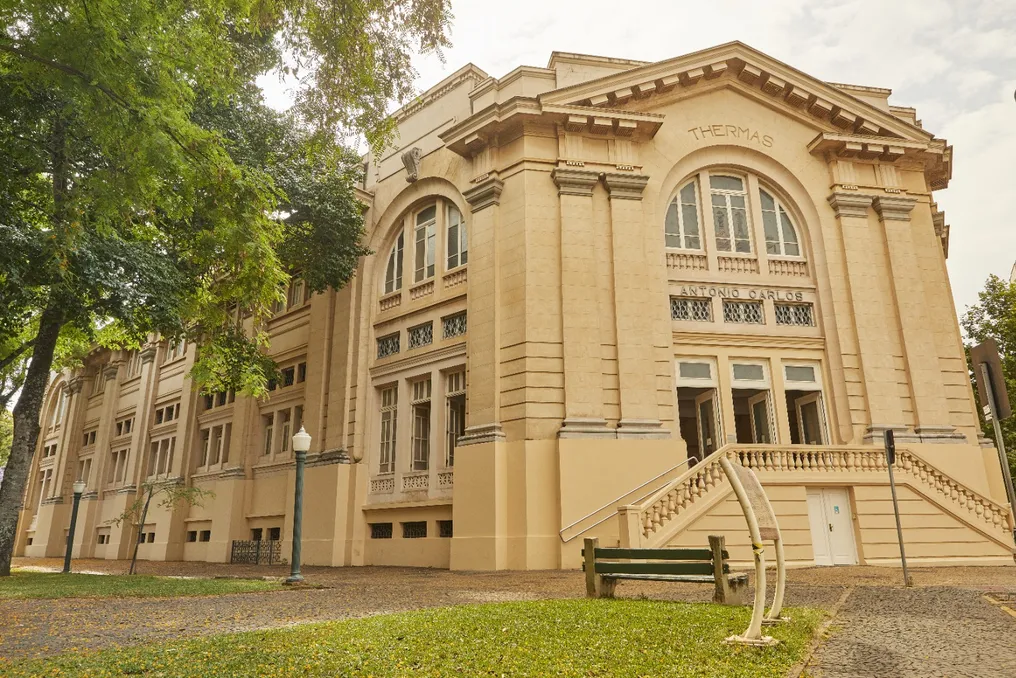
The construction of Thermas Antônio Carlos took place decades later as part of a city renovation project aimed at strengthening Poços de Caldas' position as a balneological center. The building was designed in the late 1920s by architect Eduardo Pedrenheira and opened on March 31, 1931. Its name honors Antônio Carlos Ribeiro de Andrade, who was the governor of Minas Gerais at the time and financed part of the city's modernization efforts.
With neoclassical architecture, the building is part of the José Affonso Junqueira Park complex in the city center, next to the Palace Casino built during the same period. The structure has four levels and was designed to accommodate various types of treatments. Among the equipment are mechanotherapy devices brought from Germany in the 1920s, as well as immersion rooms, showers, saunas, and massage facilities.
The water for bathing is sulfurous and reaches the surface at a temperature of about 45°C, then cools to 37°C before entering the baths. Upon opening, Thermas became the first modern thermal institution in Brazil to offer a comprehensive range of medical services using these waters.
Currently, the complex belongs to Companhia de Desenvolvimento de Minas Gerais. After nearly three decades of management by the Poços de Caldas city hall, management returned to the Government of Minas Gerais on January 15, 2018.
The complex currently offers over 50 services and activities, including thermal baths, saunas, massages, aesthetic procedures, and physiotherapy. Service costs can be checked on the official website.
Location: Thermas Antônio Carlos — Rua Junqueiras, s/nº, Centro, Poços de Caldas. Exhibition hours: from December 4 to March 31, 2027. The complex operates from Thursday to Saturday and on holidays from 9:00 AM to 7:00 PM; on Sundays from 9:00 AM to 2:00 PM. Entry to the exhibition is free.