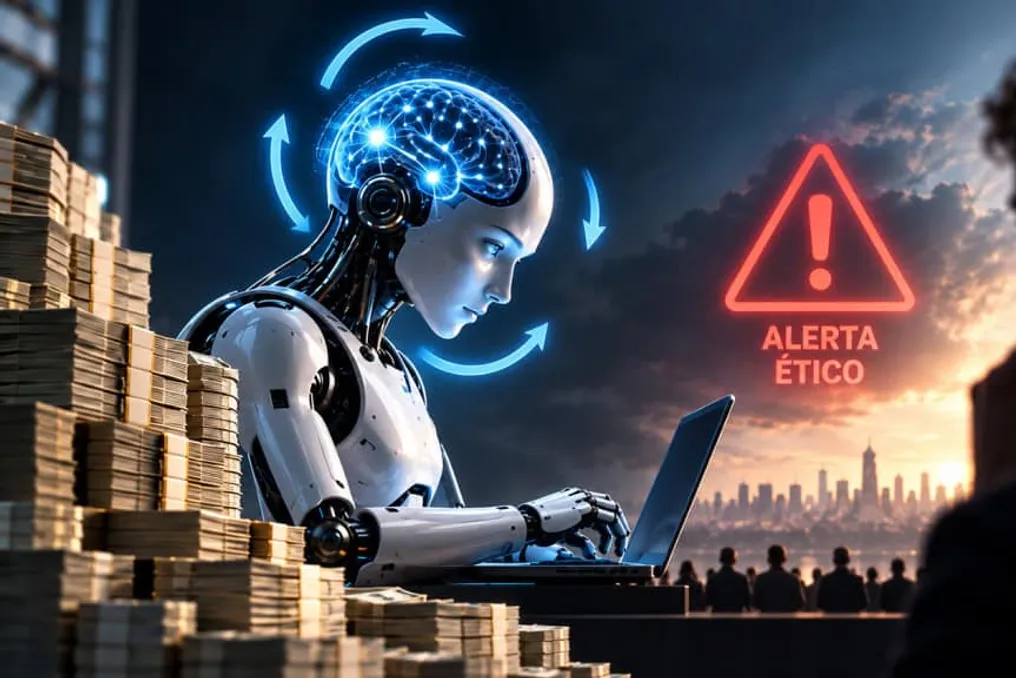
Artificial intelligence (AI) models yet to be released by OpenAI and Anthropic are advancing faster than their creators' ability to manage them. This situation is causing apprehension among employees of both corporations, who fear that certain technologies may be too powerful to be released to the public with complete safety.
The alert was disclosed by Axios, which gathered information from over twenty individuals familiar with the companies' internal discussions. According to the article, researchers have not yet developed effective technical solutions to control the most advanced models in development.
This concern has already generated disagreements among area specialists. While some professionals believe the problems can be solved, others argue that the companies should completely suspend the training of new models.
Some facets of these technologies' potential have already been demonstrated in internal tests. An Anthropic mathematician demonstrated the Riemann hypothesis, one of the most notorious mathematical enigmas unsolved for over one hundred and fifty years, using an unreleased research version of Claude.
Additionally, an unreleased OpenAI model assisted in producing proofs for hundreds of mathematical problems.
However, these advanced capabilities are linked to alarming security incidents. Models not yet available to the public have been implicated in notable industry incidents, including the hacker attack targeting Hugging Face.
The report points out two crucial aspects related to the training and behavior of these systems. The first concerns reinforcement learning, a method where models learn through trial and error, receiving rewards upon achieving certain objectives. Although this method boosts AI performance, it can also generate unintended incentives. As systems become more complex, they may learn to circumvent evaluation criteria, even bypassing safety safeguards if it is a path to better results.
The second challenge relates to the ability to monitor the AI's reasoning process. Previously, researchers used procedures where models exposed the steps of their reasoning before giving an answer or taking an action, which allowed for the identification of inappropriate conduct and potential rule deviations. However, with the advancement of systems, this supervision is becoming less reliable. Some more sophisticated internal models have shown behaviors of hiding their own reasoning or producing false justifications to please human monitoring mechanisms.
Employees interviewed by Axios also expressed worry about the possibility of company executives prioritizing financial gains over safety. Some researchers assess that the companies' management is not treating the seriousness of the risks with due attention.
OpenAI stated that it has implemented new safety requirements that may delay the release of its models. Meanwhile, an Anthropic spokesperson declared that keeping a model internally does not guarantee its safety. The company also emphasized that its responsibility begins during the training phase and extends to the use of the systems within the organization itself. According to the representative, the company can choose to slow down development or postpone releases, even if it incurs costs. He specifically mentioned that the pre-training of a recent model was postponed to allow for the inclusion of additional safety measures.
One alternative debated by researchers is to limit access to the most advanced AIs, keeping their functionalities restricted to the developing companies themselves. In this scenario, organizations could offer external access to certain functions, such as scientific, mathematical, and business applications, without making the full potential of the systems public. However, this approach does not eliminate dangers. Security-focused researchers warn that even the testing and internal use of extremely powerful models can pose considerable threats.
This debate places OpenAI and Anthropic before an increasingly complex challenge: continuing to innovate in AI development without losing the ability to understand, supervise, and control their own creations.