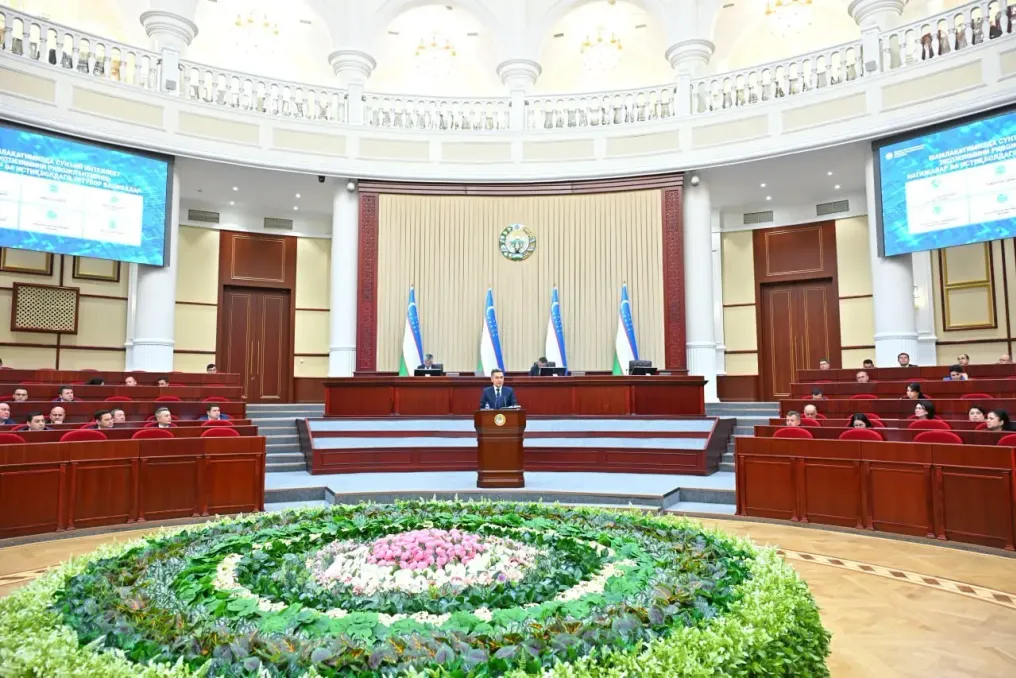
Uzbekistan plans to launch an artificial intelligence cluster with a capacity of 7 exaflops by 2027
Read more
UzDaily
uzdaily.uz

Uzbekistan plans to launch an artificial intelligence cluster with a capacity of 7 exaflops by 2027

The Ministry of Digital Technologies reported that Uzbekistan intends to commission a new computing cluster with a capacity exceeding 7 exaflops by 2027 to support the development of artificial intelligence (AI).

This information was announced following a session of the Legislative Chamber of the Oliy Majlis, where on November 24, lawmakers heard a report from the Minister of Digital Technologies, Sherzod Shermatov, on AI development, its implementation in priority sectors, and the realization of relevant projects.

The Minister presented a report on the progress of implementing the Strategy for the Development of Artificial Intelligence Technologies until 2030. This strategy envisions the use of AI in public administration, the economy, and social services, as well as the development of national computing infrastructure and the expansion of international cooperation.

In July 2026, modern computing infrastructure was launched in the e-government system's data center. Additionally, a more compact computing cluster began operating to serve the healthcare sector.

Currently, over one hundred AI projects are being implemented with the support of the Reconstruction and Development Fund. These projects cover areas such as digital government, workforce training, healthcare, social services, public safety, legal protection, agriculture, and ecology.

A national Uzbek language corpus has also been created, which includes 6.5 million documents, 6.1 billion words, and 20 billion tokens. The aileaders.uz platform was launched to train specialists. Under the 'Five Million AI Leaders' project, over 1.6 million young people have completed training and received certificates.

Seven textbooks on AI have been developed for general education in schools, and three for universities. These textbooks were included in curricula starting from the 2026/2027 academic year. Three AI laboratories have been opened at higher educational institutions.

According to the ministry, the number of employees in the IT park engaged in AI has reached 240 people. Their total service volume amounted to 895 billion soms, and exports reached 75 million US dollars.

Thanks to these efforts, Uzbekistan has risen eight positions, ranking 62nd out of 195 countries in the Oxford Insights Index of Readiness for Using AI in Public Administration.

On July 16, 2026, Uzbekistan also became one of 29 countries that signed the foundational agreement on the World Organization for AI Cooperation (WAICO).

Further Tasks and Goals

During the discussion, lawmakers identified additional tasks. By the end of 2026, the number of servers is expected to increase to 24, and the number of graphics processing units to 192. The government also aims to increase the number of AI laboratories in universities to 21 by the end of the year to solve practical problems in various economic sectors.

Special attention was paid to ensuring that research organizations, startups, and regional consultants have preferential access to GPU clusters and large databases. The Legislative Chamber took note of the minister's report.


Similar stories

Uzbekistan holds week-long campaign to prevent respiratory diseases
Read more
uzdaily.uz

Uzbekistan holds week-long campaign to prevent respiratory diseases

The Ministry of Health announced that Uzbekistan is organizing a campaign aimed at preventing respiratory diseases, which will last for one week from November 16 to 21. This initiative is titled 'Erkin Nafas' ('Free Breath').

The campaign coincides with World COPD Day, observed on November 21. The main goal of the event is to raise public awareness about respiratory diseases, their prevention methods, and the importance of early diagnosis.

As part of this action, citizens are advised to visit polyclinics and pulmonology centers for medical consultations and examinations.

Available Services

The program includes consultations with qualified doctors to assess the condition of the respiratory system and provide appropriate medical recommendations. Spirometry tests will also be available, which measure the volume and speed of exhaled air to assess lung function.

Modern radiological examinations may be conducted if there are medical indications. It is expected that artificial intelligence technologies will be used to analyze the images, helping to detect possible pathological changes in the lungs. Doctors will determine which specific examinations are necessary and which types are suitable. The Ministry emphasized that citizens should not undergo CT scans or any other available tests independently.

Symptoms to Watch For

According to the press release, reasons to consult a doctor may include a cough lasting several weeks, regular phlegm production, wheezing, and shortness of breath during normal physical activity. If COPD is suspected, a doctor may prescribe spirometry, which measures the volume and speed of exhaled air.

Emergency medical services should be called immediately at 103 in cases of sudden severe shortness of breath, blueing of the lips, confusion, or inability to speak due to lack of air.

Risk Factors for Respiratory Diseases

Smoking remains one of the main preventable risk factors for developing COPD and lung cancer. Passive smoking, including exposure to tobacco smoke in children, also poses a danger. Other risk factors include dust and chemical substances in workplaces, harmful gases, as well as smoke from heating equipment and cooking in poorly ventilated rooms.

Dust storms pose a particular concern for Uzbekistan, especially in the Aral Sea region, alongside air pollution from industrial and automotive emissions. Recommended preventive measures include quitting tobacco, adhering to occupational safety requirements at work, using personal protective equipment, and maintaining the proper functioning of ventilation systems.

The Ministry also highlighted the need for vaccination against influenza and pneumococcal infections, depending on the person's age and general health status. For individuals with chronic diseases, physical activity and pulmonary rehabilitation programs must be developed individually after consulting a doctor.

Morbidity Statistics

According to data provided in the press release, the registered incidence of respiratory diseases in Uzbekistan has increased by almost 3% in the period 2024–2025. The number of registered pneumonia cases has increased by approximately 2.6 times. However, official statistics only account for registered cases and are subject to the population's willingness to seek medical help and the availability of examinations.

According to estimates by the World Health Organization published in 2026, approximately 61 million deaths were recorded worldwide in 2023. About 33 million, or 54%, were related to ten leading causes of death. COPD ranked third on this list, causing 3.6 million deaths. Lower respiratory infections took fourth place, and tracheal, bronchial, and lung cancer was seventh.

Central Bank of Uzbekistan is developing its own artificial intelligence solutions
Read more
uzdaily.uz

Central Bank of Uzbekistan is developing its own artificial intelligence solutions

The Central Bank of Uzbekistan is engaged in creating its own small-scale artificial intelligence solutions and is also studying ways to reduce dependence on global providers of such services.

Deputy Chairman of the Central Bank, Nodirbek Achilov, announced this during the presentation of the International Monetary Fund's (IMF) regional economic forecast for the Caucasus and Central Asia. According to Achilov, many countries in the region, as well as their neighbors and trading partners, are heavily reliant on several large international AI platforms.

He emphasized the need to consider issues related to reducing this dependence. The Deputy Chairman noted that developing internal capabilities will require significant investment in local servers and infrastructure. Furthermore, reliance on one or two providers creates additional risks for uninterrupted service operation.

Specifically, access to platforms may be restricted by decisions made in the provider's country, and servers might become unavailable when needed. Achilov stressed that expected results should include scenarios for abandoning dependence on two or three global providers of these AI services.

While acknowledging the Central Bank's use of external AI services, the regulator is simultaneously developing its own tools to perform specific tasks. The Deputy Chairman clarified that the goal is not to create a very large super-AI system, but rather the ability to independently solve smaller tasks.

AI Investments and Risks for the Region

Roberto Cardarelli, Assistant Director of the IMF Department for the Middle East and Central Asia, mentioned that the issue of dependence on computing power for artificial intelligence was covered in a separate IMF report. He stated that the economic return from large investments in AI, especially in Gulf countries, will largely depend on demand from foreign clients, including the possibility of exporting computing power to other states.

The IMF's regional economic forecast also analyzes a scenario of a sharp correction in the artificial intelligence market, assessing the potential consequences for the countries of the Caucasus and Central Asia. According to the IMF, the impact of such a scenario on oil-importing countries, including Uzbekistan, will be limited, as the region is not yet deeply integrated into the AI development cycle, and the main channel of impact is the decline in global oil prices.

Uzbekistan launches digital platform to connect businesses and attract investments
Read more
uzdaily.uz

Uzbekistan launches digital platform to connect businesses and attract investments

Uzbekistan has introduced the first phase of the World Business Integration Platform (wbip.uz) — a digital service created to assist foreign companies in finding partners, investors, and clients.

The launch was announced by Mukhtar Umarov, Chairman of the Assembly of the Economy of Uzbekistan, during the FINOBOD 2026 forum in Tashkent. The project was presented on November 13 at a plenary session titled 'Digital Uzbekistan – an Innovation Hub of Central Asia.' According to Umarov, the platform is part of the OS Assembly System cluster, which uses artificial intelligence to unite 65 industry associations representing about 100,000 companies.

Additionally, a separate platform called Tijorat Markazi is available for Uzbek entrepreneurs, designed for selling goods, attracting investments, and hiring personnel. Umarov reported that over 2,000 Chinese companies have already applied to participate in this international platform.

He noted that this service can facilitate cooperation with partners from China, Japan, Russia, and European countries. A session moderator emphasized that Uzbekistan previously lacked a single platform of this scale.

According to data presented at the meeting, as of September 1, 2026, approximately 21,500 enterprises with foreign investments were operating in Uzbekistan, of which about 17,000 were wholly foreign-owned. Chinese companies constituted the largest group, followed by Russian, Turkish, Kazakh, and South Korean enterprises.

Ildus Khalitov, representative of the Ministry of Economic Development of Russia in Uzbekistan, stated that more than 3,500 companies with Russian capital operate in the country, accounting for nearly 20% of all enterprises with foreign investments. He added that Russian companies are increasingly entering Uzbekistan with the aim of localizing production and gaining access to third-country markets. He also mentioned that one Russian-Uzbek technological park is already fully occupied by local companies.

Timur Kornilov, Managing Director of the Skolkovo Foundation, reported that about 70 out of 3,500 resident companies of the foundation operate in Uzbekistan, calling this a relatively small number. In September, the foundation signed an agreement with the Ministry of Higher Education, Science, and Innovation of Uzbekistan and approved a roadmap for creating an artificial intelligence center in Tashkent, scheduled for 2027–2028.

Kornilov pointed to the limited size of the Uzbek venture market as one of the factors slowing down the country's development as a regional innovation hub. He estimated the market at approximately 145–150 million US dollars, noting the presence of about 13 funds. Furthermore, he highlighted the shortage of qualified personnel and the need to harmonize business conditions in the region.

Ekaterina Yelmanova, Deputy Chairman of the Board of Rosbank, reported that the bank has been using its proprietary AI-based end-to-end platform since 2023, covering processes from data processing to model management. She specified that about two-thirds of the bank's architecture consists of internal developments, and Rosbank is ready to cooperate with Uzbek partners in the field of banking platforms and artificial intelligence.

Hasan Rakhmatov, Chairman of the Supervisory Board of Asia Alliance Bank, stated that clients expect integrated platforms and fast solutions, while speed and security remain key requirements.

Popular