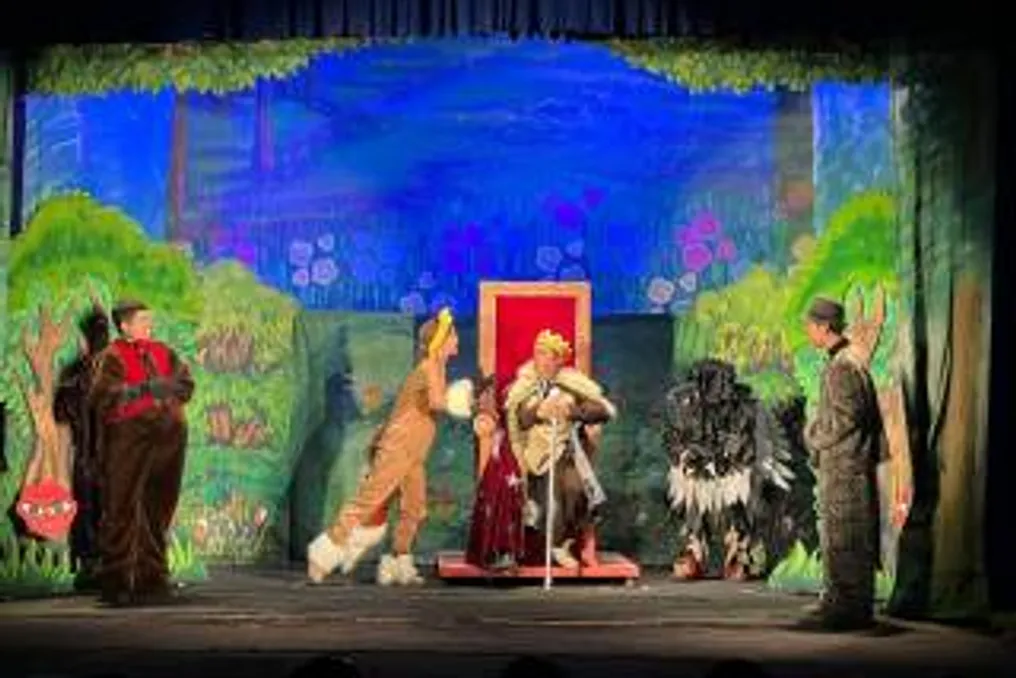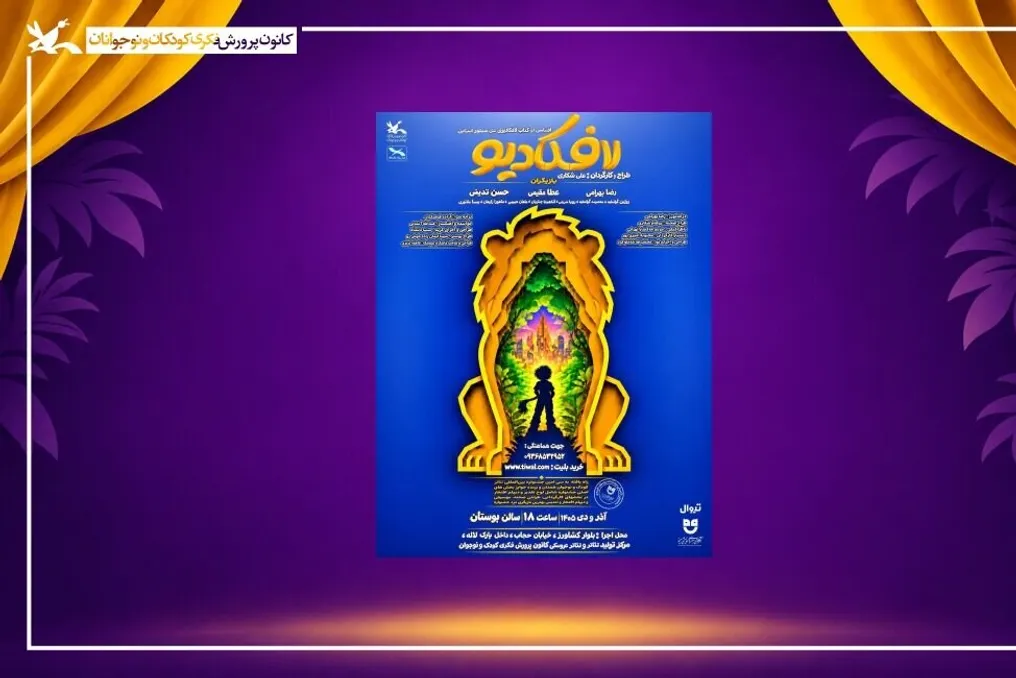
The Tehran Center for the Production of Theater and Puppet Theater of the Institute for Intellectual Development of Children and Youth (Kanun) presents the production 'Lafkadio' on stage. This play was written and directed by Ali Shekari and is based on the children's book by American author Shallow Silverstein.
The production will run until December 21st. It has been adapted for the stage by Reza Bahrami and is intended for young audiences and children.
The plot tells the story of a curious young lion whose curiosity leads him from the jungle into the human world. By imitating human behavior and habits, he finds himself in a series of amusing and thought-provoking situations. The story explores themes of identity, individuality, and belonging through humor and adventure, prompting the young audience to reflect on their decisions and the importance of staying true to themselves.
The cast includes Reza Bahrami, Ata Moghim, Hassan Tadayoni, Rojin Geranmeh, Masoumeh Geranmeh, Roya Sharifi, Anahita Chenarian, Mahan Khabibi, Mahoura Zareian, and Yasna Mollanouri.
Silverstein's first children's book, 'Lafkadio: The Lion Who Shot Back,' was published in 1963, marking the beginning of the author's distinguished career in children's literature. The author, who wrote and illustrated the work, combined absurd humor, imaginative storytelling, and philosophical questions in a modern parable that appeals to both young readers and adults.
The story begins in the African jungle, where a young lion encounters a hunter. When the hunter refuses to listen to the lion's attempts to persuade him, the animal eats the hunter and takes his rifle. Through diligent training, the lion becomes an exceptionally skilled marksman.
His exceptional talent attracts the attention of a circus promoter, who gives him the name Lafkadio and brings him into the human world. The lion soon becomes a famous performer, gaining fame and wealth. He adopts human manners, wears fashionable clothes, enjoys the comfort of a luxurious life, and becomes a public phenomenon.
However, his success gradually creates an unexpected problem: despite having everything he could ever want, he begins to feel a growing detachment from his former life. When he eventually returns to Africa for a hunting expedition, he meets other lions and is forced to confront the question of where he truly belongs. Neither his former identity as a lion nor the life he adopted among humans seems sufficient to define him.
Through Lafkadio's unusual journey, Silverstein examines the tension between personal identity and social expectations, as well as the difference between external success and internal satisfaction. The story also raises questions about imitation, the pursuit of recognition, and the complexity of finding a place where one feels at home. Humorous episodes and an unconventional ending give the narrative a depth that goes beyond a typical children's adventure story.
Shallow Silverstein (1930–1999) was an American poet, cartoonist, illustrator, playwright, songwriter, and performer widely considered one of the most distinctive voices in modern children's literature. Born on September 25, 1930, in Chicago, Illinois, he first gained recognition for his cartoons and illustrations published in various publications, including Playboy magazine. His works were characterized by unconventional humor, imaginative characters, and distinctive original drawings.
Silverstein began writing and illustrating books for young readers in the early 1960s, encouraged by children's book editor Ursula Nordstrom. His first children's book, 'Lafkadio,' appeared in 1963, followed by other works that became classics of children's literature.
Among his most famous works are 'The Giving Tree' (1964), a story about the relationship between a boy and a tree that gives him everything throughout its life. This book sparked extensive discussions about generosity, love, sacrifice, and the nature of human relationships. Other notable works include 'Giraffe and Half' (1964), 'Where the Sidewalk Ends' (1974), 'The Lost Part' (1976), 'Light in the Attic' (1981), and 'Falling Up' (1996).
His collections of poems are particularly valued for their playful language, unexpected rhymes, unconventional characters, and imaginative illustrations. Silverstein often challenged the boundaries of traditional children's literature, addressing serious themes through humor, wordplay, and seemingly simple narratives. His works have been translated into many languages and continue to attract readers of all generations.
In addition to children's literature, Silverstein achieved success in music. He wrote songs for several famous performers, including Johnny Cash. The song 'Boy Named Sue,' recorded by Cash, won a Grammy Award, and his authorship also earned him an Academy Award nomination for the song 'I Check Yes or No,' performed by Marilyn Strait in the 1990 film 'Postcards from the Coast.' He died on May 9, 1999, in Key West, Florida, at the age of 68, leaving behind a rich legacy spanning literature, illustration, music, and theater.