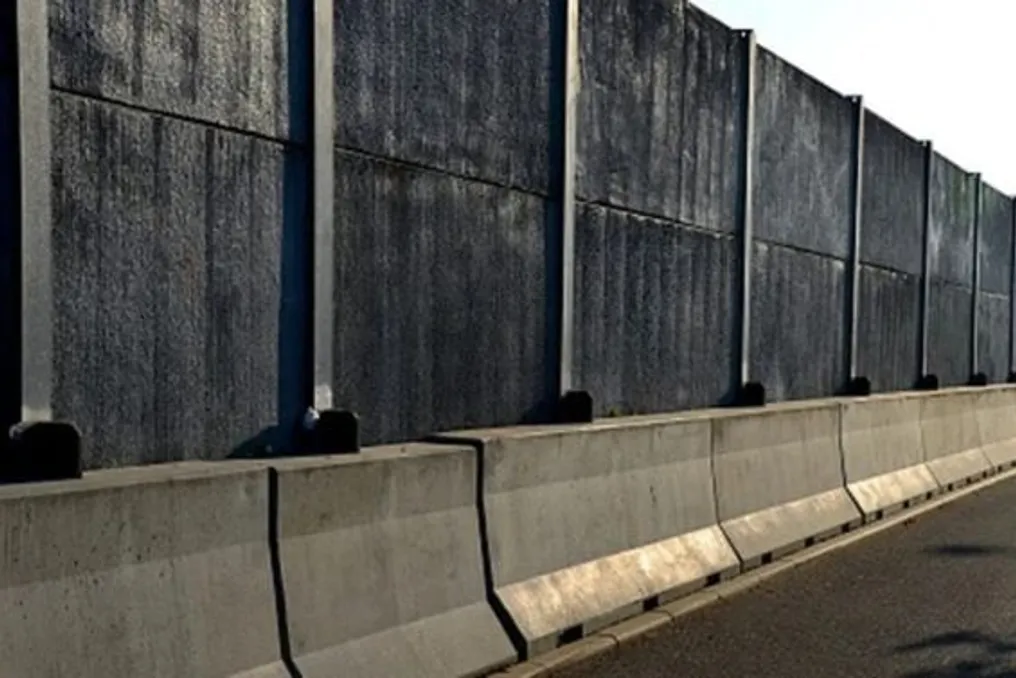
The concrete walls installed along the margins of highways that pass through urbanized areas do not have the primary function of preventing out-of-control car passage. In fact, they function as acoustic barriers, being taller structures than conventional protections, designed to dampen the noise generated by engines and tires before it reaches residences, schools, and hospitals.
One example of this occurred in São Paulo, where the Rodoanel Oeste concessionaire, belonging to the Motiva group, began installing 8 kilometers of these barriers on the Mário Covas Ring Road at the end of October, representing an investment of R$115 million.
To be effective, the material used must possess characteristics of rigidity, density, and the absence of gaps that allow sound leakage. For this reason, a wall performs better than a simple row of trees. Although earth is considered the most efficient alternative, it requires a considerably larger space.
According to the FHWA, the United States highway agency, which has an equivalent to the National Transport Infrastructure Department (Dnit), a barrier that obscures the track can reduce noise levels by approximately 5 decibels. Additionally, every extra meter of height provides an additional reduction of 1.5 decibels. Despite this, these walls rarely exceed a height of 7.6 meters, as exceeding this limit makes the construction more expensive, more complex to maintain, and negatively impacts the landscape.
The sound impact is perceived most intensely by people living up to 60 meters from the road, which justifies the concentration of these barriers in urban segments.
In the Brazilian context, the Dnit establishes its own standards for acoustic barriers. Concurrently, NBR 10151, issued by the Brazilian Association of Technical Standards (ABNT), defines noise limits for strictly residential areas, setting them at 50 decibels during the day and 45 decibels at night.
Besides sound attenuation, the walls also play a role in preventing animal movement and containing debris that might be thrown during accidents. However, the act of obscuring the other side of these structures generated controversy in Rio de Janeiro.
This happened in 2010, when about 11 kilometers of panels were implemented to separate the Maré Complex from the Red and Yellow lines, which are important expressways in the city. The city hall justified this measure with the aim of mitigating noise for residents. However, community groups labeled the work as the 'wall of shame,' arguing that it hid the favelas visible to those arriving in Rio via Galeão Airport. A survey conducted in 2011 by the community newspaper Maré de Notícias indicated that three in four residents shared this same perception.