
European Court of Human Rights allows deportation of migrants if their arrival is used for political purposes
Read more
Noticias ao Minuto
noticiasaominuto.com

European Court of Human Rights allows deportation of migrants if their arrival is used for political purposes

The European Court of Human Rights (ECHR) has ruled that states have the right to deport migrants from their borders if these migrants arrive from a state that uses migration for political purposes, and the migrants themselves are not particularly vulnerable.

This new approach was introduced by the institution in three rulings concerning the 2021 migration crisis. During that period, thousands of migrants arrived from Belarus at the borders of European Union (EU) countries such as Poland, Lithuania, and Latvia.

The Court found that Minsk organized this flow 'with the aim of destabilizing' its neighbors and the EU, which was done 'in response to sanctions' imposed on the regime of Alexander Lukashenko after the suppression of the opposition movement in 2020.

In this case, the ECHR was involved with groups of migrants from Afghanistan, Kurdistan in Iraq, and Cuba. They accused the states carrying out their deportation of violating their fundamental rights by sending them back to Belarus without allowing them to apply for asylum.

In its decision, the Court established that deportations are permissible in situations of 'migration used for political purposes,' except where there are clear personal vulnerabilities, such as those related to age, health, or disability. Deportation is also prohibited if migrants can prove that returning to their country of origin would put their lives under 'real and immediate threat' or subject them to ill-treatment.

As a result, Latvia was condemned for repatriating families with young children, and Poland for returning a man whom the European Court had explicitly asked not to return to Belarus.

Nevertheless, the ECHR dismissed the cases of migrants who could not prove their special vulnerability.

The lawyer for four Cubans whose case against Lithuania was dismissed reacted to the decision: 'This decision is a real shock to me because it seems to deny that Article 3 [of the European Convention on Human Rights, prohibiting torture and inhuman treatment] must be universal and absolute.'

Daria Sartori, quoted by the French news agency AFP, expressed regret: 'This will have consequences for all future cases and even for European migration policy.'

This change in judicial practice in Strasbourg occurred just a few months after political struggles between the 46 states that have signed the European Convention on Human Rights. Most of these states, including the United Kingdom, Italy, and the Scandinavian countries, pressured the Court to interpret the Convention less favorably for individual immigrant rights, thereby facilitating deportations.

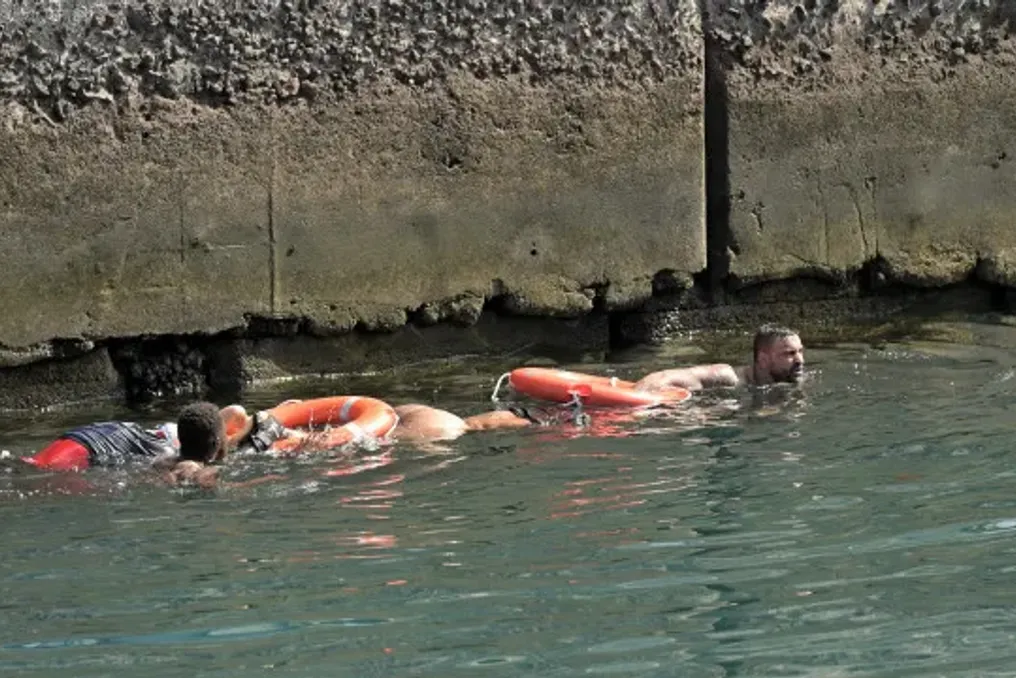
This ruling was announced shortly after a new migration crisis on the borders of Europe, when thousands of migrants entered Ceuta, a Spanish enclave on the border with Morocco, at the end of July. Most of these people returned to Moroccan territory, but the crisis significantly impacted all of Europe, triggering attacks from right-wing and far-right forces against the left-wing government of Spain, as well as accusations against Rabat of using migration for political purposes.
Similar stories

133 migrants rescued in Canary Islands; total arrivals reach 407 on Thursday
Read more
noticiasaominuto.com

133 migrants rescued in Canary Islands; total arrivals reach 407 on Thursday

Spanish maritime authorities announced that two vessels carrying 133 migrants were rescued near the island of El Hierro in the Canary Islands. This increased the total number of people arriving on Thursday to 407.

The two boats were discovered in waters close to El Hierro island late Thursday evening, according to data from the Canary Islands Emergency and Security Coordination Center. The migrants were transported to the island where they received medical assistance; all were in good health.

These 133 individuals joined 274 people who arrived at the port of La Restinga in El Hierro aboard three other vessels during Thursday, the Maritime Rescue Service reported. One of the rescued vessels was partially flooded upon discovery 15 kilometers from the island, and its passengers, mostly men from sub-Saharan countries but also including women and children, received aid from paramedics and emergency crews.

The origin of the vessel is unknown, and its passengers will be transferred within the next few hours to a support center managed by the non-governmental organization (NGO) Corazón Naranja – Ebrima Sonko. They will remain under police supervision until transferred to other locations outside the island.

The Canary Islands, and particularly El Hierro, are experiencing significant pressure due to the growing number of migrants. The regional government has counted over 6,500 people since November 1st. This situation has led to the declaration of a 'migration state of emergency' in the Canary Islands, especially in El Hierro. The president of the regional government, Fernando Clavijo, insisted on the urgent need to strengthen sanitary response for migrants, including the creation of a field hospital.

El Hierro is the smallest inhabited island in the Canary Islands, with a population of about 12,000, and it is the island where most fragile vessels such as 'pateras' or 'cayucos' arrive with migrants. The increase in arrivals has forced the Canary Islands government to reopen centers in Tenerife that had been closed since summer for initial accommodation.

The Atlantic migration route, which starts from Morocco and Western Sahara via the shortest path, as well as from Mauritania, Senegal, Gambia, and Mali via longer crossings, is considered one of the most dangerous in the world. Crossings can take several days or even weeks in the open sea. Despite a decrease in crossings towards the Canary Islands over the past two years, mortality on this route has increased due to the opening of longer and more dangerous routes (for example, from Guinea-Conakry or Gambia).

The flow of vessels on this route usually intensifies in autumn—a phenomenon known locally as the 'cayuco crisis'—mainly due to the typical wind lull in this area during that period, which facilitates sailing at sea. According to UN estimates, 17,788 irregular migrants arrived in the Spanish islands in 2025 on 263 vessels. The UN has also documented the death or disappearance of at least 416 people at sea, while the NGO Caminando Fronteras points to 1,906 deaths on this route already in 2026.

Popular