The Document Foundation imposes rules for AI-generated code in LibreOffice
Read more
Tecnoblog
tecnoblog.net

The Document Foundation imposes rules for AI-generated code in LibreOffice

The Document Foundation (TDF), which is responsible for LibreOffice, has implemented new guidelines to prevent code created by artificial intelligence (AI) from being submitted to the project irresponsibly.

The organization has established five specific rules for the use of large language models (LLMs) within LibreOffice. These rules include the requirement for prior authorization, the demand for transparency regarding the code, the obligation for the developer to understand the material generated by AI, the limitation on using AI in internal communications, and restrictions applicable to certain sections of the source code.

The purpose of these regulations is to ensure that developers maintain full responsibility for their contributions, even when using AI assistance, thereby prioritizing crucial factors such as software security and performance.

Although the TDF is adopting cautious measures regarding AI in development, it does not entirely prohibit any AI-assisted contribution to its office suite. The restrictions aim to mitigate potential problems arising from the uncontrolled use of this technology.

In essence, the TDF expects anyone submitting code to LibreOffice to be responsible for it as if they had written it entirely themselves, favoring the technical quality of the product.

The five detailed rules are: the developer must request permission before using an LLM in their work on LibreOffice; the use of LLM must always be documented in the code change logs (commits); the developer has the duty to be able to fully explain all code produced with the help of AI; LLMs are prohibited from being used in commit messages, code comments, bug reports, or communications directed to other project members; and there are restrictions preventing specific parts of the LibreOffice source code from receiving LLM-generated contributions.

Despite this point-specific flexibility in the use of AI in the project's internal structures, the office suite itself remains functionally independent of this type of technology. It is relevant to remember that the release of LibreOffice 26.8 was notable for the absence of AI-based features.

Similar stories

Anthropic introduces Claude Ship — an AI for reviewing, correcting, and approving code changes
Read more
olhardigital.com.br

Anthropic introduces Claude Ship — an AI for reviewing, correcting, and approving code changes

Anthropic has announced Claude Ship, a tool that utilizes artificial intelligence (AI) agents to analyze, correct, and approve modifications in software code. This development aims to automate certain stages of software creation and reduce the need for manual intervention in routine tasks.

The system is designed to work with GitHub repositories and is available to subscribers of Claude Team and Enterprise plans. Claude Ship combines three functional components: Code Review, which was already available, and two new agents currently in beta testing—PR Steward and Claude Approvals.

The core idea is that developers can delegate tasks following code creation. Thus, instead of interrupting work to fix issues found during review or waiting for approval from another specialist, these agents can take on part of this process.

Claude Ship integrates three tools with different functions. The PR Steward agent logs comments, explaining what changes were made and how they can be reverted if necessary. However, this agent does not have the authority to independently approve or implement changes to the code.

The responsibility for approval lies with Claude Approvals. This component uses policies set by the team to determine which changes can pass without human involvement.

A key advantage of Claude Ship is the ability to delegate the approval process to AI. Teams can set rules in the repository files themselves, defining which changes are considered standard and which require deeper human evaluation. The system can also consider data received from Code Review and configured classifiers when making decisions.

Anthropic advises companies to start using the feature in observation mode. In this mode, Claude evaluates the changes and indicates which ones should be approved, but it does not automatically perform the approval itself. This allows teams to assess the agent's behavior before their decisions begin to be used as requirements for integrating changes into projects.

The launch occurs at a time when AI tools are increasingly involved in code creation. Consequently, reviewing and approving changes can become a bottleneck for teams using agents to accelerate development. Anthropic itself states that Claude writes most of the code created by the team responsible for Claude Code, and developed Ship specifically to speed up the subsequent stages after these changes are made.

The tool also provides administrative management features, allowing users to select which repositories will be serviced, set the depth of reviews, and define monthly cost limits. Claude Ship is available to organizations using Team and Enterprise plans and working with projects hosted on GitHub. Code Review is already publicly available, while PR Steward and Claude Approvals remain in beta testing.

Anthropic warns that the tool uses tokens and may generate additional costs depending on the volume and size of the analyzed changes, as well as the frequency of reviews. The company also informs that Claude Ship potentially might miss errors, security vulnerabilities, and other issues.

Canva adds option to disable generative artificial intelligence features
Read more
tecnoblog.net

Canva adds option to disable generative artificial intelligence features

Canva has implemented a new button that allows users to disable the generative artificial intelligence features available on the platform. This functionality includes two free controls, accessible to both Free and Pro plan subscribers.

In addition to allowing the hiding of these tools, the new feature enables reducing the visibility of AI-created content within the platform's library of templates and graphic elements.

According to the official statement, the release of these controls is happening gradually, and there may be a delay in the settings appearing in certain accounts. The company emphasized user autonomy, stating: 'AI is everywhere. When and how you use it must always be your choice.'

The intention is to give the user the freedom to decide when to use systems capable of producing text, images, and other types of content. The platform had already expanded its offering with additions such as spreadsheets and other AI-based tools.

The deactivation button can be found at Profile > Settings > Permissions, specifically under the option titled 'Enable generative AI features.' When disabled, compatible tools are hidden in the interface, but the user retains the ability to reactivate them at any time.

In the help center, Canva lists features affected by the change, such as Magic Write, Magic Design, Dream Lab, and Canva Code. By default, these features remain active until the user changes their preference.

The second control mechanism functions as a filter that reduces the amount of AI-generated templates and elements displayed in searches and recommendations in the library. To apply this adjustment, one needs to navigate to Profile > Your account > AI personalization and disable the option related to AI-generated content.

It is important to note that this filter does not guarantee the complete removal of all AI-created items, nor does it delete elements already incorporated into existing projects. These new settings are applied individually.

Features such as Background Remover and Magic Grab will continue to function normally, even with generative AI turned off. Background Remover serves to isolate the main object from a photograph, while Magic Grab allows for the selection and relocation of components within an image.

Additionally, Canva is in the process of developing a badge intended to identify designs that were produced without the aid of generative AI tools. The company has not yet provided a launch date or detailed the functioning of this badge.

This change comes after the integration of an AI agent into the platform, aiming to enhance work tools. Canva reported that its AI tools have already been used over 38 billion times and that the company will maintain its continuous investment in this area.

Semantic DLP Secures Enterprise Generative AI by Shifting from Pattern Matching to Intent Management
Read more
yourstory.com

Semantic DLP Secures Enterprise Generative AI by Shifting from Pattern Matching to Intent Management

Most modern enterprises are experiencing an intense struggle. On one side, employees—engineers, financial analysts, lawyers, and operational staff—are actively using generative and agentic AI to automate tasks, summarize contracts, and debug code. On the other side, security and compliance executives aim to prevent the leakage of confidential source code, financial forecasts, and regulated customer data into unsecured models.

For most Chief Information Security Officers (CISOs), the question is no longer whether personnel use AI, but what specific information they input into it. However, the security tools that most organizations use to control this boundary were designed for a completely different era.

Traditional Data Loss Prevention (DLP) systems were created for structured data moving through predictable channels such as email, file transfers, and cloud storage. They heavily rely on regular expressions (regex), keyword lists, and static rules. For example, an outdated DLP system flags a document containing a 16-digit credit card number or a government ID.

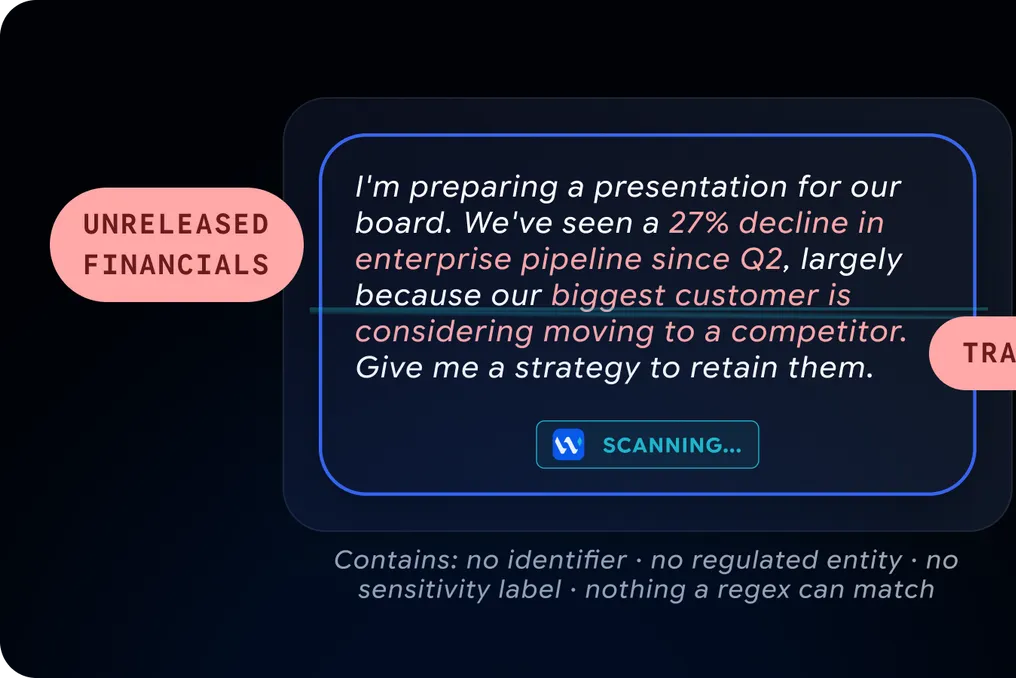
Generative AI completely disrupts this model. Interaction with AI occurs based on unstructured natural language, where data sensitivity is determined by context and intent, not a fixed format. Consider two scenarios: neither prompt contains a credit card number, a social security number, or a flagged keyword. For a regex-based DLP system, both interactions appear completely harmless. Conversely, when security teams tighten keyword rules to catch more nuances, the number of false positives sharply increases, leading to alert fatigue among security teams and frustration among employees simply trying to do their jobs.

Faced with this visibility gap, many organizations initially resorted to a complete ban on using public AI tools. Nevertheless, blocking AI only forces its use underground on personal devices and unauthorized accounts, increasing the risk of 'Shadow AI' and depriving the enterprise of productivity growth potential.

As generative AI evolves from simple chat interfaces to complex autonomous workflows involving Model Context Protocol (MCP) tool calls and inter-agent communication, the enterprise attack surface expands on every endpoint device and in every application. Securing this environment requires a shift from pattern matching to semantic understanding.

The platform at Wald.ai was built on a simple premise: to protect AI, your security level must understand language as well as the AI itself. Instead of scanning static patterns, Semantic DLP assesses the meaning, context, and intent behind every uploaded file and query. By deploying a specialized Small Language Model (SLM) directly on the employee's endpoint device, Wald.ai checks and classifies AI interactions locally in milliseconds before sensitive data enters the network or reaches an external server or AI provider.

This context-based, on-device approach simultaneously solves three critical enterprise challenges: 1. Detecting what Regex misses: semantic models differentiate when an engineer inputs harmless open-source code versus revealing proprietary algorithms, or when discussing general market research versus confidential corporate strategy. 2. Eliminating alert fatigue: through real-time context recognition, organizations significantly reduce false positives, allowing security teams to focus on actual data exposure risks. 3. Ensuring secure productivity on the endpoint: instead of a binary 'allow or block' policy, enterprises can implement granular, real-time restrictions, automatically masking, redacting, or cleaning sensitive entities in a query while preserving the context needed for a useful LLM response.

This approach is already transforming how regulated industries, such as financial services, healthcare, and legal practice, adopt AI. For instance, financial institutions and credit unions using Wald.ai have moved from restrictive AI policies to sanctioned, enterprise-wide adoption.

As enterprises advance on their AI journey, the line between data infrastructure and AI security blurs. Participation in the NetApp Excellerator Cohort 15 program was a turning point for Wald.ai in scaling its contextual intelligence architecture for large enterprise environments. Working with NetApp technology leaders and the deep tech ecosystem provided insight into how global enterprises design, manage, and administer massive datasets in hybrid and cloud environments. Combining robust data infrastructure practices with real-time semantic controls on the endpoint ensures that data remains protected from the storage layer right up to the AI query.

The next wave of enterprise competitiveness will not be defined by companies that restrict AI, nor by those that use it recklessly. It will belong to organizations that embed trust into their AI stack, replacing outdated, reactive compliance checks with intelligent, conversational-speed controls. When security understands context, enterprises no longer have to choose between innovation and data privacy.

Popular