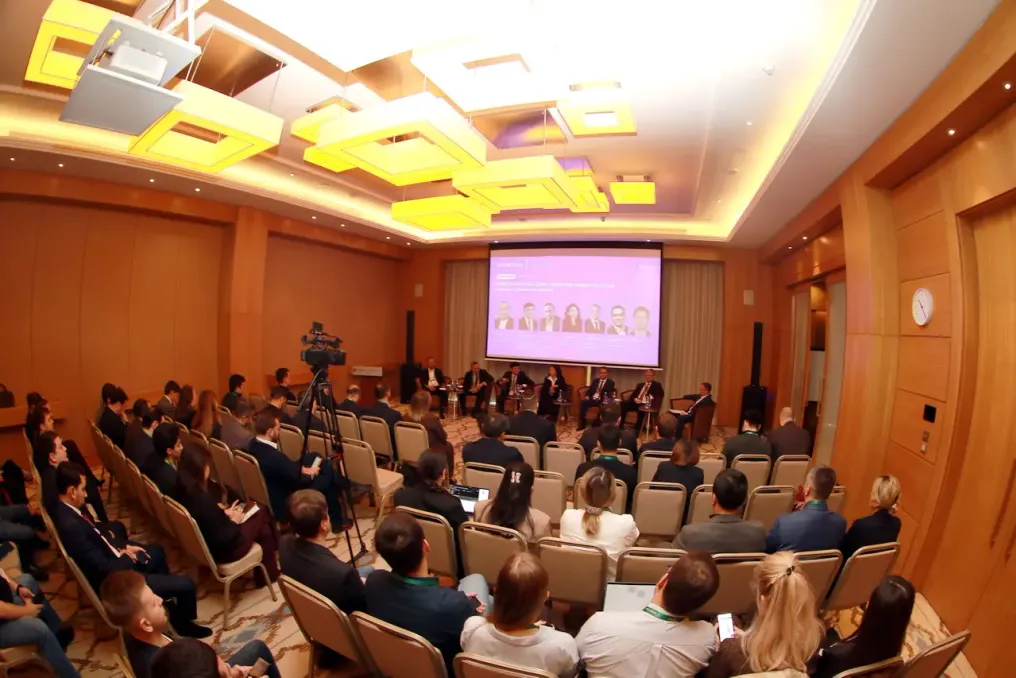
The third International Forum on Financial Innovations, FINNEXT Asia 2026, gathered about 700 participants, including representatives from banks, regulators, fintech companies, and investment funds, in Tashkent on November 19. The main theme of the forum was the transition of the Central Asian fintech market from pilot projects to economically sustainable and scalable solutions.
Discussions covered international integration, attracting investments, developing digital ecosystems, and the application of artificial intelligence. Participants analyzed changes in banking business models, prospects for cross-border payments, and ways to increase the profitability of technological investments.
The Reality of Central Asian Fintech: From Strategy to Results
The plenary session titled 'The Reality of Central Asian Fintech: From Strategy to Results' examined structural transformations in the regional market. Alexey Maslov, advisor to the Chairman of the Board of HUMO, moderated the discussion. Representatives from IT Park Uzbekistan, the Center for Artificial Intelligence and Digital Economy under the Ministry of Digital Technologies of Uzbekistan, UzVC, the Central Asian Fintech Association, Uzum Bank, and VEB.RF took part in the discussion.
Experts discussed the impact of regulatory initiatives on financial institutions' strategies, the development of banking ecosystems, the role of artificial intelligence, and venture capital attraction models. Svetlana Khe, CEO of Uzum Bank, noted that competition among financial organizations is shifting from individual products to satisfying customers' daily needs. According to her, the key factor is the bank's ability to meet users' daily needs, rather than the number of services offered.
As a result, financial services are increasingly integrated into retail and technology platforms, with banks establishing partnerships with online marketplaces. Azamat Rakhmonzoda, Head of the IT Export Development Department at IT Park Uzbekistan, reported that international companies accounted for 23% of new ecosystem members at the time of the forum, compared to 5% in 2024. He linked this growth to the establishment of clear rules and national strategies, emphasizing that predictable regulation allows foreign companies to plan long-term activities and make decisions about establishing businesses in Uzbekistan.
Rakhmonzoda also highlighted the importance of providing startups with access to data and open banking infrastructure for developing and scaling solutions before entering foreign markets. Participants in the plenary discussion concluded that the overall financial space in Central Asia does not require complete legislative harmonization; instead, they identified the compatibility of technological solutions and standards as one possible way to promote cross-border cooperation between banks and payment systems.
Artificial Intelligence and Big Data: From Pilot to Profit
A separate session, titled 'Artificial Intelligence and Big Data: From Pilot to Profit,' was dedicated to assessing the economic return on technology implementation. It was moderated by Behzod Ismoilov from AICA. Representatives from Ipoteka Bank, Microcreditbank, SQB Bank, and the Higher School of Economics reviewed the use of language models, alternative credit scoring, automated debt collection, and chatbots to reduce customer service costs.
Participants also discussed methods for measuring the real impact of artificial intelligence, obstacles to scaling solutions, and the time required to create integrated AI platforms. One of the identified problems was the shortage of specialists, which underscored the need for banks to develop partnership programs with universities.
The Workforce That Doesn't Yet Exist
Human resource provision became the central theme of the session 'The Workforce That Doesn't Yet Exist.' Moderator Andrey Darkevich from the Higher School of Economics discussed alternative approaches to specialist training together with representatives from the Employers' Association of Uzbekistan, Inha University in Tashkent, AVO Bank, and Click. Proposed measures included corporate educational programs accessible not only to employees of individual companies but also a reassessment of the role of higher education with a greater emphasis on candidates' practical skills.
Participants also considered the prospects for young specialists. Since AI automates basic tasks, companies will need to find new ways to help novice employees develop into mid-level and senior specialists.
Open Banking and Next-Generation Digital Identity
The session 'Open Banking and Next-Generation Digital Identity' focused on integration between financial institutions and digital platforms. Participants noted that technological cooperation continues despite the delay in launching open banking. Topics discussed included the quality of customer service across online and offline channels, user protection during the digital sale of investment products, and preparing the data infrastructure necessary for implementing AI agents. Opportunities for monetizing services and developing partner ecosystems were also examined.
Money of the Next Generation: Digital Currencies, Payments, and Islamic Banking
The session 'Money of the Next Generation: Digital Currencies, Payments, and Islamic Banking' explored the integration of Islamic financial instruments into mobile banking applications. Experts discussed the prospects of the digital sum, drawing on the experience of the digital tenge and digital ruble, as well as the regulation of digital assets and the balance between data protection and financial monitoring requirements. Issues of cross-border settlements using instant payment systems and national digital currencies were also addressed.
The closing session, titled 'Central Asia 2027: Stakes on the Table,' focused on participants' forecasts regarding the development of key fintech market areas in the coming year. The forum also held the 'Startup Centre: New Wave' startup competition, won by MASCOT STUDIO—a Tashkent platform for creating branded 3D characters. The project received 50 million soms in investment from HUMO Ventures for further product development.
FINNEXT CEO Evgeniy Yakunin stated that the regional fintech is increasingly focusing on the economic results of technology implementation, rather than the number of launches. She added that banks and tech companies are beginning to view each other as partners in developing artificial intelligence, open APIs, and digital currencies. Yakunin also emphasized the potential of Central Asia in creating its own technological products for international markets. The forum's national payment system was the state payment mechanism of Uzbekistan, HUMO. Other partners included U-BSS, ratexa.ai, DECO SYSTEMS, aladdin, BTech, Creatio banza, bitmanager, and UPplatform. Conceptual partners were PERSON HUNTERS, International Beverages Tashkent, EMBRAS, Employers' Association of Uzbekistan, UZUMFERMER.UZ, and CONNEKT.