Bisleri reports that the FSSAI check concerned one batch from Goa, which is no longer in circulation
Read more
Business Standard
business-standard.com

Bisleri reports that the FSSAI check concerned one batch from Goa, which is no longer in circulation

Bisleri International announced on Tuesday that the FSSAI inspection was limited to one batch produced at its Goa plant in September 2025, and this batch is currently not being sold. Furthermore, subsequent tests showed that the bromate level in the samples is within acceptable limits.

The bottled drinking water manufacturer Bisleri International stated that all 143 of the company's production sites continue to operate and comply with FSSAI regulations. Additionally, the facility in Goa continues its operations without any regulatory directives for suspension.

The company clarified: 'Bisleri produces over 50,000 batches annually. The sales ban by FSSAI applies only to one batch, GO 270, manufactured in Goa on September 27, 2025. There are currently no stocks of this batch in the market.' It was also noted that 'FSSAI categorically and finally clarified on November 23, 2026, that upon retesting the sample of the aforementioned batch, bromates were found to be below the permissible limit.'

In response to the FSSAI clarification of November 23, Bisleri emphasized that the regulatory action pertains exclusively to batch GO 270, released on September 27, 2025, and that there are no remaining stocks of this batch in the market. The company acknowledged that one of the six tested samples showed the presence of polycyclic aromatic hydrocarbons (PAHs) at a level of 0.144 micrograms per liter.

Previously, on Sunday, the Food Safety and Standards Authority of India (FSSAI) announced sanctions for legal proceedings against Bisleri International after one sample of bottled drinking water failed laboratory tests due to the detection of bromate above permissible limits, and subsequently, polycyclic aromatic hydrocarbons (PAHs).

Bisleri disputed the laboratory results, pointing to discrepancies in test data, and claimed it had not received official notification of the stated regulatory actions. On Monday, FSSAI explained that according to the law, the report from a referral laboratory is final in case of an appeal by food industry operators (FBOs). It was reported that 'the sales ban order was issued to Bisleri International for Batch No. Go 270. Only one non-compliant batch was found. The FBO (Bisleri) was instructed to conduct a root cause analysis.'

On Tuesday, Bisleri stated that it noted the discrepancies in PAH results and requested retesting in February 2026. The company added that no subsequent samples tested by FSSAI across all its facilities showed adverse PAH results. The company also reported that samples produced later at the Goa plant complied with applicable FSSAI standards, and it will continue to cooperate with the regulator on this matter.

In its statement responding to the FSSAI clarification of November 23, the company reiterated that the regulatory intervention relates to one batch identified as GO 270, produced on September 27, 2025, and that there are currently no stocks of this batch in the market. Bisleri also stressed that the retesting by FSSAI established that the bromate content in the sample is below the permissible level, but the company admitted that one of the six tested samples contained polycyclic aromatic hydrocarbons (PAHs) at a concentration of 0.144 micrograms per liter.

According to Bisleri, initially all six samples passed inspection, whereas the subsequent round of testing detected PAHs in one sample from batch GO 270. Another sample from the same batch met all parameters. The company stated that it highlighted the result discrepancies and demanded a reanalysis of the PAH results in February 2026. It also added that it would continue to cooperate with the food safety authority and defend its position in any proceedings.

Bisleri also noted that no subsequent samples tested by FSSAI at its production sites showed negative PAH indicators. Seeking to separate the regulatory check of a specific batch from its overall operations, Bisleri stated that all its 143 production sites remain operational and compliant with FSSAI norms. The company emphasized that its Goa facility received no instructions to suspend operations, and subsequent production samples met applicable food safety standards.

Bisleri pointed out that it produces over 50,000 batches annually, asserting that the regulatory action was limited to one batch produced more than a year ago. This development occurs amid heightened consumer sensitivity to the quality of bottled drinking water and oversight of food and beverages. The difference between results obtained from individual samples and compliance in subsequent batches will likely be significant for consumer trust and the company's brand reputation. Bisleri welcomed the regulator's clarification and urged consumers to rely on verified information, adding that it would consider legal action against what it termed false and misleading statements. According to company information, established over fifty years ago, Bisleri International operates 143 plants and has a distribution network of over 6,000 distributors and 7,500 trucks across India and the UAE.
Similar stories

FSSAI cancels licenses of five healthcare companies; legal action approved against Bisleri
Read more
www.aajtak.in

FSSAI cancels licenses of five healthcare companies; legal action approved against Bisleri

The Food Safety and Standards Authority of India (FSSAI) has suspended the licenses of five healthcare companies with immediate effect due to serious violations of food safety regulations. These companies include Vedanta Remedies Private Limited, Lucid Health Care Private Limited, Ambico Ayurvedic Healthcare, Vitamedic Health Nutraceuticals, and Adorial Healthcare.

During the investigation, several deficiencies were found in these companies' premises, such as poor cleanliness, improper storage of products, giving misleading information, and non-compliance with essential food safety regulations. FSSAI took this action under the provisions of the Food Safety and Standards Act, 2006.

In the premises of Vedanta Remedies Private Limited, dirt, structural damage, water accumulation, inadequate lighting, and poor pest control arrangements were observed. AYUSH and FSSAI licensed materials were being stored and processed together without proper segregation. Additionally, expired food flavorings and products manufactured without a valid FSSAI license were found. The company achieved only a 12 percent compliance score under FoSCoS.

Poor hygiene, improper storage, lack of lighting, and negligence in pest control were also found at Lucid Health Care Private Limited. Ayurvedic and nutraceutical products were being manufactured in the same premises without proper safety measures. There was also a lack of necessary sanitation facilities for employees and mandatory FoSTaC training. Furthermore, 10 re-labelers were found applying labels on products without valid approval or No Objection Certificate (NOC). This company recorded a compliance score of 27 percent.

Inspections at Ambico Ayurvedic Healthcare revealed poor condition of walls and floors, lack of ventilation, potential for pest entry, and dirty equipment. Deficiencies in expired material and improper storage of products were also noted. This company received a compliance score of 46 percent.

The licensed premises of Vitamedic Health Nutraceuticals were found closed, and no authorized employee was present there. This company was operating from another location using a new address approval without a license, and this premise was shared with another food unit involved in meat processing. Meanwhile, the licensed commercial premises of Adorial Healthcare did not exist; construction work was underway during the inspection. The property owner denied any association with the company, even though the company's FSSAI license was active. Officials also found cases of providing false or misleading information.

Many food businesses failed to submit a satisfactory response or compliance report to the notices issued for rectification. There was also no evidence of corrective action accompanying some responses. FSSAI clarified that the licenses of all five companies have been immediately suspended given the serious food safety and regulatory violations. Through this action, the authority emphasized adherence to rules regarding cleanliness, correct manufacturing processes, transparent labeling, valid licenses, and maintenance of necessary records.

Following laboratory testing that found a sample of packaged drinking water unsafe, FSSAI has approved legal action against Bisleri International Private Limited. Preliminary investigations indicated that the water sample contained bromate levels exceeding the prescribed limit. After the company's appeal, the sample was sent to a referral food laboratory, where the presence of polycyclic aromatic hydrocarbons (PAHs) was also detected. Consequently, the sample was declared unsafe again.

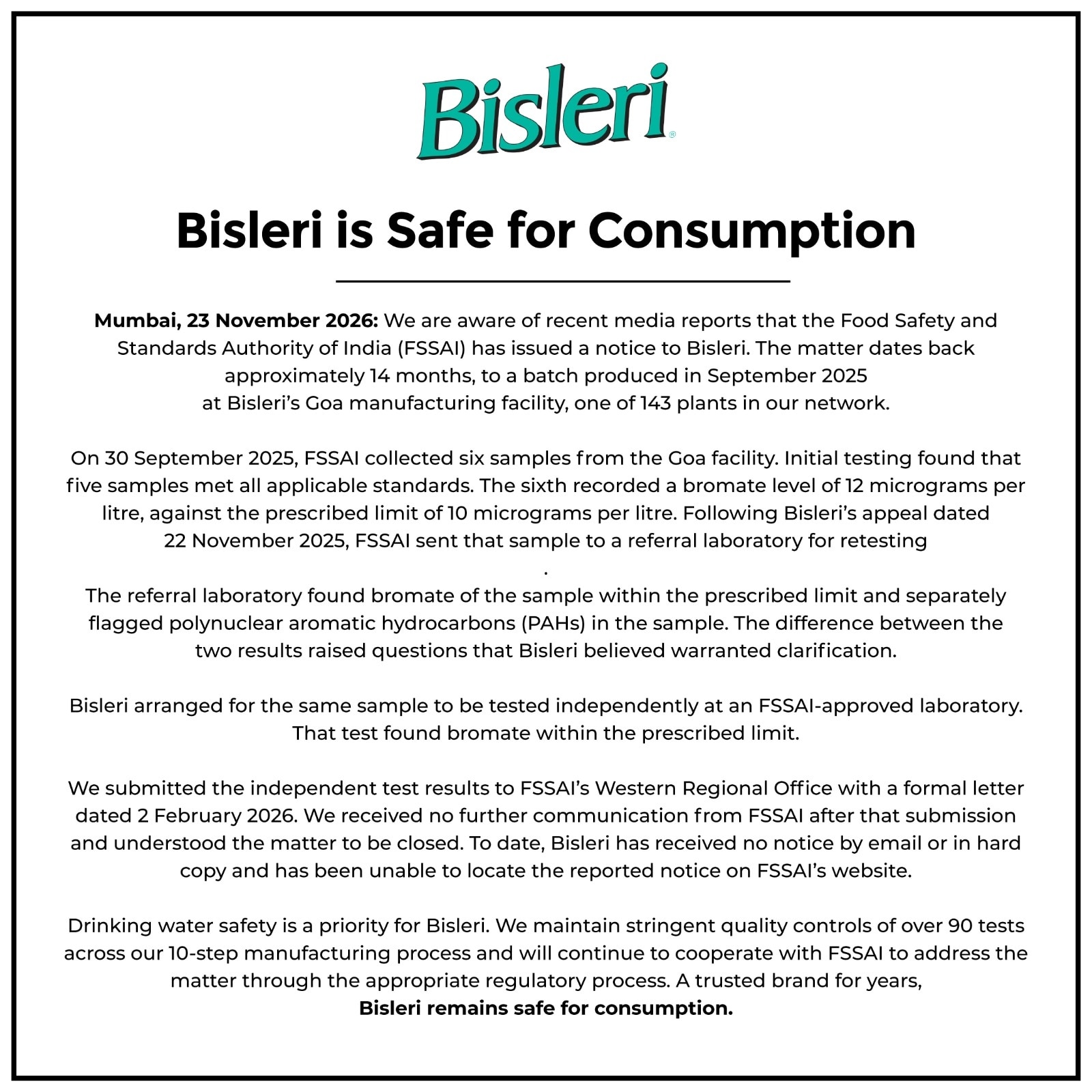
Bisleri claims that this case relates to a batch prepared at its plant in Goa in September 2025. According to the company, FSSAI collected six samples on September 30, 2025, five of which met all standards, while the sixth sample showed a bromate level of 12 micrograms per liter, whereas the prescribed limit is 10 micrograms per liter.

The company stated that after an appeal on November 22, 2025, the referral lab found the bromate level within the prescribed limit but also mentioned the presence of PAHs. Subsequently, Bisleri had the same sample tested by an independent laboratory accredited by FSSAI, which found the bromate within the prescribed limit. The company submitted the independent laboratory's report to the Western Regional Office of FSSAI on February 2, 2026, after which it received no further communication and assumed the matter was closed. Bisleri also stated that it conducts over 90 types of quality tests in its 10-step manufacturing process and that its water is safe for drinking.

Bisleri Company Denies FSSAI Allegations, Claims Water Samples Are Safe After Independent Tests
Read more
www.aajtak.in

Bisleri Company Denies FSSAI Allegations, Claims Water Samples Are Safe After Independent Tests

Bisleri International, a bottled drinking water producer, faced an FSSAI approval to initiate legal proceedings after the regulator deemed its packaged drinking water unsafe. However, Bisleri issued a statement asserting that the water is completely safe for consumption and that this issue with FSSAI arose approximately 14 months ago.

According to Bisleri's statement, the incident concerns a batch produced at the company's Goa plant in September 2025. Bisleri operates 143 plants across the network. On September 30, 2025, FSSAI collected six samples from the Goa facility. Initial analysis showed that five samples complied with all established standards. The sixth sample contained a level of bromate amounting to 12 micrograms per liter, exceeding the set limit of 10 micrograms per liter.

Following the company's appeal on November 22, 2025, the sample was sent to a referral laboratory for re-analysis. According to Bisleri, the referral laboratory found that the bromate level was within normal limits; however, it also mentioned polycyclic aromatic hydrocarbons (PAHs). Since the results of the two analyses differed, Bisleri conducted an independent verification at an accredited FSSAI laboratory, which confirmed that the bromate level met the established limits.

Bisleri reported that it submitted the independent verification report to the Western Regional Office of FSSAI via a letter dated February 2, 2026. After receiving no response, the company considered the matter closed. Furthermore, Bisleri claims it has not received any notifications, either by email or in hard copy, and such a notification is not available on the FSSAI website.

The company stated that the safety of drinking water is a priority for Bisleri. It emphasized that its ten-step production process maintains strict quality control through over 90 tests, and the company will continue to cooperate with FSSAI to resolve this matter through proper regulatory procedures. Bisleri insists that it remains a reliable, safe brand for drinking over many years.

In fact, FSSAI stated in its social media post that the established limits for bromate were not met in the regulatory samples of packaged drinking water (excluding mineral water), and consequently, under the FSS Act, 2006, it was declared unsafe. According to FSSAI, even the referral food laboratory recognized the sample as unsafe due to the detection of PAHs after the company's appeal, which served as the basis for approving legal action against Bisleri International Private Limited.

FSSAI deems Bisleri water unsafe for drinking after detecting chemical substances
Read more
www.aajtak.in

FSSAI deems Bisleri water unsafe for drinking after detecting chemical substances

The Indian food regulatory body, FSSAI, has taken strict action against Bisleri International, the bottled water manufacturer. On Sunday, FSSAI announced permission to file a lawsuit against Bisleri International Private Limited.

These actions were taken after samples of the company's packaged drinking water were deemed 'unsafe' during an inspection. FSSAI confirmed this measure through a social media publication.

According to FSSAI, a regulatory sample of 'packaged drinking water' (excluding mineral water) was taken from the premises of Bisleri International for testing. FSSAI reported that this sample did not meet the established limits for bromate and was declared unsafe in accordance with the Food Safety and Standards Act (FSS Act), 2006.

Subsequently, at the request of the company, the sample was sent to the Reference Food Laboratory. Further analysis there also found the sample to be 'unsafe' due to the detection of polycyclic aromatic hydrocarbons (PAHs).

Since the laboratory report proved a violation of legal provisions related to unsafe food products, FSSAI granted permission to prosecute Bisleri International Private Limited under the FSS Act, 2006.

In addition to Bisleri, FSSAI approved the initiation of cases against several other companies, including Vasant Masala Private Limited, Tit-Bit Foods India Private Limited, Mimansa Industries, and Asha Confectionery. Furthermore, FSSAI suspended the licenses of Urmi Lifesciences LLP and Gaur Ayurvedic Store for non-compliance with regulations.

A directive was also issued for the recall of products from Asha Confectionery, as inspections revealed that its packaged chocolate biscuits were unsafe. The company was obliged to withdraw these goods from the market.

It is worth noting that in the current calendar year (2026), FSSAI has intensified supervision and enforcement measures against food manufacturers and e-commerce companies. The tightening control also extends to companies producing energy and alcoholic beverages.

Popular