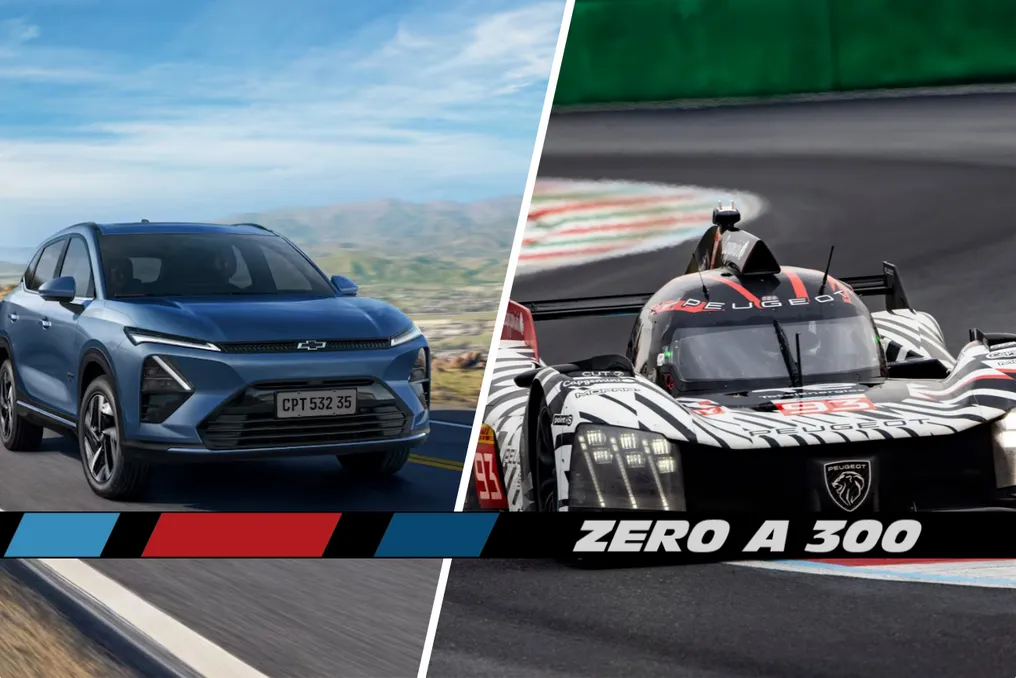
GM has introduced the Chevrolet Captiva PHEV to the Brazilian market, marking the arrival of its first hybrid vehicle in the country. This plug-in hybrid SUV has an initial price starting from R$ 199,990 and is already available for pre-order.
The Captiva PHEV features domestic assembly in Horizonte (CE), utilizing components imported from China. Its design is a collaboration with manufacturers SAIC and Wuling, known in the Chinese market as the Wuling Starlight S. The hybrid system combines a 1.5-liter naturally aspirated four-cylinder engine, operating on the Atkinson cycle, with an electric motor. Together, they generate a total power of 227 hp and 31.6 kgfm of torque, allowing it to reach 100 km/h in 8.3 seconds, with a top speed of 190 km/h. The individual power output of each powertrain was not disclosed.
The transmission used is a DHT (Dedicated Hybrid Transmission) type, characterized as a single-speed gearbox with multiple ratios. This system manages various driving modes, capable of operating in 100% electric mode (using a 20.5 kWh battery), series hybrid mode (where the combustion engine generates energy), or parallel hybrid mode (with both engines acting simultaneously).
In fully electric mode, the Captiva PHEV offers a range of 60 km, potentially reaching up to 1,069 km when using all hybrid drivetrain resources. Charging can be done at 3.3 kW via alternating current (AC) stations or at 24.6 kW via direct current (DC). Visually, the distinction between the purely electric version and the PHEV is only the inclusion of the charging port. The vehicle measures 4.74 m in length and 2.80 m in wheelbase, with a trunk capacity of 532 liters, expanding to 1,690 liters with the rear seats folded down. Standard features include a panoramic roof, a 15.6-inch multimedia center, an 8.8-inch digital dashboard, a 360° camera, and an electric tailgate. The driving assistance package includes autonomous emergency braking and adaptive cruise control.
Production takes place at the Ceará Automotive Plant (PACE) in Horizonte (CE), which also manufactures the Chevrolet Spark EUV and Captiva EV electric models.
Following meetings with employee representatives in France, Stellantis announced the termination of its official motorsport programs. Peugeot will immediately leave the WEC without a farewell season, as it did not register the 9X8 for 2027, and the registration deadline expired that Monday. The car bids farewell after 34 starts without victories, and the revised version planned for next year will not compete.
Citroën and Opel will remain in Formula E for one more season, competing in the first round of the Gen4 cars, and will leave the championship at the end of this season, in mid-2027. The Citroën team is managed by Monaco Sports Group, and Stellantis indicated that it will decide its own future, maintaining the possibility of continuity in the grid with another manufacturer.
The permanence of Lancia has not been confirmed. A Stellantis spokesperson, interviewed by DirtFish, clarified that the Lancia Corse HF is driven by PH Sport, and is not an official group team in the WRC, and therefore is not subject to the decision. Customer programs, such as Ypsilon Rally2 HF Integrale, C3 Rally2, Rally4, and Mokka GSE Rally, will continue, and plans for 2027 will be communicated soon. It is relevant to note that the Ypsilon secured the WRC2 team title upon its debut.
Stellantis also detailed the destination of financial resources, directing them towards customer competitions and street sports versions (Veloce, GTi, HF, and GSE) of brands such as Alfa Romeo, Peugeot, Lancia, and Opel, as well as exclusive models for Alfa and Maserati.
Additionally, Dodge, which was uncertain in NASCAR, maintained its participation without restrictions. Tony Sapienza, Stellantis' Vice President of Communications in North America, told RACER that there will be no changes to the region's programs.
Many enthusiasts have dreamed of owning classic cars from the 'Fast & Furious' franchise, especially in the 2000s, when modified vehicles like the orange Supra, Brian's Skyline, or Han's RX-7 Veilside were very popular. Periodically, replicas or real cars seen in the movies are announced by auctioneers and specialized stores, often reaching very high values.
However, for those seeking something more unique, an Acura Integra GS-R has emerged that, according to documentation, served as an extra in '2Fast 2Furious' (2003). This vehicle is listed in an auction on the Bring a Trailer website, with a current bid slightly over US$ 1,300 and six days remaining until closing.
It is the American version of the Honda Integra SiR, equipped with a B18 engine that originally produced 170 hp. The design reflects the aesthetic of the era, featuring custom black and red paint and a harmonized interior. The 1.8 VTEC engine was enhanced with a Jackson Racing mechanical compressor and modified intake, although the current power output was not specified. The car retains a five-speed manual transmission and front-wheel drive. Aesthetic modifications include gullwing doors and 19-inch HRE wheels, in addition to paint applied after filming, as reported by Bring a Trailer.
There is an important caveat: there is no confirmation that the car actually appeared in the movie. What exists is a charge receipt for damage to the rear bumper amounting to US$ 2,472, issued by the company responsible for filming. Nevertheless, rewatching the movie to locate this Integra can be a fun nostalgic act, and its future owner can display a movie car in the garage, even if its appearance was cut from the edit.
A composite is essentially a resistant fiber inserted into a resin matrix, and these fibers can be diverse. While race cars and supercars use carbon, old Brazilian cars from the 70s and 80s were built with fiberglass, and Kevlar is used where impact resistance is prioritized over rigidity. Volvo employs cotton textile fiber in its interior finishes.
Nissan now intends to add pineapple leaf to this list. In partnership with Food Reborn, an Okinawa-based company specializing in natural fibers, the manufacturer recently presented a plastic hood reinforced with pineapple leaf fiber, which, according to both parties, is the first body panel globally manufactured with this material.
Vegetable fibers have been used in automobiles for decades; Brazil has notable examples. Mercedes-Benz began using coconut fiber in the headrests of its trucks in 1994. Volkswagen applied curauá, an Amazonian plant related to pineapple, mixed with polypropylene, in the headliner, door trim, and trunk lid of the Fox and Polo, but always in internal applications, such as padding or lining.
Regarding external applications, Porsche pioneered in 2019 by launching the 718 Cayman GT4 Clubsport with doors and a rear wing made from a natural fiber composite, such as linen and hemp. Nissan claims to have achieved a material with tensile strength superior to linen composites, according to its own tests, but has not released data on weight, stiffness, or comparison with carbon or glass fiber.
The production process is similar to that of carbon fiber: the fibers are extracted from the leaves, transformed into a flat thread, and woven like fabric. This fabric is immersed in resin, forming what is called prepreg, and subsequently molded into the shape of the part. The difference lies in the raw material: instead of an expensive synthetic filament, an agricultural residue is used, which, according to Nissan, represents over 50 million tons discarded annually worldwide.
Currently, the focus of this material is on racetracks. According to Nissan, certain series-based categories already require natural fiber composites when external panels are altered, and executive Tatsuzo Tomita assures that the material meets motorsport requirements. The manufacturer has also licensed its technology so that Food Reborn can produce the yarn, fabric, and prepreg, and the Japanese company already plans to use it in sporting goods. There is still no concrete information about the application of pineapple fiber in road vehicles.
Since its presentation in July 2022, the N Vision 74 has gone through a period of uncertainty. In December 2023, Korean press and Car and Driver mentioned a production run of 100 units with 800 hp, with 30 destined for the tracks. In August 2024, the car appeared in a slide during Hyundai's Investor Day among future high-performance electric vehicles, leading to the belief that production was officialized.
However, Simon Loasby, Head of Hyundai's Design Center, informed The Drive that the project will not proceed at this time. Loasby explained during the presentation of the new Elantra to the press that the project progressed significantly, reaching a clay model with defined exterior and interior. The obstacle encountered was financial, as the car, evaluated in isolation in terms of sales volume and return, 'did not have a chance.' He added that including brand image value could increase the chances, but reiterated: 'for now, no.' Although Hyundai has not issued an official statement, Loasby's declaration suggests a significant postponement of the project.
For context, the N Vision 74 was a reinterpretation of the Pony Coupe designed by Giorgetto Giugiaro in 1974, a concept that gave rise to the Pony, the first car developed by Hyundai itself. Internally, the vehicle was not retro: an 85 kW hydrogen fuel cell and a 62.4 kWh battery powered two electric motors, one for each rear wheel, totaling 680 hp and 91.8 kgfm. Prototypes tested by the press used the fuel cells from the Nexo SUV.
Some elements of the original design will be preserved. Loasby mentioned that the top view, pillars, roof crease, and sides of the new Elantra (Avante in Korea) follow the 'N74 playbook,' and he himself addressed the possibility of a future N version of the sedan. Previously, in 2024, there were speculations that an affordable sports car would be more advantageous for Hyundai than a limited-edition hydrogen supercar, and it seems this is the path on which the N Vision 74 will find its survival.