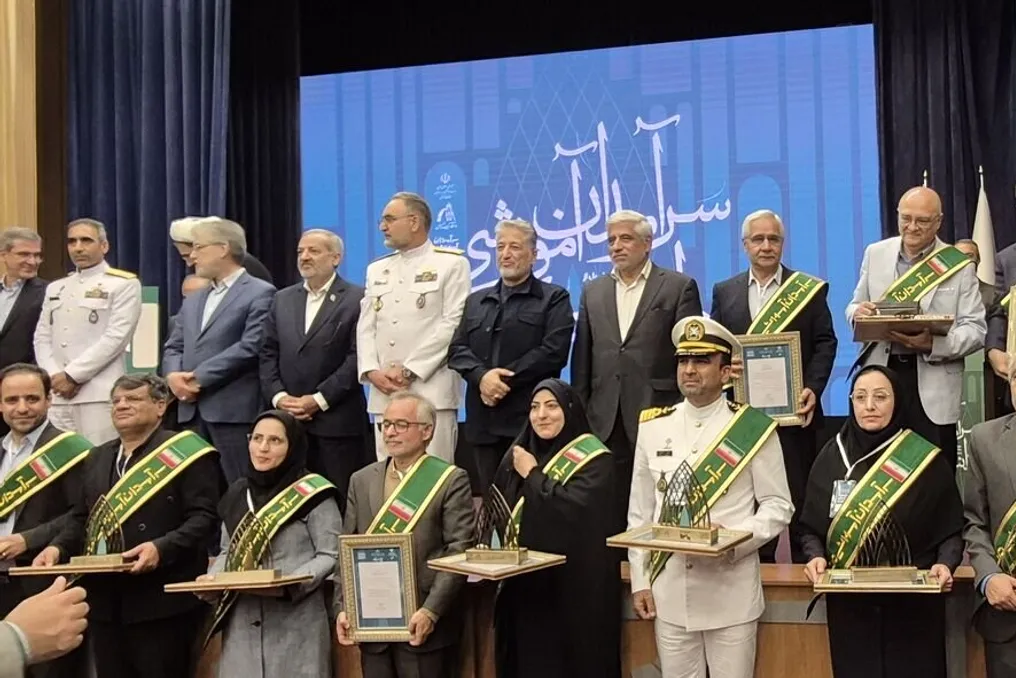
The fourth National Ceremony of Teaching Integrity was held in Tehran, where twenty-one professors from various universities and higher education institutions across the country were awarded. The event took place at Tarbiat Modares University on Tuesday.
The ceremony was attended by the Minister of Science, Research and Technology, Hossein Simai-Sarraf, as well as high-ranking officials from the higher education sector and university representatives. The purpose of the event was to recognize the contribution of outstanding educators to university education and the training of future generations.
Addressing the attendees, Simai-Sarraf emphasized that education remains the primary mission of the university. He noted that a professor's legacy is defined not only by scientific publications, books, inventions, and innovations but also by the students they educate and develop. The Minister called education the vital core of universities, stating that scientific research and technological development cannot thrive without a strong educational foundation.
The Minister also called for achieving a better balance between teaching and research within the country's higher education system. He pointed out that the excessive focus on research outcomes and academic publications over the last two or three decades has relegated teaching to a secondary position when evaluating faculty members.
Simai-Sarraf noted that the previous system of academic advancement placed great importance on research achievements, which sometimes put outstanding educators at a disadvantage despite their significant contribution to student development. However, under the updated rules for academic staff promotion, teaching is now recognized as an independent path for career growth, allowing professors with exceptional pedagogical merits to advance without evaluation based solely on the number of published works.
Furthermore, Simai-Sarraf specifically highlighted the indispensable human aspect of the teacher-student relationship. He stressed that while digital platforms and artificial intelligence can provide educational content, they cannot replace the personal interaction, care, and guidance necessary for nurturing students. He advised professors to go beyond simply conveying course material and pay attention to students' personal issues, aspirations, and future prospects, helping them become informed, responsible, and well-rounded individuals.
The twenty-one awarded professors represented a wide range of educational institutions, including Sharif University of Technology, Tarbiat Modares University, University of Tehran, Amirkabir University of Technology, Shiraz University, Tabriz University, and Ferdowsi University of Mashhad. This recognition of excellence in teaching comes amid Iran's efforts to strengthen its position in the international academic and research arena.
According to the Times Higher Education Asia University Rankings for 2026, 90 Iranian universities participated, nine more than in the previous edition, with 14 institutions making it into the top 200 regionally. Sharif University of Technology ranked highest nationally, securing a joint 76th position. The Nature Index Research Leaders rankings for 2026 also demonstrated the research activity of Iranian universities. Among Iran's leading academic institutions in applied sciences were the University of Tehran, Islamic Azad University, Sharif University of Technology, Amirkabir University of Technology, Tabriz University, and Tarbiat Modares University.
The annual ceremony, which began in 2022, aims to improve the quality of education, recognize outstanding teaching practices, and strengthen the role of university professors in developing human capital and advancing the nation's scientific potential.