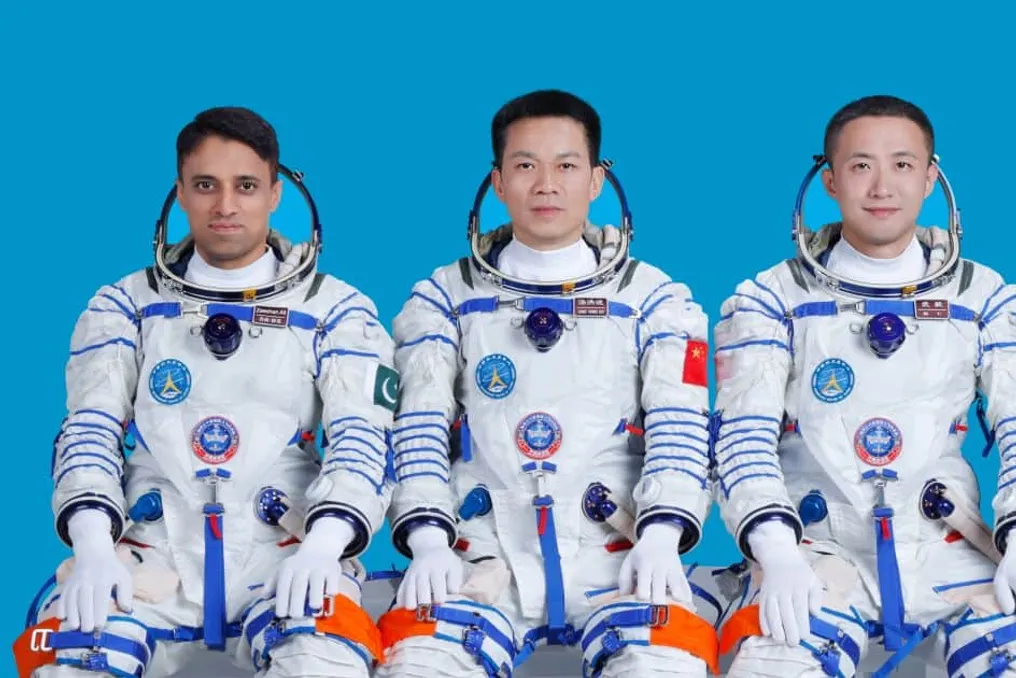
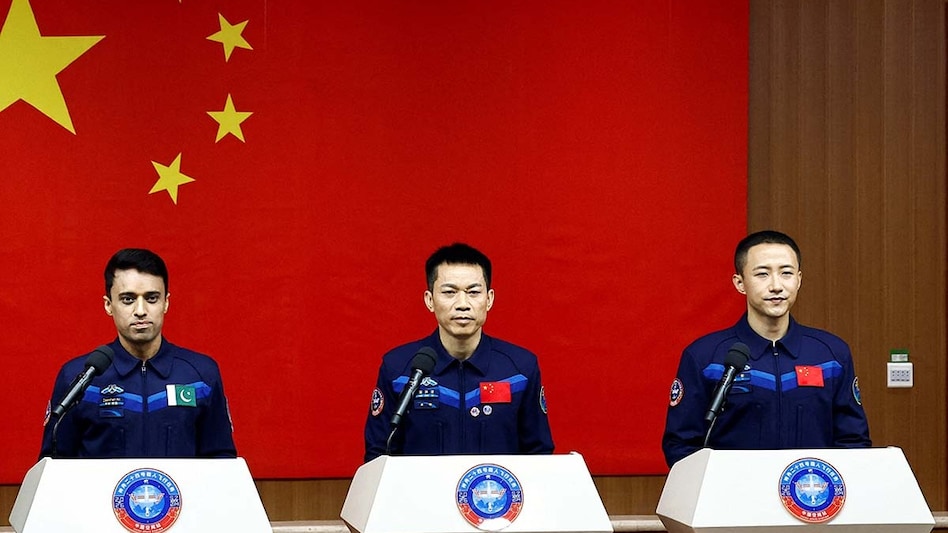
The Pakistani pilot Zeeshan Ali, aged 40, is set to become the first Pakistani citizen to orbit and the first foreigner to board the Chinese space station Tiangong through the Shenzhou-24 mission.
This event marks an advancement in Beijing's space diplomacy and reinforces collaboration between China and Pakistan. The launch is scheduled for 8:18 AM (corresponding to 9:18 PM Brasília time) at the Jiuquan Satellite Launch Center, located in northwest China. The spacecraft will be propelled by a Long March-2F rocket.
Ali will be part of a three-person crew, along with commander Tang Hongbo and flight engineer Wu Yi. During the expected five to ten days in the station, he will serve as a payload specialist, participating in various scientific experiments.
Before the trip, the pilot dedicated seven months to training in Beijing. This preparation involved intensive Mandarin lessons, as well as cultural activities such as calligraphy practice, poetry reading, learning Chinese songs, and table tennis. Ali expressed his feelings to a journalist, saying: 'I am not flying for myself. I carry the name of Pakistan on my shoulders.'
Space cooperation between China and Pakistan predates this mission, dating back to the early 1990s when Beijing launched Pakistani satellites. Furthermore, the two countries are developing new joint projects; in 2028, a rover built by Pakistan is expected to participate in a Chinese lunar mission.
This convergence is part of China's broader strategy to increase its global influence through the space sector. Victoria Samson, Chief Director of Space Security and Stability at the Secure World Foundation, assesses that Beijing uses the construction and launch of satellites for other nations, as well as the installation of telescopes and tracking centers in the Global South, as diplomatic tools.
Blaine Curcio, founder of the Hong Kong-based consultancy Orbital Gateway Consulting, believes that Pakistan's participation in Tiangong generates both diplomatic and technological benefits, including prestige, scientific knowledge, and closer ties between the countries. For him, the inclusion of a foreign astronaut demonstrates Beijing's openness to international cooperation, especially considering that the International Space Station (ISS), led by NASA, may be decommissioned by 2030.
Tiangong, which has been fully operational since late 2022 and whose name means Celestial Palace in Chinese, has the capacity to accommodate up to six astronauts during crew rotations. However, this time the transition will be different: while the members of the Shenzhou-23 mission will return to Earth with Ali, Commander Zhu Yangzhu will remain in the station for one year.
Zhu's extended stay contributes to Chinese studies on human adaptation to the space environment, providing crucial data for future crewed missions to the Moon and potential trips to Mars. Upon completing his period, he will set the record for the longest individual stay among Chinese astronauts, although it will still fall short of the 14.5-month mark achieved by a Russian cosmonaut in 1995.
China maintains the goal of sending humans to the Moon by 2030, despite the postponement of the Chang'e-7 lunar mission this year due to unfavorable weather conditions caused by a tropical storm. Additionally, Beijing plans to establish a lunar research base in partnership with Russia by 2035.
On the other hand, the United States plans to send astronauts back to the Moon in 2028. In the context of the dispute over building lunar bases, Washington warned that Beijing might attempt to monopolize access to resource-rich lunar areas. The Chinese government refutes such allegations, stating that it defends the peaceful use of space.
Ali also expresses interest in these prospects, hoping that the partnership between China and Pakistan evolves from a singular mission to multiple joint flights destined for the Moon, Mars, and beyond.