In the forests of Australia lives a bird that possesses an astonishing ability to reproduce the sounds of chainsaws, camera clicks, and the voices of other animals. The lyrebird has become one of the most famous imitators in nature, demonstrating exceptional accuracy in sound reproduction and transforming its vocal repertoire into a complex performance program.
This amazing talent has attracted widespread public attention, but behind the familiar video clips lies a fascinating story about vocal learning, communication, and the science of mimicry. The truth behind some of its famous mechanical sound imitations is as intriguing as the sounds themselves.
Two species of lyrebirds are found in Australia: the superb lyrebird and Albert's lyrebird. Both species are known for their outstanding ability to imitate sounds, although the superb lyrebird is more famous for its lush tail feathers and rich vocal arsenal.
The superb lyrebird inhabits the forested areas of southeastern Australia, including parts of Victoria, New South Wales, and Queensland. Albert's lyrebird has a more restricted range, living in the subtropical rainforests of southeastern Queensland and northeastern New South Wales.
Despite the spectacular displays, lyrebirds are primarily ground birds. They forage for insects, spiders, frogs, and other small invertebrates among fallen leaves, using their strong legs and feet to dig in the forest litter.
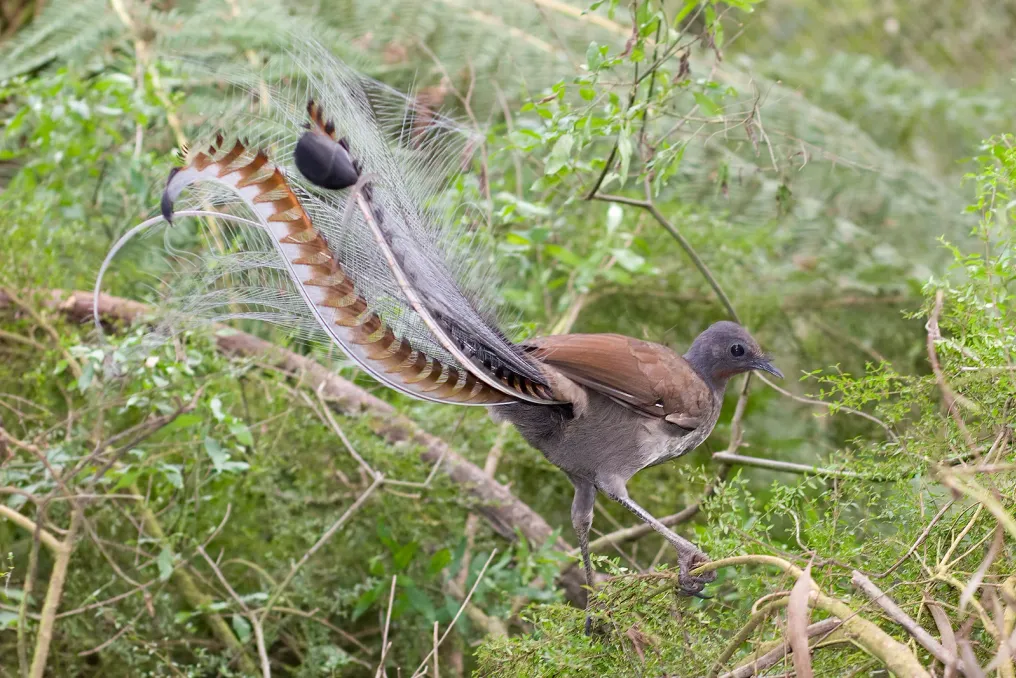
Their appearance is also quite peculiar. The male superb lyrebird has a long, ornate tail that, when fully spread during a display, resembles the shape of a lyre—the musical instrument that gave the bird its name. This tail consists of specialized feathers that create an impressive visual spectacle, especially during the breeding season.
However, it is their voice that has given them international fame. Lyrebirds are among the most skilled vocal imitators in the world. Instead of relying solely on their own species calls, they can reproduce the songs, calls, and vocalizations of other birds with remarkable accuracy.
Their repertoire can include the sounds of many nearby species. A single lyrebird performance can sound like a series of different birds, sometimes overlapping or repeating in a way that makes it difficult for listeners to determine the original source of the sound.
Lyrebird mimicry is not just instinctive behavior; it involves vocal learning—a relatively rare and complex ability of animals to acquire sounds by listening and copying others. Young lyrebirds master elements of their vocal repertoire, with social interaction and exposure to ambient sounds playing a crucial role. As they mature, they form extensive collections of imitations that are integrated into their song.
This ability allows lyrebirds to produce sounds very close to the originals, and researchers are studying not only what sounds they copy but also how accurately they reproduce them. Some imitations are so convincing that birds of the imitated species may react as if they heard the genuine call of one of their own.
Chainsaw sounds, camera clicks, and even other mechanical noises are often associated with lyrebirds in videos and online publications. These recordings have helped cement the bird's reputation as an almost limitless sound imitator. Nevertheless, the story behind these mechanical noises is far more complex than viral clips suggest.
Some of the most famous recordings of lyrebirds reproducing mechanical sounds were obtained from captive birds. Researchers and naturalists caution against assuming that these sounds are regularly heard from wild lyrebirds in their natural habitat. Recordings of chainsaw operation, which circulate frequently, have been subjected to careful analysis, as some were made by captive birds exposed to man-made sounds.
There is no established evidence that wild lyrebirds frequently imitate the sound of chainsaws as implied by viral videos. This distinction is important because the bird's extraordinary mimicry is well-documented in nature, but its wild repertoire does not necessarily match the repertoire of individuals living in environments where they are constantly exposed to machinery, cameras, or other artificial noises. Nevertheless, it remains a remarkable ability demonstrating that birds can learn and reproduce complex sounds, sometimes including noises from human-influenced environments. Mechanical imitations are an interesting extension of their capacity for vocal learning, rather than proof that every lyrebird in the forest copies machinery.
The Role of Mimicry in Mating Behavior
For male lyrebirds, mimicry is not just a way to impress listeners; it is part of a complex mating display combining song, movement, and an incredible visual presentation. During the breeding season, superb lyrebird males create and maintain display mounds in the forest. From these elevated positions, they perform elaborate shows that can include singing, dancing, and spreading their characteristic tail feathers over their bodies.
The tail is often the most dramatic part of this display. The male raises and fans his feathers into a wide, almost translucent fan, moving rhythmically and emitting an intricate sequence of sounds. These displays are intended to attract females, as the combination of vocal abilities, choreography, and feather presentation is part of the courtship ritual.
Researchers have found that lyrebird males do not always use their entire repertoire in every performance. Studies of superb lyrebird displays have shown differences in the types of sounds used during singing on a branch versus dancing performances. During vocal performances, males may imitate a wide range of other bird vocalizations, including non-alarm calls. However, during dance displays, they were observed selectively imitating alarm calls. This suggests that mimicry may serve different functions depending on the context, and that lyrebirds may carefully select sounds for specific performances.
Scientists are still figuring out what these sounds convey, but research indicates that lyrebird mimicry is not simply thoughtless copying of everything the bird hears. Singing and complex vocal performances are often associated with males, especially in species where males put on mating displays to attract females. However, lyrebirds have helped researchers study the complexity of female vocal behavior.
Studies have documented vocal mimicry in both superb lyrebirds and Albert's lyrebirds, disproving the idea that complex mimicry is exclusively a male trait. Female lyrebirds have been recorded producing complex vocalizations and imitating other sounds, although their vocal repertoires and contexts for using mimicry may differ from those of males.
These findings contribute to a broader understanding of bird song, vocal learning, and the roles that complex vocal behavior can play beyond courtship. Lyrebirds can be found in the forests of southeastern Australia: superb lyrebirds are found in areas of Victoria, New South Wales, and Queensland, while Albert's lyrebird occupies a smaller area of subtropical rainforest along the borders of Queensland and New South Wales.
Visitors exploring Australian forests and reserves may be lucky enough to hear or see a lyrebird, though this cannot be guaranteed. They are often heard before they are seen, and their ability to imitate other birds makes it difficult to pinpoint the source of the sound. The best way to encounter a lyrebird is to slow down and listen. Early mornings in wooded areas can provide opportunities to hear bird songs, and quiet walks along forest trails may reveal a lyrebird foraging in leaf litter or moving through the undergrowth. Visitors should maintain a distance, avoid approaching display mounds too closely, and never attempt to provoke the bird into a performance. The most memorable wildlife encounters often happen when the animals remain undisturbed.
The lyrebird's ability to imitate sounds has made it one of Australia's most interesting natural ambassadors. From accurately reproducing the calls of other birds to the famous recordings sounding like machinery, its vocal repertoire has captivated audiences far beyond its habitat. Yet, its remarkable talent is about more than mere imitation. Lyrebirds offer scientists a window into vocal learning, animal communication, and the complexity of mating behavior. Their performances show how sound can become a tool for interaction, display, and survival.