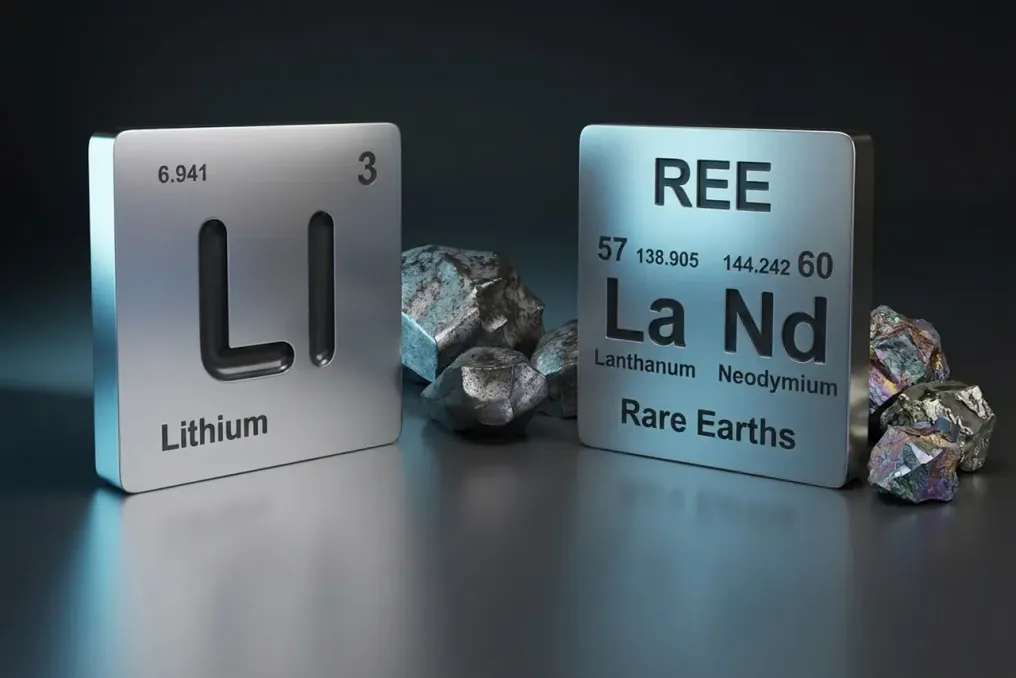
According to estimates, Uzbekistan will require approximately 19,400 tons of lithium carbonate equivalent (LCE) and up to 875 tons of neodymium-praseodymium-based permanent magnets annually by 2040 to support the development of the automotive and energy sectors. The country plans to produce 200,000 electric vehicles per year by 2030, increase energy storage system capacity to 4.5 GW, and expand wind energy production, with all three sectors needing lithium and rare earth metals.
This analysis is the first part of a series dedicated to future domestic demand. The next article will examine the sufficiency of Uzbekistan's domestic resources and the economic feasibility of their processing.
Economic Development of Uzbekistan
Uzbekistan has the largest population among the five Central Asian countries and ranks second in the region in terms of economic volume after Kazakhstan. In 2025, the country's share in the total GDP of Central Asia was about 27%. The country is transforming the structure of its national economy by developing mechanical engineering, chemical, and electrical engineering industries, while agriculture and raw material sectors continue to play a significant role.
Over the past five years, real GDP has grown by approximately 40%, and the population of Uzbekistan has increased by 12.8%, reaching 38.2 million people. Population growth expands the domestic market and opens new opportunities for the country's industrial development. Uzbekistan is modernizing existing enterprises and building new production facilities using domestic resources while attracting foreign investment and loans.
In 2025, capital investment reached 591.1 trillion sums, including 422.1 trillion sums in the form of foreign investment and loans. However, cooperation with foreign partners must go beyond simply acquiring equipment and ready technologies; it must include joint research with the participation of Uzbek scientists and engineers. The results of these projects must remain in the country, allowing Uzbek enterprises and research organizations to improve the acquired technologies and develop their own solutions.
Priorities of Economic Development and Low-Carbon Economy
In his address to the Oliy Majlis and the people of Uzbekistan on December 26, 2025, President Shavkat Mirziyoyev defined attracting investment in high-tech production and increasing the output of high value-added goods as economic priorities. Plans for 2026 alone included launching 782 industrial and infrastructure projects totaling 52 billion US dollars. Implementing these plans will allow Uzbekistan to localize the production of strategically important goods and expand industrial cooperation with both traditional partners and new countries providing access to additional markets.
Simultaneously, further industrial development requires rational use of natural resources, increased energy efficiency, and reduced environmental impact from production. In December 2022, Uzbekistan approved the Program for Transition to a Green Economy by 2030. This program envisions reducing greenhouse gas emissions per unit of GDP by 35% compared to 2010 levels, increasing industrial energy efficiency by at least 20%, and increasing installed renewable energy capacity to 15 GW.
President Shavkat Mirziyoyev spoke about the need to develop new energy sources, implement resource-saving technologies, and attract investment at an international summit in Abu Dhabi on January 14, 2025. Uzbekistan declared 2025 the Year of Environmental Protection and Green Economy. In November of the same year, the country submitted an updated Nationally Determined Contribution under the Paris Agreement (NDC 3.0), raising the goal for reducing greenhouse gas emission intensity to 50% by 2035 compared to 2010 levels. It is important to note that this goal relates to emissions per unit of GDP, not to the absolute reduction of total emissions, which may continue to rise with economic growth.
Automotive Industry and New Energy: Future Demand for Lithium and Rare Earth Metals
Industrial production and population growth are increasing Uzbekistan's demand for electricity. Electricity generation has almost doubled over the last decade, and the country intends to increase generation to 129 billion kWh by 2030. Nevertheless, alongside increased generation, Uzbekistan needs to develop electrical grids and generating capacities in remote areas, as shortages there limit the possibilities for creating new enterprises. Development must also take into account environmental standards.
Despite having significant reserves of gas and coal, Uzbekistan continues to import both fuels because domestic production does not cover growing consumption. The problem is particularly acute in the power sector, where natural gas accounts for 72.3% of generation. Meanwhile, gas production has fallen by almost a third since 2019, and import costs reached 1.21 billion US dollars in January-August 2026 alone. Replacing gas with coal is also difficult: between 2019 and 2025, coal consumption doubled to 11.8 million tons, exceeding domestic production.
Further increases in electricity generation, based primarily on gas and coal power plants, will require even more fuel. Therefore, Uzbekistan is actively developing solar, wind, and hydropower. An active phase of construction of the first nuclear power plant in the Jizzakh region began in June 2026.
The automotive industry could become one of the largest consumers of lithium and rare earth metals in Uzbekistan. In 2025, the country produced about 458,000 passenger cars, mainly for the domestic market, exporting some vehicles to Kazakhstan, Azerbaijan, and other states. The state strategy 'Uzbekistan–2030' envisages increasing annual car production to 1 million units, including 200,000 electric vehicles. The production of electric and hybrid vehicles is already developing in the country: since June 2024, the BYD enterprise has been operating in the Jizzakh region, planning to expand production and localize component manufacturing.
Electric vehicle production creates demand for lithium used in traction batteries and rare earth metals, particularly neodymium and praseodymium, used in permanent magnets for electric motors. Based on the government's 2030 target, and assuming all 200,000 vehicles will be fully electric, an average battery capacity of 60 kWh would ensure an annual demand of 12 GWh of batteries. Producing such batteries would require about 7,200 tons of lithium carbonate equivalent, based on an estimate of 600 tons of LCE per 1 GWh of battery capacity.
Assuming a consumption rate of 1.5 kg of NdFeB magnets per electric motor, producing this number of vehicles would require about 300 tons of permanent magnets containing 75–90 tons of neodymium and praseodymium.
Forecast of Lithium and Rare Earth Material Demand in Uzbekistan until 2040
The expanding electricity market will create additional demand for lithium used in lithium batteries. By the end of 2025, energy storage systems in Uzbekistan reached a cumulative capacity of 1,545 MW. The country plans to increase this capacity to 4.5 GW by 2030. Assuming a three-hour discharge duration, the total capacity of energy storage systems will reach 13.5 GWh. Producing the necessary batteries will require about 8,100 tons of LCE. Unlike the automotive industry, where lithium demand depends on annual EV production, demand in the energy sector is determined by the pace of energy storage system construction. Consequently, an estimated 8,100 tons of LCE will be needed for all energy storage facilities built by 2030, not within a single year.
Wind energy can also become a consumer of rare earth metals. Direct drive turbines use about 650 kg of NdFeB magnets per 1 MW of capacity. These magnets contain 160–195 kg of neodymium and praseodymium. According to the author's scenario, Uzbekistan's wind capacity will grow from 5 GW in 2030 to 10 GW in 2040. After 2030, it is assumed that annual production of fully electric vehicles will increase to 500,000 units by 2040, and total passenger car production could reach 1.3 million units. The country is also considering increasing the installed energy storage capacity to 12 GW.
Maintaining an average traction battery capacity of 60 kWh, the automotive industry's battery needs by 2040 will reach 30 GWh annually. Producing these batteries will require about 18,000 tons of lithium carbonate equivalent per year, with demand potentially ranging from 16,500 to 21,000 tons of LCE depending on battery production technology. Assuming a consumption rate of 1.5 kg of NdFeB magnets per vehicle, the demand for permanent magnets will rise to 750 tons in 2040, of which about 190–225 tons will be neodymium and praseodymium.
In the energy sector, lithium demand will depend on the pace of energy storage system construction. Capacity may increase from 4.5 GW to 12 GW by 2040. This expansion alone over the decade will require an additional 13,500 tons of LCE, and this estimate does not include potential battery replacement before end-of-life. Wind energy development will also increase the demand for permanent rare earth magnets. If, after 2030, an additional 2.5 GW of wind capacity is introduced every five years, and half of the new installations use permanent magnet generators, then approximately 625 tons of NdFeB magnets will be required for each five-year period. This equates to an average annual requirement of 125 tons, based on an average consumption of 500 kg of magnets per 1 MW of corresponding capacity across various turbine designs. Including the automotive industry, Uzbekistan's total annual demand for permanent rare earth magnets could reach 875 tons by 2040.
Potential Market for Critical Materials in Uzbekistan
According to estimates, the automotive industry and new energy storage systems in Uzbekistan may require an average of about 19,400 tons of lithium carbonate equivalent annually by 2040. Of this volume, 18,000 tons will be needed for vehicle production in 2040, and 1,400 tons will constitute the average annual demand for energy storage system construction between 2031 and 2040. The automotive industry will be the main consumer of lithium and rare earth magnets. Its demand will be tied to the annual volume of vehicle production, while procurement volumes in the energy sector will depend on construction schedules and equipment selection.
These projected volumes also indicate a substantial market for finished products. By 2030, the cost of batteries required to meet the state strategy's electric vehicle production target could amount to about 1.2 billion US dollars annually at 2025 prices. However, these figures represent potential material demand, and it remains unclear what share of this market domestic producers can capture. Although Uzbekistan possesses its own reserves of lithium and rare earth metals, the question remains whether they will be sufficient to meet the country's future needs and how economically viable industrial processing will be.