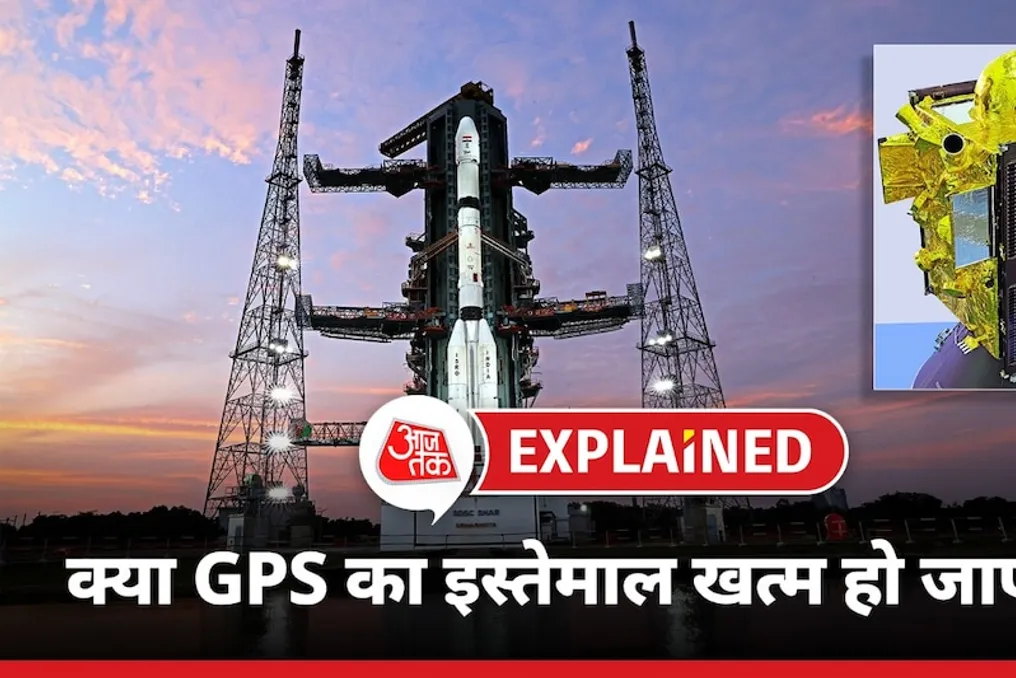
The success of the NVS-03 satellite is not just another achievement in India's space program; it is a significant step towards strengthening the national navigation system NavIC. Accurate location and time determination is required everywhere—from mobile phones and aviation to maritime transport, trains, military equipment, and disaster management systems.
Until now, many countries relied on foreign systems, such as American GPS, to provide these services. India developed its own alternative through NavIC, and the success of NVS-03 advances this alternative toward greater reliability.
The importance of this mission is amplified by the fact that the previous satellite, NVS-02, failed to reach the designated orbit. Thus, NVS-03 has not only raised hopes for restoring the required number of satellites for NavIC but has also demonstrated how the space program can be improved by learning from technical failures.
Satellite NVS-02 was launched on January 29, 2025, using the GSLV-F15 rocket. Although the rocket managed to place it into a geosynchronous transfer orbit, the satellite could not achieve the intended trajectory using its own engines. The cause was a technical issue related to the supply of oxidizer needed for fuel combustion. The problem was that the pyrovalves in the satellite's propulsion unit did not open. The investigation revealed a possible cause in a breach of electrical connector contact, which prevented the satellite from receiving the necessary oxidizer for the main engine and consequently prevented it from changing its orbit.
To avoid this problem in NVS-03, ISRO adopted a different approach: the satellite was launched with three pyrovalves pre-opened. V. Narayanan, head of ISRO, reported after the launch that this change was made to enhance mission reliability. This approach received approval after tests related to vibration and shock. Pyrovalves are special valves that are usually opened by an electrical signal and a small explosive charge, and once opened, they cannot be closed. This time, an attempt was made to prevent a recurrence of problems similar to NVS-02 using pre-opened valves.
NavIC stands for Navigation With Indian Constellation. Previously, the system was called Indian Regional Navigation Satellite System (IRNSS). It is India's own regional satellite navigation system, developed by ISRO. Its goal is to provide location, direction, speed, and precise time information in a region extending approximately 1500 kilometers from India and its borders. It functions similarly to American GPS, Russian GLONASS, European Galileo, and Chinese BeiDou, but its primary focus is on India and the surrounding territory.
Simply put, satellite navigation works like this: satellites continuously transmit radio signals containing their position and time information towards Earth. A mobile phone or navigation device receives these signals and determines its location by calculating the time of arrival. Typically, at least four signals are required for this. While three satellites can give a rough idea of the location under ideal conditions, in real-world scenarios, discrepancies between the receiver's clock and the satellite's clocks must be corrected, making the fourth satellite necessary.
This is why having four active satellites for NavIC is not just a matter of increasing numbers, but a fundamental capability for autonomous positioning. With three satellites, the Indian system could provide time and some navigational support, but autonomous positioning capability was limited. The arrival of NVS-03 brought a significant improvement in meeting this minimum requirement.
NVS-03 is equipped with domestic rubidium atomic clocks and also includes atomic clocks acquired from abroad. Clock accuracy is critically important for a navigation system. Since there is a certain time delay for a radio signal to travel from the satellite to Earth, the receiver calculates the distance to the satellite based on this time. Even the slightest error in the clocks can lead to significant errors in location calculation. Therefore, atomic clocks are a vital part of navigation satellites. The significance of domestic clocks for India goes beyond a mere technical achievement. Previously, issues related to foreign atomic clocks on some NavIC satellites affected the system's capabilities. The use of domestically developed rubidium atomic clocks is a step towards reducing this dependence. However, installing domestic clocks does not make the entire system completely independent of foreign technologies; this requires developing internal potential in other components of the satellites, ground stations, chipsets, and signal processing technologies.
A key advantage of NVS-03 is its L1 frequency band. Previously, NavIC operated mainly in the L5 and S bands. Now, NVS-03 also transmits a signal in the L1 band, which is used by many international navigation systems such as GPS.