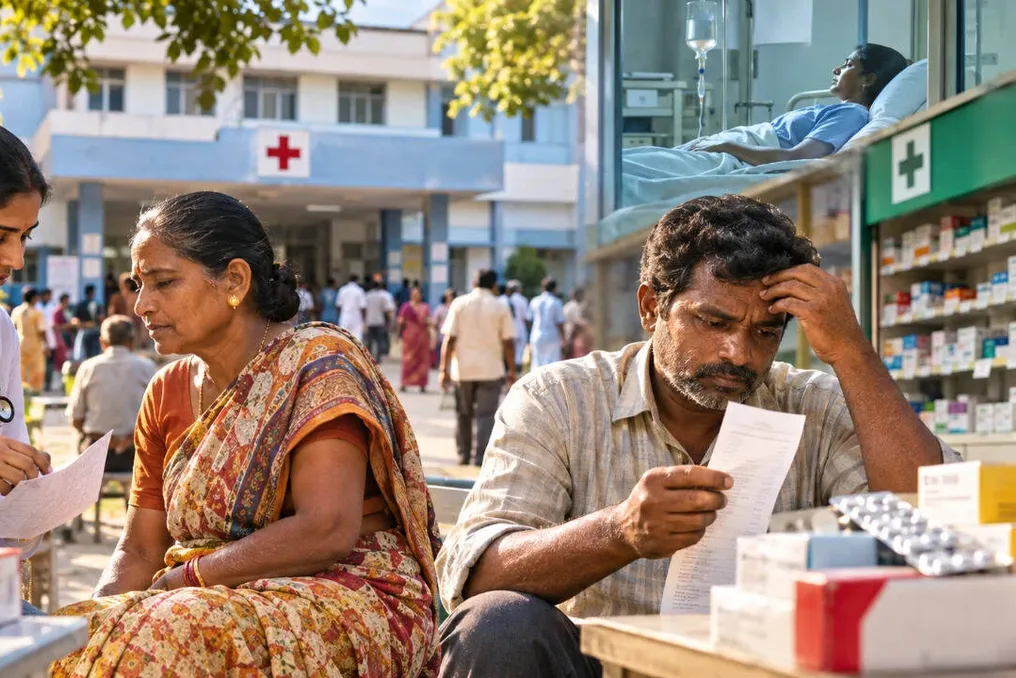
In October 2026, a 27-year-old woman from Mathura, Lucknow, who lost the ability to walk, underwent two complex spinal surgeries at a private hospital. Doctors estimated the treatment could cost 6–7 lakh rupees, but she received it free thanks to the Ayushman Bharat program. In the same month, in the Bargarh district of Odisha state, a daily wage worker borrowed money to buy medicine for his family. His son's chemotherapy was covered by Ayushman Bharat, but the family's monthly medication expenses amounted to 20,000 rupees.
Both cases illustrate the same reality: although the government is taking on an increasing share of healthcare costs in the country, huge medical expenses can still lead individual households into financial difficulties at the local level.
If we consider India's entire healthcare budget as 100 rupees, in the 2013–14 period, families directly paid 64.20 rupees, the government spent 28.60 rupees, and the remaining 7.20 rupees were financed from other sources. By 2023–24, the government's share grew to 43.50 rupees, while direct household payments accounted for 42.70 rupees. The remaining 13.80 rupees were covered by other financing mechanisms, including private insurance.
In absolute terms, government health expenditures increased from 1.30 lakh crore in 2013–14 to 4.14 lakh crore in 2023–24. Meanwhile, direct household payments grew much slower—from 2.91 lakh crore to 4.06 lakh crore. Thus, government spending exceeded direct household payments by approximately 8,000 crore.
Government spending first surpassed direct household payments in the series of National Health Accounts in 2021–22, when pandemic-related costs raised them to 48%. A more detailed analysis of the latest National Health Accounts reveals the specifics of these figures.
Of the 4.14 lakh crore spent by the government in 2023–24, about 1.13 lakh crore was allocated to capital expenditure on health infrastructure, equipment, and other long-term investments. Excluding this, government spending on current healthcare—that is, funds used to provide services and goods during the year—amounted to about 3.01 lakh crore. Meanwhile, households directly paid 4.06 lakh crore.
For every 100 rupees spent on current healthcare services and goods, the government provided 36 rupees, while households paid directly 48.50 rupees. Other sources covered the remaining 15.50 rupees. Even excluding capital investments, households continue to bear a larger share of daily healthcare costs.
However, government spending on current healthcare has more than tripled: from approximately 98,000 crore in 2013–14 to 3.01 lakh crore in 2023–24. The government's share of current healthcare expenditure rose from 23.2% to 36%.
Nearly half of the decade-long decline in the household share of total healthcare expenditure occurred in one year, dropping from 58.7% to 48.8% in 2017–18. This coincided with a change in the survey used to assess household health expenditures and preceded the launch of PM-JAY in September 2018. It is unclear what portion of this decline is related to the change in assessment methodology.
Government health expenditures increased by approximately 219% over the decade, excluding inflation. Direct household payments rose by about 40%. For every 100 rupees the government spent on healthcare in 2013–14, a decade later it spent about 319 rupees. For households, 100 rupees turned into approximately 140 rupees.
By 2023–24, government spending surpassed direct household payments. The Ayushman Bharat program, launched in 2018, became a notable initiative in this expansion. Its hospital insurance component, Pradhan Mantri Jan Arogya Yojana (PM-JAY), provides eligible families with an annual medical policy worth up to 5 lakh rupees for certain inpatient procedures.
In October 2024, eligibility was expanded to all senior citizens aged 70 and above, regardless of their economic status. However, the increase in government spending in India goes far beyond just hospital insurance.
Government health insurance schemes, including PM-JAY and regional programs, amounted to 33,385 crore in 2023–24, or about 8% of total government health expenditure. A much larger portion of public funds is directed towards the healthcare system itself.
Government spending on primary healthcare, the first point of contact for many patients, increased from approximately 50,000 crore in 2013–14 to 1.53 lakh crore in 2023–24. In 2023–24, this accounted for about half of total current government healthcare spending.
Through the National Health Mission and Ayushman Arogya Mandirs, the government aims to expand basic consultations, maternal and child care services, access to essential medicines, and diagnostic tests. State and local authorities provided almost 68% of government health expenditure in 2023–24, highlighting their role in this expansion.
In 2023–24, government spending exceeded direct household payments in 13 out of 21 states and union territories for which the National Health Accounts provided comparable estimates. In the remaining eight, families had to pay more directly.
In Uttarakhand, the government covered 66% of total healthcare costs, while households paid 26.7% directly. The government's share was 57.9% in Odisha and 59.5% in Assam. Kerala shows the opposite trend: for every 100 rupees spent on healthcare in the state, households contributed 65.20 rupees directly, compared to 25 rupees from the government. In West Bengal, these figures were 63 and 30 rupees, respectively.
State-level government expenditure figures include spending by the federal government and local authorities, not just the state's own health budget. Household expenditure estimates are based on 2017–18 survey data updated for subsequent years.
The 2025 National Sample Survey showed that coverage by health insurance or health financing increased from less than one in five Indians in 2017–18 to nearly half, mainly due to government-sponsored schemes.
At least half of outpatient treatments in government facilities did not require direct medical expenses. Average per capita outpatient treatment costs, excluding childbirth, were 6,631 rupees in government facilities compared to 50,508 rupees in private hospitals. Although treatment types may differ, private hospitals, including those covered under government schemes, accounted for 60.3% of all hospitalizations, excluding childbirth.
Medications purchased separately account for over 42% of what Indian households pay directly for healthcare. Medicines remain a significant financial burden: in 2023–24, households spent 1.71 lakh crore on separately purchased medicines, accounting for approximately 42% of their direct healthcare costs. While PM-JAY primarily covers hospitalization, initiatives like government free drug programs and Jan Aushadhi are aimed at reducing daily medical costs. The number of Jan Aushadhi outlets grew from approximately 80 in 2014 to about 11,000 by March 2024.
Families also finance healthcare through insurance contributions. Expenditures through private health insurance, which includes employer group coverage and individual policies, rose from 3.4% of total healthcare expenditure in 2013–14 to 10.2% in 2023–24.
When looking at the source of health funds, including household insurance contributions, the picture changes. In 2023–24, households provided 55.70 rupees out of every 100 rupees spent on current healthcare, compared to 72.90 rupees in 2013–14. Contributions from government budgets and grants increased from 21.10 to 34 rupees over the same period.
There is also a cost that the National Health Accounts cannot account for: treatment that a person needed but could not afford. Both a patient who received free treatment in a government hospital and a person who declined treatment due to unaffordability may register zero direct medical expenses. Their experiences are hardly different. The real measure of India's health progress is whether an Indian can fall ill without becoming impoverished.