Physicist creates black hole simulation on a chip and observes potential leakage of disturbances
Read more
Olhar Digital
olhardigital.com.br

Physicist creates black hole simulation on a chip and observes potential leakage of disturbances

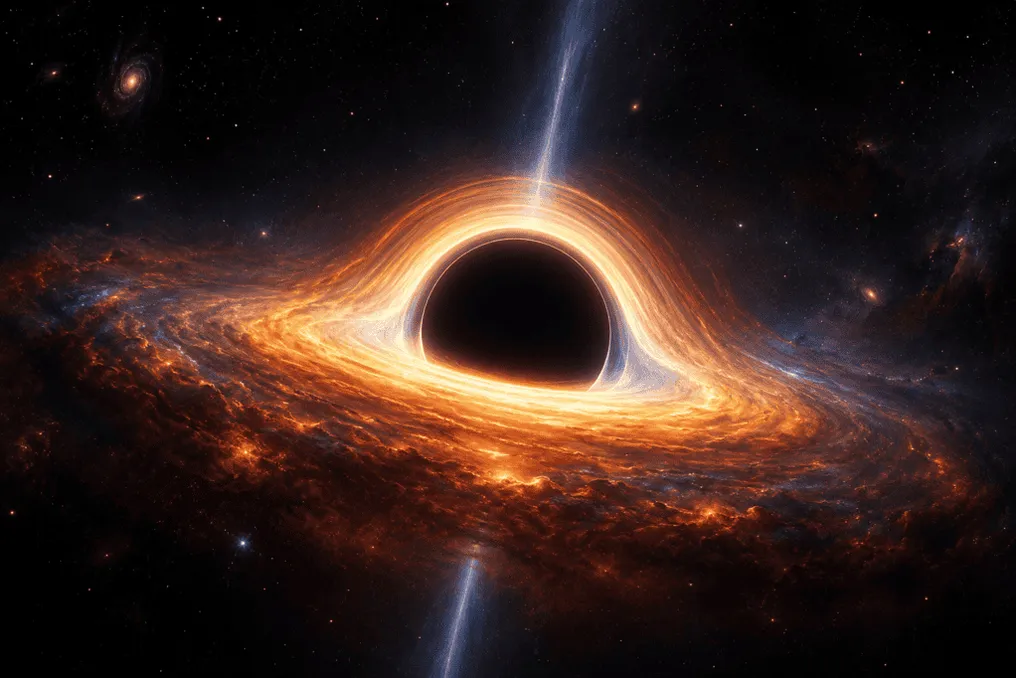
Black holes are notorious for their ability to attract matter and prevent any escape through their event horizon. However, a study conducted by physicist Antonino Flachi, affiliated with Keio University in Japan, demonstrated distinct behavior. He developed a digital representation of a black hole on an electronic circuit and found that small disturbances could partially cross its boundary.

This experiment does not replicate a genuine black hole, but rather a simulation capable of mimicking some of its physical characteristics. By modifying just one bit of information within the digital event horizon, Flachi generated a disturbance that managed to escape partially. According to the Science Alert portal, this finding provides a new methodology to investigate which attributes of these celestial bodies are universal and which are tied to the specific physical laws of each system.

Studying black holes directly is complex, given that they prevent light from escaping beyond the event horizon. For this reason, scientists create experiments that replicate some of their properties in a laboratory setting. A traditional technique involves using sound waves in moving fluids.

When a fluid advances into an area faster than sound can propagate in the opposite direction, the waves become trapped. This limit functions as an event horizon, resulting in what physicists call an acoustic black hole.

Flachi replaced the physical fluids and equipment with a digital circuit consisting of cells that store data in bits, units represented by zeros and ones. This structure was assembled with about 604 million bits, arranged in a grid. In each clock cycle, logic gates update the data following rules inspired by fluid dynamics.

These rules simulate a flow moving into a region while also defining how disturbances spread throughout the system. When the simulated flow reaches the same propagation speed as the disturbances, a digital acoustic horizon is established.

To validate the model, Flachi evaluated five aspects: the stability of the event horizon, its architecture, the dissemination of disturbances, the phenomenon known as ringdown, and superradiance. The latter occurs when waves can gain energy by interacting with a rotating black hole.

The horizon remained stable for a period of three hours, and the circuit reproduced the expected patterns for ringdown and superradiance. Due to its operation based on exact digital rules, the system also allows for the repetition of tests under identical conditions, permitting control over every bit of information.

The most surprising outcome occurred when the researcher modified a single bit located inside the event horizon. This alteration triggered a disturbance that remained almost entirely contained, but a small fraction managed to escape through short-wavelength waves, which are capable of traveling faster than the effective speed of sound in the circuit.

The leakage decreased exponentially as the alteration occurred further away from the edge of the horizon. This suggests that the ability to block the exit of disturbances depended both on the wavelength and the proximity to the limit.

It is important to note that this result does not imply that real black holes allow matter or information to escape from their event horizons. It demonstrates that the properties of an analog black hole can be influenced by the physical rules used in its construction, indicating that different systems can replicate certain behaviors of these objects without possessing all their characteristics.

Similar stories

What are white holes: the theoretical counterpart to black holes
Read more
super.abril.com.br

What are white holes: the theoretical counterpart to black holes

If a black hole is a region of spacetime from which escape is impossible, then a white hole is its complete opposite: one cannot enter it, and it ejects matter and energy instead of absorbing them.

Both concepts are calculations based on Einstein's equations; however, black holes exist, while white holes, as far as is known, remain only a theoretical structure.

Around a black hole there is a boundary called the 'event horizon.' Once this imaginary line is crossed, return is impossible, regardless of effort. All trajectories in time and space inevitably lead to the center. In the case of a white hole, the opposite occurs: no path leads to the center, and the fabric of reality diverges at the event horizon, making the interior inaccessible.

An interesting mathematical possibility is that black and white holes can be connected through a shortest path—the Einstein-Rosen bridge, or 'wormhole.' In such a scenario, they complement each other: what enters one exits the other.

Independent EHT Data Analysis Confirms Black Hole's Historical Photograph
Read more
olhardigital.com.br

Independent EHT Data Analysis Confirms Black Hole's Historical Photograph

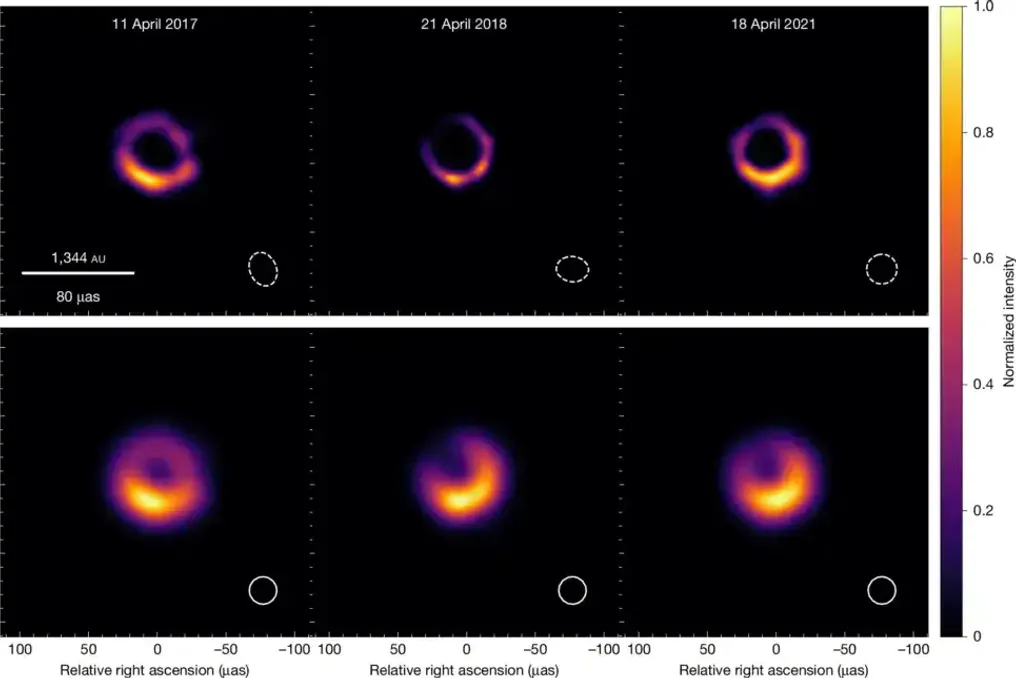
A recent independent analysis of the data used to create the first image of a black hole in 2019 has confirmed the presence of a bright ring-like structure around the dark region. These findings were published on November 11 in the scientific journal Nature.

The study largely aligns with the initial conclusions of the Event Horizon Telescope (EHT), but it leaves open questions regarding the distribution of luminosity and the methods used for image reconstruction.

The international EHT collaboration presented the first image of a black hole shadow in 2019. The recorded structure was a glowing ring around the central dark zone, consistent with Albert Einstein's predictions from general relativity.

To obtain this image, the project combined simultaneous observations from radio telescopes located on different continents. These instruments function as a single virtual telescope with a resolution comparable to an Earth-sized antenna.

Nevertheless, the reconstruction process faces limitations. Since radio telescopes do not cover the entire surface of the planet, gaps in observations arise that must be compensated for using mathematical methods and computational models. The choice of these methods can influence the final result.

It is this aspect that raised doubts about the original image. Starting in 2022, astrophysicist Junichiro Makino from Kobe University in Japan and his colleagues began challenging the EHT's conclusions. By applying one of the methods used by the collaboration, but with different assumptions, the team obtained an image where the radio emissions appeared concentrated in an irregular structure rather than clearly forming a ring.

In response to these discrepancies, Samuel Lai, an astrophysicist from the Australian Centre for Scientific and Industrial Research (CSIRO), and his co-authors developed their own methodologies to re-examine the data. Their results generally matched the data presented by the EHT in 2019.

According to Nithyanandana Thyagarajan, a CSIRO astrophysicist and co-author of the study, different models used to guide the neural network can lead to slightly different reconstructions. He explained: 'Depending on your prior model, you may follow slightly different paths.'

Despite these differences, the researcher noted that the new group also discovered a ring-like structure.

However, Makino continues to question the results obtained. One of the differences noted by the researcher relates to the placement of the brightest points around the central structure, which changes depending on the reconstruction method used. He stated: 'If both methods are mathematically sound, it is difficult to understand why this happens.'

Thus, the new analysis confirms the general existence of a ring-like structure but does not establish definitive confirmation of all image details. The distribution of luminosity remains one of the areas of disagreement among different reconstructions.

US Physicists Simulate Black Hole Using Matter Waves Trapped by Light
Read more
nplus1.ru

US Physicists Simulate Black Hole Using Matter Waves Trapped by Light

Physicists working in the USA have developed a Fabry–Pérot resonator that allows for an exchange of roles between light and matter. Thanks to this experiment, it was possible to record the exponential accumulation of energy around specific trajectories in spacetime.

The researchers found that isolated stationary points corresponding to these trajectories function as horizons for both black and white holes. The experimenters confirmed their observations by comparing them with a theoretical model that considers stroboscopic evolution.

The results obtained may find applications in various fields, including signal compression, multiplexing, and resonator cooling processes. The details of this study were published in the scientific journal Physical Review Letters.

Popular