
Missing the Start Date: How It Affects an Offer and What Are the Rules
Read more
Aaj Tak
www.aajtak.in

Missing the Start Date: How It Affects an Offer and What Are the Rules

Receiving a job offer from a company is an exciting event for any candidate. However, sometimes candidates cannot start work on the specified date due to the need to complete resignation notice with the previous employer, personal issues, or other reasons. In such cases, the question arises: is the job offer letter voided as soon as the start date passes? Can the company refuse to hire?

The answer to this question is not universal and depends significantly on the terms outlined in the job offer letter, as well as the decision of the company itself.

It is not necessarily true that a job offer letter is automatically canceled as soon as the start date expires. First and foremost, the employee should carefully study the conditions regarding the start date that were written in the offer letter. If it clearly states that the offer will be withdrawn or considered invalid if the person does not show up by the established deadline, the company has the right to act based on this condition.

Conversely, if such conditions are not explicitly stated, the candidate should not assume that the job offer has automatically terminated. In this case, it is necessary to contact the company and request permission for a new start date.

To understand job offers and their associated conditions in India, the Indian Contract Act, 1872, is extremely important. According to its Section 5, an offer can be revoked before it is accepted. Furthermore, Section 55 addresses situations where a promise is not fulfilled within the stipulated time. If both parties assumed that adhering to the set deadline was mandatory, the other party may choose to terminate the contract in case of non-compliance with the deadlines.

Nevertheless, the influence of these legal provisions on a specific employment case will depend on the terms of the job offer letter and all the factual circumstances of the case. Therefore, it is incorrect to claim that any company can withdraw a job offer letter in any situation or, conversely, that it will never do so.

If for any reason you cannot start work on the appointed date, it is very important to pay attention to several points. Firstly, do not wait until the start date passes; you must immediately notify HR or the recruitment manager about the difficulties that have arisen. Secondly, the request to extend the start date should be submitted in writing. If necessary, the reason for the delay and relevant documents should be provided. And thirdly, you must obtain written confirmation, as relying only on verbal agreement from HR is not advisable.

Yes, the company may grant the candidate additional time to start work according to its hiring procedure and the terms of the offer letter. However, this is not an automatic right of the candidate. Granting an extension depends on the company's approval and the circumstances of the case. Consequently, the candidate should plan their next steps only after receiving written confirmation of the new date.

Similar stories

Companies are shifting from permanent employees to consultants, which is viewed as an indirect staff reduction
Read more
www.aajtak.in

Companies are shifting from permanent employees to consultants, which is viewed as an indirect staff reduction

For a long time, stable employment was considered a significant career achievement, implying a monthly salary, a set work schedule, employee benefits, and job security within one company. However, this system is undergoing changes.

Although companies still require qualified specialists, they are forming their teams based on specific projects, tasks, and business needs. In addition to permanent staff, consultants, independent professionals, fixed-term employees, and contract workers are being engaged. This does not mean the immediate disappearance of permanent jobs, but the approach to employment and career security is changing.

India's workforce is moving beyond traditional employment.

According to the Economic Survey for 2025-26, the number of gig economy workers in India increased from 7.7 million in the financial year 21 to 12 million in the financial year 25, representing a 55% growth over four years. Gig workers now account for more than 2% of the country's total workforce.

In the Economic Survey, gig work is defined as self-employment performed on a short-term basis, for a specific task or project. This includes a wide range of jobs, from goods delivery to professional services. Although its scope is broader than just consulting companies, its growth demonstrates the increasing number of opportunities outside traditional employment.

A similar trend is observed in organized hiring. According to the India Skills Report 2026, project-based hiring increased by 38% compared to the previous year. This report, prepared by the Confederation of Indian Industry and its partners, examines changing forms of employment, including independent specialists, AI-related roles, and remote work.

This data indicates that companies are increasingly preferring to hire people to complete specific tasks rather than relying solely on long-term traditional positions.

Flexible employment is becoming a new hiring path, raising concerns after contracts end.

These changes are not limited to independent specialists and consultants. Formal flexible employment is also becoming an important part of the employment system in India. According to annual data from the Federation of Indian Personnel for the financial year 26, provided by the India Brand Institute, the formal workforce associated with flexible employment stood at 1.91 million people. In financial year 26, this sector added 1.18 lakh new formal flexible workers, recording an 8% growth in new hiring.

Under flexible employment, companies engage personnel through recruitment agencies to meet their specific needs. This helps manage seasonal demand, quickly scale up teams, and acquire specialized skills without directly including every employee in the permanent payroll.

It is important to understand that flexible employment cannot be equated with independent consulting. Many flexible employees remain employees of recruitment agencies and may receive employment-related benefits.

India's changing workforce includes temporary staff from recruitment agencies, fixed-term employees hired directly, independent consultants providing professional services, and independent specialists completing various projects. All of them may fall outside traditional permanent employment, but the terms of their contracts and legal protection are not always the same.

When the services of fixed-term or project-based workers conclude, it does not always result in announced traditional layoffs. The contract may simply expire by date or not be renewed after the work is completed. For the employee, this can lead to job and income loss, as well as uncertainty about future opportunities.

The distinction between the growth of temporary and project hiring and the absence of layoffs or contract non-renewal is significant. This does not mean that flexible hiring is used exclusively to avoid dismissals, but it can make employee departures less noticeable compared to traditional job cuts.

What is the difference between a permanent employee and an independent consultant?

The main difference between a permanent employee and an independent consultant lies in the nature of their employment relationship. A permanent employee is typically retained without a predetermined end date and works according to company policy. Their employment may include termination notice, internal disciplinary procedures, salary structure, and applicable legal benefits.

A true independent consultant is engaged through a service agreement. This agreement usually defines the scope of work, expected outcomes, professional fee, term, and conditions for terminating the services. A permanent employee has an employment relationship with the organization, whereas a consultant performs professional work under a service contract. Permanent work is usually continuous and has no predetermined end date. Consulting work is typically tied to a specific term, project, or particular duty.

A permanent employee is usually paid a salary every month, while a consultant is paid a professional fee according to the contract. The conditions for terminating a permanent employee's service are determined by the employment contract, company policy, and applicable labor legislation. The conditions for the termination and exit of a consultant are stipulated in the service agreement.

Canadian Professional Finds New Job One Month After Being Laid Off Using Search Strategy
Read more
www.aajtak.in

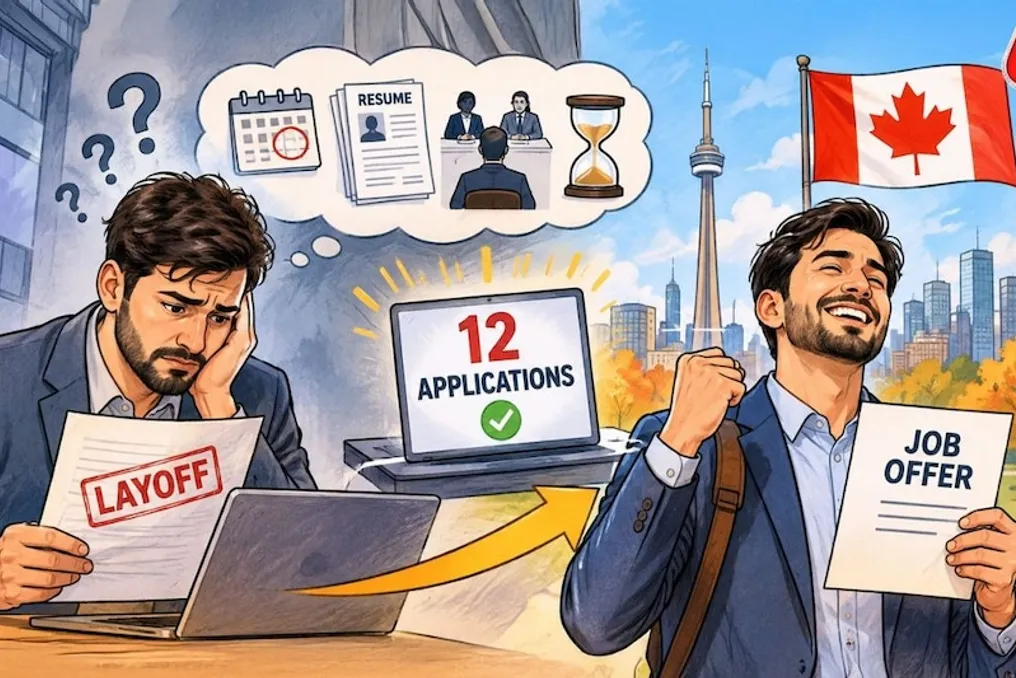
Canadian Professional Finds New Job One Month After Being Laid Off Using Search Strategy

After losing a job, many people wonder about the next steps, when the next opportunity will arise, how many resumes to send, and how long the job search will take. However, the story of one specialist living in Canada showed a different scenario: he lost his job due to layoffs in September but received a new job offer in October.

In his post, he shared that instead of applying to hundreds of vacancies, he focused on only 12 companies. The specialist told the Reddit platform that he was a victim of layoffs in September and then started looking for a new job in October, receiving an offer after about three and a half weeks.

He specified that he worked in the SaaS (Software-as-a-Service) sector in Canada in a product-related position. With seven years of product experience and ten years of total experience, he applied to only 12 companies. Among them, he passed three interviews and ultimately accepted an offer from one of the firms.

From sending the first application to signing the offer, about three and a half weeks passed. He noted that his total compensation was around 1.8 million Canadian dollars, emphasizing that this amount cannot be directly compared to the monthly salary in Indian rupees.

The main question raised by readers was how he managed to find a job in just three weeks. Regarding this, the specialist explained that a simple portfolio helped him greatly. He selected 1-3 most important projects from his work and included them in the portfolio, demonstrating his role in problem understanding, strategy development, and achieving results.

He mentioned that creating such a portfolio was easier thanks to the help of artificial intelligence, and he hosted it on GitHub Pages. Although he believes not every recruiter will view the entire portfolio, he thinks it can make a candidate stand out among other applicants in the eyes of the hiring manager or recruiter. He also advised attaching a link to the relevant part of the portfolio to the resume.

During the job search, he actively used AI tools such as ChatGPT and Grok. With their help, he filtered vacancies, adapted applications for each role, and prepared for interviews. To do this, he gathered information about his skills, old resumes, work experience, and writing style in one place. Additionally, he kept a separate document where he recorded lessons learned after each application, interview, or rejection, which helped him improve subsequent submissions.

Nevertheless, he warned that it is crucial to independently verify content created by AI, and one should not blindly trust its suggestions without thorough analysis.

This specialist emphasized that he did not apply for every available vacancy, but only for positions where his experience and skills were most relevant. He sent only 12 applications, but each one was carefully tailored to the specific vacancy. He also reported that all three interview invitations came as cold applications, meaning he applied to companies where he had no prior contacts or recommendations. Furthermore, in three instances where he received recommendations, he was not even called for the first round of interviews.

In conclusion, the professional honestly stated that his personal experience does not guarantee the same result for everyone. Many factors influence success in the job search, including experience, industry, position, skills, and the current labor market situation. Thus, while the sheer number of applications is not a guarantee of success, his story shows that the quality of applications, having a portfolio, and lessons learned from each interview can be very useful.

Company offers top employees the opportunity to leave and start their own business with the option to return
Read more
www.aajtak.in

Company offers top employees the opportunity to leave and start their own business with the option to return

While most companies strive to retain their most valuable employees, one company in Bangalore has chosen a different approach: it encourages its workers to leave their jobs to launch their own businesses, offering them the possibility of returning.

Amid growing anxiety about layoffs and downsizing in new ventures, the company iD Fresh Food in Bangalore has implemented a unique initiative. Instead of retaining good employees, the company motivates them to establish their own businesses. To facilitate this, it provides financial support, mentorship, and access to its business network.

A special feature of this policy is that if an employee's startup proves unsuccessful, they retain the right to return to the company. The company's Global CEO, Mustafa P., announced this new entrepreneurial policy via a LinkedIn post. He emphasized that employees should not be forced to choose between realizing their dreams and ensuring financial stability.

iD Fresh Food is not just encouraging staff to create their own ventures; the company provides a range of resources to support this endeavor. Under this policy, employees wishing to start their own business will receive three types of assistance:

Firstly, they will be given access to the entire company ecosystem and its partner network. Secondly, the company's management team will provide guidance during the launch and development of the business. Thirdly, employees can take paid leave for a certain period to work on their business ideas in the initial stages.

The most significant aspect is the option to return. If an employee's business does not succeed or they decide to work for hire again, they retain the opportunity to come back to iD Fresh. This reduces the fear of complete financial loss when attempting to start a business while providing a chance for their own enterprise.

This initiative is linked to the personal experience of CEO Mustafa P. He shared in his LinkedIn post that iD Fresh started from a small kitchen in Bangalore. At the time, they only had a starting capital of 50,000 rupees, and the path forward was not easy. Mustafa noted that many mistakes were made in the early stages of the business; he experienced sleepless nights and faced uncertainty. However, some people believed in his idea even when he himself was not entirely sure of its success, and he still does not forget that help. Now, he wants to pass on this trust and support to his employees so they too can realize their business dreams.

Mustafa admitted that watching some of the company's best employees leave is not easy. Nevertheless, he is glad that they are achieving something new independently and making a significant contribution to society. He believes that an employee's decision to start their own business should not be viewed solely as a loss for the company; if it becomes successful, it brings pride.

Mustafa P. is a co-founder and Global CEO of iD Fresh Food. He founded the company with his cousins in 2005. Before becoming an entrepreneur, he worked in multinational corporations and is a graduate of NIT Calicut and IIM Bangalore.

The company's decision is attracting public attention because, in an era of increasing artificial intelligence usage, many large companies are conducting staff reductions. While this option provides relief to employees, it also helps them realize their dreams.

Popular