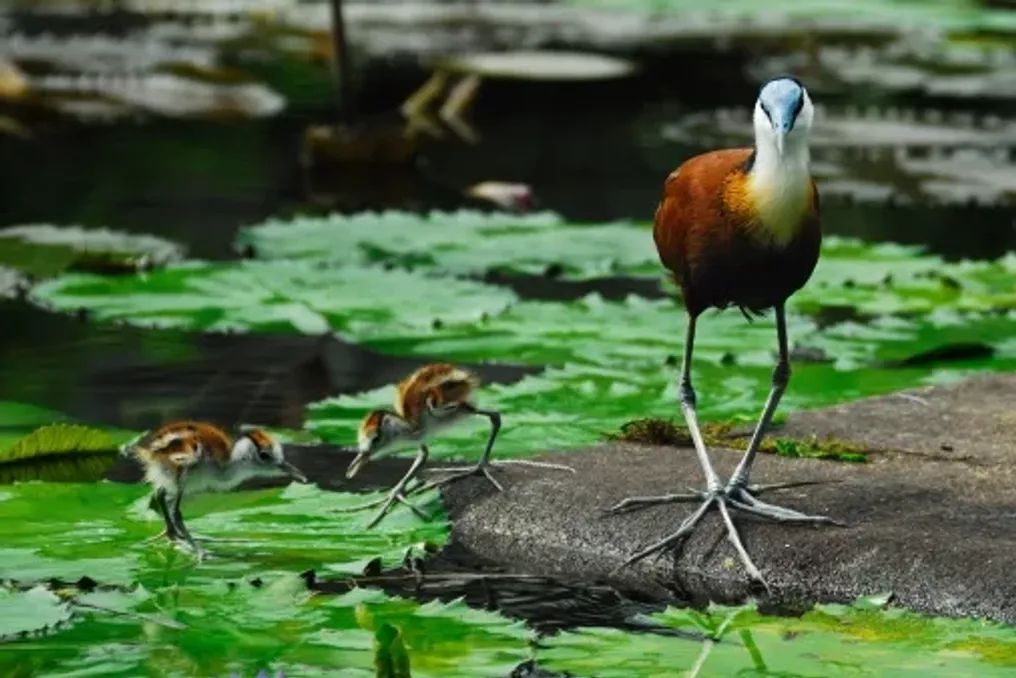
On the surface of African wetlands, where green lilies, reeds, and floating vegetation form a mosaic, an unusual family scene sometimes unfolds. The male African jacana carefully moves across the aquatic plants, balancing on its large foot, while several tiny chicks peek out from under its wings.
This sight seems almost incredible, but for the African jacana, it is part of daily life. A reversal of parental roles occurs, which is usually associated with other birds: the male takes on the responsibility of incubating eggs, protecting hatched chicks, and accompanying the young in the early stages of life.
The African jacana (Actophilornis africanus) is one of the most amazing waterbirds on the continent. Its appeal is due not only to its appearance and remarkable feet but also to its breeding system, where females mate with multiple males, and fathers bear a significant part of the responsibility for raising the next generation.
This distinctive waterbird is found in many parts of sub-Saharan Africa, especially in freshwater wetlands with shallow water and abundant aquatic vegetation. It inhabits swamps, lakes, ponds, coastal waters of rivers, and other wetland environments where floating plants provide both food and nesting sites.
Often called the 'lily-throated' bird, the species is well-adapted to life on water. Its body is brownish-chestnut colored, the head and neck are dark, the beak is bright yellow, and the facial shield is blue, which aids in identification. However, the most striking physical feature is its legs.
The jacana's long toes and slender claws help distribute weight over floating vegetation. Instead of sinking into the soft, unstable surface of water lilies and aquatic plants, it can move easily across them, foraging in the wetland area.
This adaptation is particularly useful in habitats where extensive mats of floating vegetation form a cover. Jacanas can feed in areas inaccessible to other waterbirds, searching for insects, small aquatic invertebrates, mollusks, and seeds among the leaves and stems of the plants.
The unusual parental behavior in the African jacana begins with its breeding system. Unlike many bird species where males compete for females and females bear the primary responsibility for offspring, jacanas follow a polyandrous type. This means a female can mate with several males during the breeding season. She can lay separate clutches for different partners, and each male then takes responsibility for incubating his eggs and caring for the chicks.
Female African jacanas are generally larger than males, which is an example of reverse sexual dimorphism in size. Their size and behavior are linked to a breeding system where females compete for access to territories containing multiple males. Males occupy and defend smaller nesting territories within a broader territory controlled by the female. After mating and laying a clutch, the female may move to another male, while her previous partner remains responsible for the eggs and, if they hatch, for the young.
Polyandry is relatively rare among birds, making the jacana's reproductive strategy particularly interesting for researchers studying sexual selection, parental care, and the evolution of mating behavior. Studies conducted in KwaZulu-Natal have examined the species' polyandrous behavior, nesting ecology, food resources, and social organization.
After egg-laying, the male's work begins. The nest is usually a simple, often partially submerged platform made of aquatic vegetation, located among the floating plants. It may look quite fragile, but its position helps hide the eggs among the leaves and stems of the wetland.
The female departs after laying, and the male takes on the incubation duties. He spends a lot of time maintaining the warmth of the eggs, although he may occasionally leave the nest to forage. The incubation period is typically around 24 days.
The jacana's incubation behavior is adapted to its aquatic environment. The nest can be wet, subject to temperature changes, and vulnerable to predators. The male uses his body to keep the eggs warm and may hide them under his wings if necessary. He also defends his nesting territory, especially against other birds that approach too closely. For a nest situated in a precarious spot among floating vegetation, vigilance can be as important as incubation itself.
Few wild sights are as memorable as the male African jacana carrying its chicks under its wings. When danger arises, the father gathers the young to him, lifting them under his wings while continuing to move across the wetlands. The chicks' little feet may dangle beneath his feathers, creating one of the most unusual examples of parental transport in the bird world. This is a practical adaptation allowing the male to move his offspring away from danger, keeping them close and protected.
Although the male provides close protection, African jacana chicks are precocial. They are able to leave the nest shortly after hatching and begin feeding independently, rather than relying on parents to bring them food. Nevertheless, the father remains crucial. He guides them to feeding areas, watches for predators, shields them when it is cold or damp, and provides a safe place to shelter when danger appears.
Young jacanas know how to swim and dive, giving them another way to avoid threats. As they grow older, they gradually become less dependent on their father, eventually developing the ability to fly and sustain themselves.
The jacana's breeding system serves as a reminder that nature does not follow a single plan for raising offspring. In an environment where food can be abundant on extensive floating vegetation, the female's ability to produce multiple clutches with different males can become part of a reproductive strategy that allows for more offspring to be raised. This system also highlights how parental care can evolve differently between sexes. In African jacanas, the beneficial care required during incubation and in the vulnerable early stages of chick development is provided by the males, while the females can dedicate their reproductive efforts to laying additional clutches.
This scheme is not without risks. Floating nests are susceptible to flooding, predators, and changing wetland conditions. Studies on the nesting ecology of the African jacana have investigated how habitat conditions, vegetation, and food availability influence nesting site selection and reproductive success.
The African jacana is widely distributed across sub-Saharan Africa and is currently classified as a least concerning species. However, its dependence on freshwater wetlands makes the health of these habitats vital for its continued survival. Wetlands provide the floating vegetation on which jacanas feed, build nests, and raise their young. They also support immense biodiversity, from fish and amphibians to insects and waterbirds. When wetlands degrade, are drained, or altered, the ecological conditions supporting these species can change drastically.
For the jacana, a healthy wetland is not just a food source. It is the setting for the entire reproductive strategy, where floating leaves become feeding grounds, nesting platforms, and sometimes, temporary nurseries for the father.
The next time you see a jacana stepping on a lily, its long toes delicately balancing over the water, take a closer look. Somewhere under those feathers, the father might be carrying the next generation of wetland wanderers.