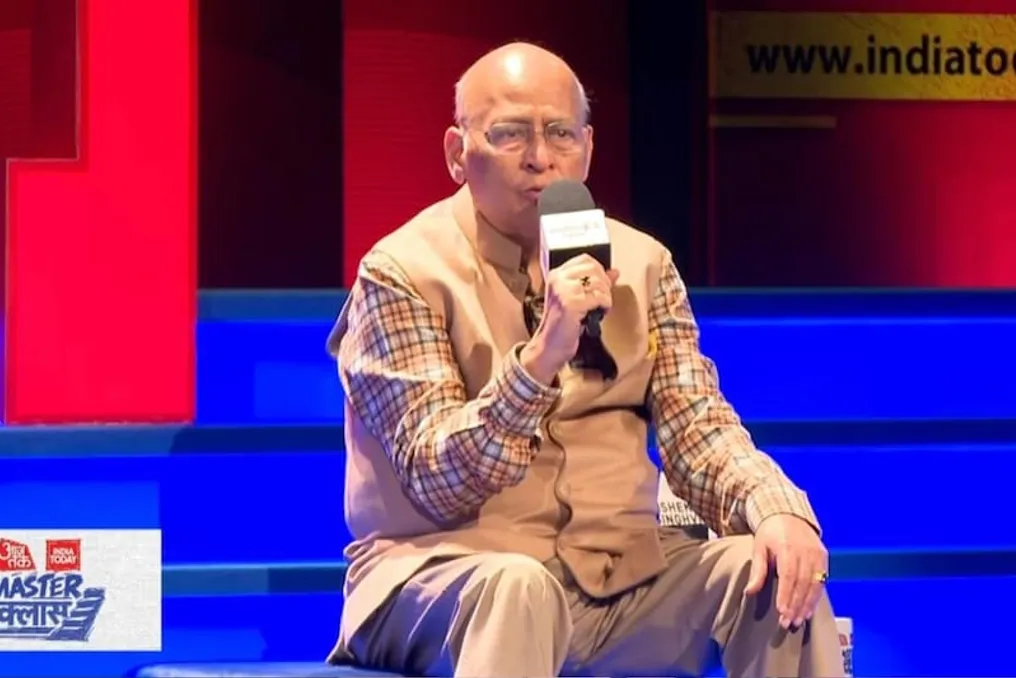
Amid the growing influence of artificial intelligence (AI) in the legal field and the advantages gained from 'nepotism' in legal families, senior Supreme Court advocate and five-time Rajya Sabha MP Rajya Sabha Singhvi shared his perspective on building a successful career in this profession with young students and lawyers. He emphasized that he was not there to lecture but to share his experience, noting that youth often dislikes moralizing.
Despite this, he highly praised the technical awareness of the current generation, observing that they have access to resources that previous generations could only imagine.
Speaking about the main principle of success in the legal field, Dr. Singhvi stated that constant hard work and patience are indispensable. He believes that success in advocacy depends 99 percent on diligent effort and only 1 percent on motivation, stressing that hard work is the most crucial aspect in this field.
Dr. Singhvi gave balanced and practical advice regarding the increasing use of AI in legal practice. He expressed full support for the technology but warned against allowing it to become the master. Specifically cautioning young lawyers, he stated that he does not support the use of AI for drafting legal documents because it prevents them from learning anything. He strongly recommended that lawyers draft documents independently during their first five years of career.
Singhvi also noted that society's attitude towards the legal profession has changed over time: if previously it was considered a last resort, today it has become the first choice for students. He highlighted the increase in women's participation in advocacy, noting that while there were very few before, they are now demonstrating outstanding results.
He openly discussed the initial advantages that lawyers from legal families can gain. While acknowledging that family background can provide a starting platform, he clarified that true recognition is achieved only through work and experience. According to him, after one or two cases, all lawyers end up on the same level, and ultimately, experience speaks. Furthermore, he added that this advantage of family origin is gradually weakening.
Discussing ethics and the role of an advocate, Dr. Singhvi stressed that lawyers should have no prejudices against their clients, as life and law are rarely black and white. He stated that an advocate should neither choose nor judge their client, because life is 'grey' (composed of mixed circumstances), not black and white, and that is precisely why advocates exist. Nevertheless, he also mentioned that he declined some cases if he felt he could not substantiate his position in court.
When asked about sources of inspiration, Dr. Singhvi recalled his father, who was himself an advocate and a Sanskrit scholar. He said that every era has its icons, and the standards of Mahatma Gandhi's time differed from today's. He saw his father as a source of inspiration, noting his multifaceted nature, and admitted that he himself is not equal to even half of his father's abilities. He also advised the youth to read biographies of great people, as they provide direction and inspiration for life.
Speaking about his busy schedule, he reported constantly finding a balance between advocacy, politics, media engagement, and studies. He starts the day with a walk and reading newspapers, and then around one o'clock, participates in parliamentary sessions and debates. He also shared that he always wanted to be a professor and still attends university lectures when he has time.