
Chicken Licken aims to conquer world record title by building the largest rubber sphere
Read more
10and5
10and5.com

Chicken Licken aims to conquer world record title by building the largest rubber sphere

The South African company Chicken Licken is once again entering the global arena, this time using not balls or medals, but a large quantity of rubber bands. The company has taken on an ambitious mission—to set a Guinness World Record by creating the largest rubber sphere.

The story of this endeavor is told through the lens of the 'Rubber Band Man' himself—South African comedian, actor, and announcer Tyson Ngubeni, who spent several weeks training, building, and mobilizing the nation, collecting rubber bands one by one.

The attempt will culminate in an official weighing on December 6th at the Fourways Mall shopping center, where Guinness World Records judges will verify whether the Chicken Licken Rubber Sphere meets the requirements for the title. To qualify as a record holder, the structure must exceed the current figure of 5,251.69 kg, which is more than five tons.

Chicken Licken, known for turning ordinary moments of South African life into unforgettable events, is utilizing one of its most recognizable elements, transforming it into a national moment. A simple rubber band, a small but strong thing that holds food together, is now at the center of the record-setting attempt.

Holisa Dyeshaana, Creative Director at Joe Public, notes: 'The Chicken Licken rubber band is part of South African pop culture. It holds our dishes together, and now it can help hold a world record.' He added: 'We didn't just want to make an advertisement about a big rubber sphere; we wanted to build it for real. This is a South African invention in its most entertaining and surprisingly unexpected form. We are carrying the hopes of the nation, one rubber band at a time.'

Residents of South Africa are invited to donate their rubber bands and participate to support the Rubber Band Man and demonstrate Mzansi's potential when they unite.

To take part in the contest, one must purchase any Chicken Licken meal at a store, then place the receipt and rubber bands in a special participation box. The contest runs until November 30, 2026, and participants can help South Africa in its pursuit of a world record, with a chance to win 100,000 Rand in cash.

Similar stories

The origin of the rubber duck: from early toys to cultural icon
Read more
super.abril.com.br

The origin of the rubber duck: from early toys to cultural icon

Rubber toys began to appear in the mid-19th century, shortly after Charles Goodyear invented vulcanization in 1839. This process made natural rubber more resistant and elastic, enabling its large-scale industrial use.

However, the initial models of these toys were heavy, very different from the floating ducks known today. At that time, they were not marketed as bath companions but rather as teething toys for babies and dogs.

In the 1930s, the company Seiberling Latex began producing a line of licensed Disney rubber figures, including some of Donald Duck. However, Seiberling was not the only one; there were already various duck-shaped toys on the market, and there is a museum in Canada that exhibits some of them.

The first documented batch of yellow rubber ducks appeared in 1948, created by Lam Leung-tim, a Hong Kong businessman, according to the South China Morning Post.

The following year, Peter Ganine, an American artist, registered a patent for a toy resembling the modern rubber duck: it was small, flexible, buoyant, and had a friendly face. Millions of these units were sold.

It is important to note that although popularly called a 'rubber duck,' Ganine's toy, like many subsequent ones, was made of plastic, specifically vinyl.

The duck only consolidated as a symbol in popular culture years later, thanks to a Sesame Street song released in 1970. Written by Jeff Moss, the song 'Rubber Duckie' is sung by the character Ernie, who describes his rubber duck as his best friend during bath time.

The song's success was notable, as in September 1970 it reached the 16th position on Billboard's Top 100, the weekly chart of most played songs in the United States, and was also a hit in other English-speaking countries.

Badgermans set two world records in Slovenia using a catapult
Read more
uzdaily.uz

Badgermans set two world records in Slovenia using a catapult

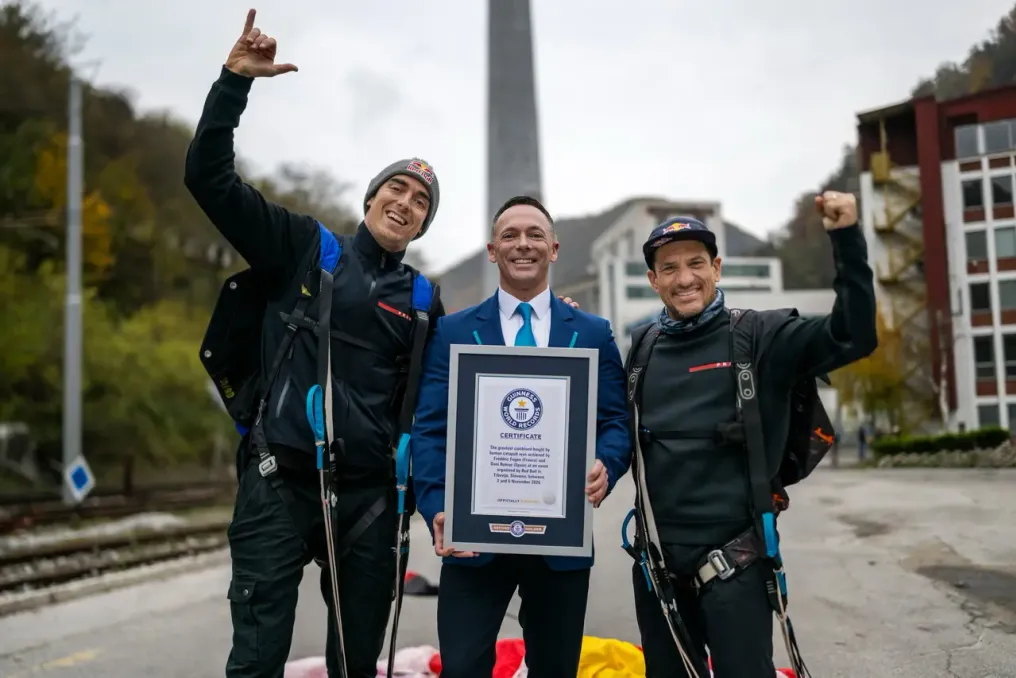
Badgermans Dani Roman and Fred Fugen have set two Guinness World Records after launching from a 60-meter catapult within a 360-meter tube in Slovenia, as reported by Red Bull. This project was named Red Bull Human Catapult.

On November 5, 2026, the athletes accelerated from zero to a speed of 180 km/h in just 2.15 seconds. After exiting the launch capsule, they continued moving vertically upwards, reached maximum altitude, and then began freefall.

Both athletes successfully deployed their parachutes and made a safe landing.

The structure was specially designed by Slovenian acrobats and engineers from DD Squad. The system was based on a two-ton multi-spring mechanism equipped with a launch device.

During acceleration, the athletes experienced G-forces up to 4.2G. Upon reaching the highest point of the trajectory, they briefly felt weightlessness before beginning the freefall.

Dani Roman, 35, stated that the athletes were inside the capsule before the start and waited for the countdown to finish. Five seconds before the start, he took a deep breath and tensed his muscles. He described the ascent as an unusual sensation, during which the surrounding environment seemed to slow down momentarily, after which the rate of fall began to increase again.

Fred Fugen, 47, noted that a launch of this scale represents a step into uncharted territory for the team. The athletes had to rely on their accumulated experience, as it was impossible to fully prepare for such a jump through training alone.

The idea for the Red Bull Human Catapult project was inspired by the Ultimate Aerial Obstacle Course project. Creating a new mechanical launching system for badging required two and a half years of work.

Initially, the team tested a smaller catapult over water, and later used six-meter systems for the Ultimate Aerial Obstacle Course. The next stage was testing a 12-meter catapult in Sass Pordoi, Italy, where the athletes experienced an acceleration of about 4G. These tests were aimed at preparing for the final launch acceleration.

For the Slovenian project, the system was scaled up to 60 meters and adapted for vertical launches. Construction inside the tube in Trbovlje took about two months.

Gaspar Novak, CEO of DD Squad, reported that the team worked at the site six days a week for approximately 14 hours a day. He added that project members even spent one night at the top of the tube during construction.

The main engineering challenge was ensuring the necessary launch power while maintaining a maximally controlled process, which was critical for athlete safety.

Roman and Fugen have participated in other extreme sports projects. In June 2026, they joined seven wing-suit pilots in an attempt to set a record for the longest group flight over Mont Blanc.

For participation in the Red Bull Human Catapult, the athletes were equipped with Prada Linea Rossa, which provided them with technical clothing, footwear, and protective goggles.

Popular