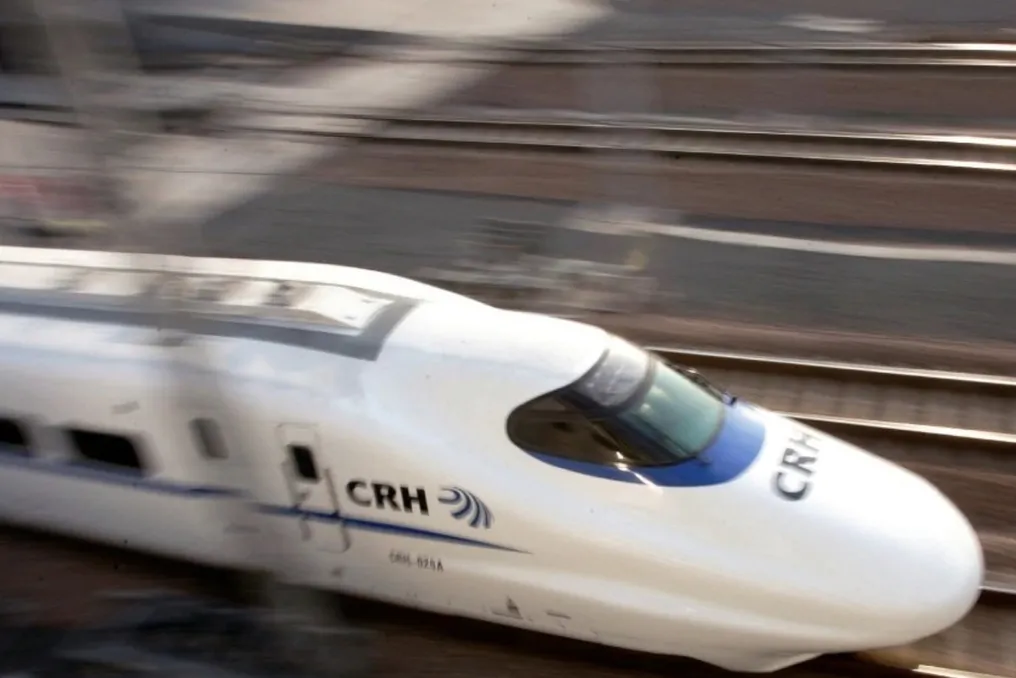
India's first bullet train ready for tests at 280 km/h; Transport Minister announces first test timeline
Read more
Aaj Tak
www.aajtak.in

India's first bullet train ready for tests at 280 km/h; Transport Minister announces first test timeline

Preparations for the launch of India's first bullet train have intensified. This high-speed train is set to appear on the corridor between Mumbai and Ahmedabad next year. The launch will be phased, with an estimated start date of August 15, 2027. Transport Minister Ashwini Vaishnaw provided the latest details regarding the testing.

The Mumbai-Ahmedabad high-speed rail project is moving towards its goals, and the first bullet train is nearly ready for its initial test run. On this 508-kilometer high-speed rail corridor, the train will initially operate on the Surat-Bilimora section. According to the Transport Minister, the train test could take place in May 2027.

On Monday, Ashwini Vaishnaw stated that electrification work on the 50-kilometer Surat-Bilimora section has been completed. Electrification of this section was carried out on November 20, marking a significant achievement in the bullet train project. The 2x25 kV traction power system is used in this sector. It is expected that signaling work on this section will be finished in January 2027, after which the first bullet train tests will follow.

The test of India's first bullet train, model B-28, is scheduled for May, and it will travel on the high-speed track at a speed of 280 kilometers per hour. The Transport Minister noted that this train successfully passed a compression test, enduring atmospheric pressure that was twice the expected level.

As previously mentioned, the first bullet train project covers the Mumbai-Ahmedabad route, which is 508 kilometers long. It will open in phases, with the first phase planned for opening next year. Union Transport Minister Ashwini Vaishnaw reported that the Ahmedabad-Vapi section is likely to be ready by the end of 2027, and the high-speed train itself is expected to arrive at the bullet train station in Thane, Mumbai, by 2029.

When the bullet train operates at full speed, its speed will reach 320 kilometers per hour, but on average between Ahmedabad and Mumbai, the train will travel at about 300 kilometers per hour starting next year. The 508 km Mumbai-Ahmedabad corridor passes through the states of Maharashtra, Gujarat, and Dadra and Nagar Haveli and includes 12 major stops. These stations include Mumbai (BKC), Thane, Virar, Boisar, Vapi, Bilimora, Surat, Bharuch, Vadodara, Anand, Ahmedabad, and Sabarmati.
Similar stories

Transport Minister provides update on India's first high-speed railway: launch timelines and progress
Read more
www.aajtak.in

Transport Minister provides update on India's first high-speed railway: launch timelines and progress

Transport Minister Ashwini Vaishnaw once again provided an update regarding the country's first high-speed rail service. He announced on Friday that this service will begin operating in the last quarter of 2027, with its initial section running between Surat and Vapi. Furthermore, it was clarified that the entire corridor up to Mumbai will be opened in phases.

Regarding the current construction status, the minister noted that work on 456 kilometers of pillars has been completed by September, and 371 kilometers of viaduct have been erected. Additionally, 600,000 noise barriers have been installed on a 299-kilometer stretch, and 9,300 overhead line support poles (OHE) have been mounted on 206 kilometers of viaduct.

The minister added that excavation work for four mountain tunnels has been completed. Specifically, 5 kilometers out of the 21-kilometer Maharashtra tunnel has been bored using a mountain tunneling system. Moreover, civil works at 8 stations are finished, and final architectural finishing is ongoing. Active work is underway at three maintenance depots—Sabarmati, Surat, and Thane.

Providing details on the underwater tunnel construction, Vaishnaw mentioned that this corridor passes through the 21-kilometer tunnel in Maharashtra, with 7 kilometers of this section crossing the sea via Thane Creek. Two tunnel boring machines were commissioned in Vikroli and Savli in July 2026.

These machines are among the largest ever deployed in India. They reach the height of a multi-story building, and each machine weighs over 3000 tons, equivalent to approximately 500 Asian elephants. Each machine is 96 meters long, comparable to five cricket fields placed end-to-end.

Concerning the production of the country's first high-speed trains, the minister stated that ICF and BEML are manufacturing indigenous B28 sets designed for a speed of 280 km/h. The first coach is ready, and structural testing is currently being conducted. Track testing is expected by mid-2027. The next step is the development of the faster B35 train, designed for a speed of 350 km/h.

Power supply begins on the high-speed track of India's first high-speed railway
Read more
www.aajtak.in

Power supply begins on the high-speed track of India's first high-speed railway

Preparations for the launch of high-speed trains in India are proceeding at an accelerated pace, with expectations that people will be able to travel on the first high-speed train on the Mumbai-Ahmedabad corridor in 2027. November 20th (Friday) is considered an important and historic day for India, as power supply will be switched on for the first high-speed train section between Surat and Bilimora.

This marks a significant achievement on the path to operating the high-speed train on the track. According to information published by the National High Speed Rail Corporation (NHSRCL) on the social network Twitter (now X), the first 50 kilometers of the section between Surat and Bilimora in the Mumbai-Ahmedabad corridor will receive power through the Overhead Equipment (OHE) system.

This railway corridor is equipped with an advanced 2 x 25 kV traction power supply system, which includes both overhead and under-track lines on an elevated platform. Within the entire 508-kilometer corridor, 14 Traction Substation (TSS) units are planned, nine located in Gujarat and five in Maharashtra. These substations will receive energy from the main grid and supply it to the overhead power system at designated points.

The electrical network of the high-speed corridor will be monitored via a centralized control center. Furthermore, the railway has issued a special warning to the general public, especially residents and passersby near this section, as well as to workers engaged in construction and living near the trajectory, strongly advising them not to approach or touch the overhead electrical equipment.

When the high-speed train operates at full capacity, its speed will reach 320 kilometers per hour; however, the average speed between Ahmedabad and Mumbai is expected to be around 300 kilometers per hour starting next year. The 508 km Mumbai-Ahmedabad corridor passes through the states of Maharashtra, Gujarat, and Dadra and Nagar Haveli, and it has 12 major stops planned. These include Mumbai (BKC), Thane, Virar, Boisar, Vapi, Bilimora, Surat, Bharuch, Vadodara, Anand, Ahmedabad, and Sabarmati.

The Compound Catenary System plays a key role in achieving the 320 km/h speed, as it is being implemented for the first time on a high-speed railway corridor in India. This advanced railway electrification system involves installing an additional auxiliary wire between the main contact wire and the contact wire, allowing high-speed trains to receive constant and stable power.

India's First High-Speed Train: Bullet Train Construction Progress, Including Underwater Tunnels and Underground Stations
Read more
www.aajtak.in

India's First High-Speed Train: Bullet Train Construction Progress, Including Underwater Tunnels and Underground Stations

The construction of India's first bullet train is nearing completion, and the wait for this event is gradually shortening. The Indian Railways is scheduled to begin operations in August 2027 on the Vapi-Surat section of the Mumbai-Ahmedabad high-speed rail corridor. Work is proceeding at an accelerated pace, and the Prime Minister personally visited the site to assess the progress of the tasks.

The bullet train project will incorporate Japanese Shinkansen technology into the Indian Railways and will operate on the 508-kilometer Mumbai-Ahmedabad corridor. Initial service is planned for the Surat-Vapi section. Recently, Prime Minister N. Modi inspected the nearly complete Surat Bullet Train station.

The National High Speed Rail Corporation (NHSRCL) published a video on the X platform (formerly Twitter) showcasing the latest achievements of the bullet train project. This video shows how passengers will move between stations through underground terminals, utilizing tunnels laid under the sea and bridges over the Sabarmati River.

In the viral video, the railway described the work on this route as 'unstoppable progress.' The video reflects the construction of tracks laid by mountain excavation, the erection of deep underground railway stations, and other infrastructure works, including bridges.

An underground station is being built in the Bandra-Kurla Complex (BKC) area of Mumbai on the Mumbai-Ahmedabad high-speed corridor, located approximately 100 feet below ground level. This depth exceeds the height of a ten-story building. A single underground point is being created in the heart of Mumbai's business district, which represents a significant engineering achievement.

Several kilometers from the Bandra-Kurla station, a 3200-ton machine is working to form India's first underwater railway tunnel, cutting through the rock under Thane Creek. The bullet train will travel at high speed through this tunnel. This section of the corridor in Maharashtra passes through a 21 km tunnel, with 7 km of it being underwater, making it India's first underwater railway tunnel.

The railway has completed the construction of a bullet train bridge over the Sabarmati River, which is 12 stories high. NHSRCL previously reported this milestone, specifying that the construction of a 480-meter long and 36-meter high bridge for the Mumbai-Ahmedabad project is finished. This bridge, reaching a height of about 118 feet, equivalent to a 12-story building, is one of the key parts of the Mumbai-Ahmedabad corridor's infrastructure.

At full speed, the bullet train will reach a speed of 320 kilometers per hour, and between Ahmedabad and Mumbai, it will travel at an average speed of 300 kilometers per hour starting next year. The 508 km Mumbai-Ahmedabad corridor covers the states of Maharashtra, Gujarat, and Dadra and Nagar Haveli, and includes 12 major stops. These stops include Mumbai (BKC), Thane, Virar, Boisar, Vapi, Bilimora, Surat, Bhuchar, Vadodara, Anand, Ahmedabad, and Sabarmati.

Popular