Texas Woman Turns Facial Surgery Bones into Jewelry
Read more
Aaj Tak
www.aajtak.in

Texas Woman Turns Facial Surgery Bones into Jewelry

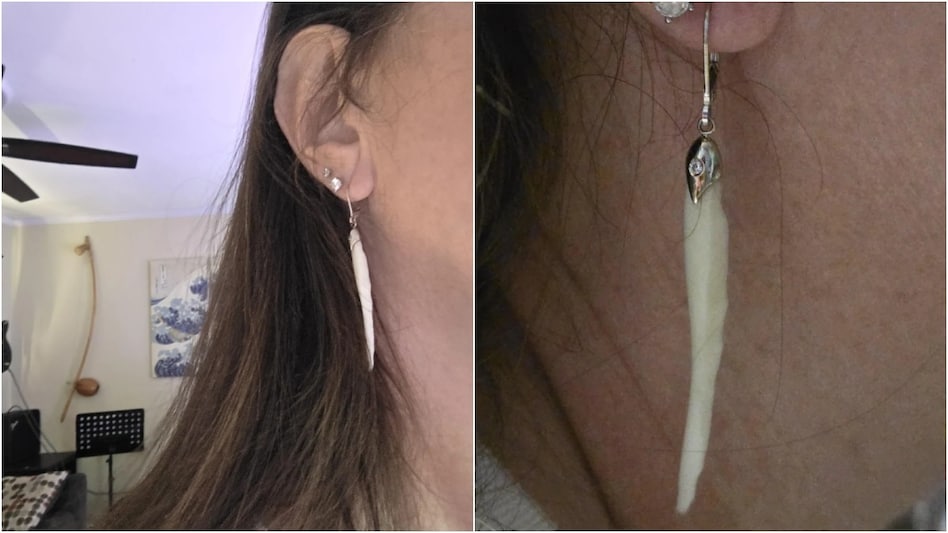
A resident of Texas in the USA found an unusual way to preserve bones extracted during a surgical operation. At the age of forty, a woman named Aubrey turned small bone fragments removed during facial surgery into custom-made earrings.

These earrings, made of white gold and zirconia, are not just an ornament for her but a special reminder of her life and self-identity. Aubrey shared photos of these earrings on social media.

She recounted that earlier this year, during a facial feminization surgery, doctors allowed her to keep small pieces of bone that were taken from her face. After that, Aubrey began searching on Reddit for an artist who could transform these bones into jewelry. Ultimately, she managed to find a custom jeweler who brought her idea to life.

Aubrey is a transgender woman, and the facial feminization surgery was part of her transition process. Speaking about her life in an interview with Newsweek, she mentioned that she had always felt different from others but couldn't accept her transgender identity for a long time. Later, she decided to acknowledge her identity to herself and loved ones.

Facial Feminization Surgery (FFS) involves changes to the bone and soft tissues of the face to give it more feminine features. During the surgery, Aubrey preserved bone fragments from different parts of her face. FFS can alter various areas of the face, including the bones of the nose, jaw, and chin.

Possible procedures include reducing or reshaping the prominent forehead bone, as well as advancing the hairline to create a smaller forehead. The Brow lift procedure is used to change the shape and position of eyebrows. Additional tissues or skin around the eyes can be modified with eyelid surgery. The width, bridge, tip, and overall size of the nose are also changed. Fat grafts or implants may be used to give the cheeks a more convex or rounded shape.

Aubrey's custom earrings contain bone fragments extracted during the operation and are set in white gold with small zirconia stones. She reported that she still has other bone fragments and plans to create a necklace from them in the future.

For Aubrey, these earrings mean more than just attracting attention; she views them as a symbol of her transition and acceptance of her identity. People who saw these unique earrings expressed their amazement, and Aubrey noted that many called them some of the most stunning and original things they had ever seen.
Similar stories

French scientists have developed artificial skin ready for transplantation
Read more
noticiasaominuto.com

French scientists have developed artificial skin ready for transplantation

Several state and private organizations in France, including the wound dressing specialist Urgo, announced on Friday the creation of artificial skin intended for transplantation in their laboratory. However, this experience still requires confirmation through clinical trials.

Guirec Le Lus, president of the Urgo group, which specializes in wound healing, emphasized that 'for the first time in the world we have been able to create artificial skin ready for transplantation in a laboratory.'

This technological breakthrough was achieved in collaboration with partners gathered in a consortium that includes CNRS, Université Lyon 1, the Stem Cell Research Center, the French Blood Institution, and Dassault Systèmes. According to Le Lus, this could be the beginning of a 'medical revolution.'

The long-term goal is to provide surgeons with pre-made artificial skin without the need to take cells from the patient themselves. This skin will be stored at a temperature of -150 degrees Celsius (°C) and will be ready for immediate use in the operating room after thawing for patients with severe injuries, such as victims of extensive burns.

The consortium stated in its announcement that 'after thawing, the cells remain alive and functional.'

Currently, the most frequently used surgical method is autotransplantation, which involves removing healthy skin from the patient themselves and then applying it to burned areas. The technology they implemented is based on 'using universal cells trained to perform the expected role in the skin, as happens in reality,' and then 'organizing' these cells in three dimensions to 'reproduce the structure of real skin,' Le Lus clarified.

At this stage, the teams are capable of producing 'about a hundred units' of this skin, which is the result of five years of research. This '100% French breakthrough' paves the way for clinical trials planned 'starting in 2030' at EFS pharmaceutical facilities, as well as 'transitioning to industrial scale for commercialization around 2040,' according to the statement.

Urgo, which is now part of a group of about ten global companies with its own 'cell bank' for artificial skin, plans to establish the necessary industrial base for large-scale production 'after completing this first clinical trial, around 2032.' Furthermore, models of artificial skin are already used worldwide for research purposes, for example, as an alternative to certain animal testing, including cosmetic product testing.

After brain surgery, a man developed visual distortions mimicking feline facial features
Read more
www.aajtak.in

After brain surgery, a man developed visual distortions mimicking feline facial features

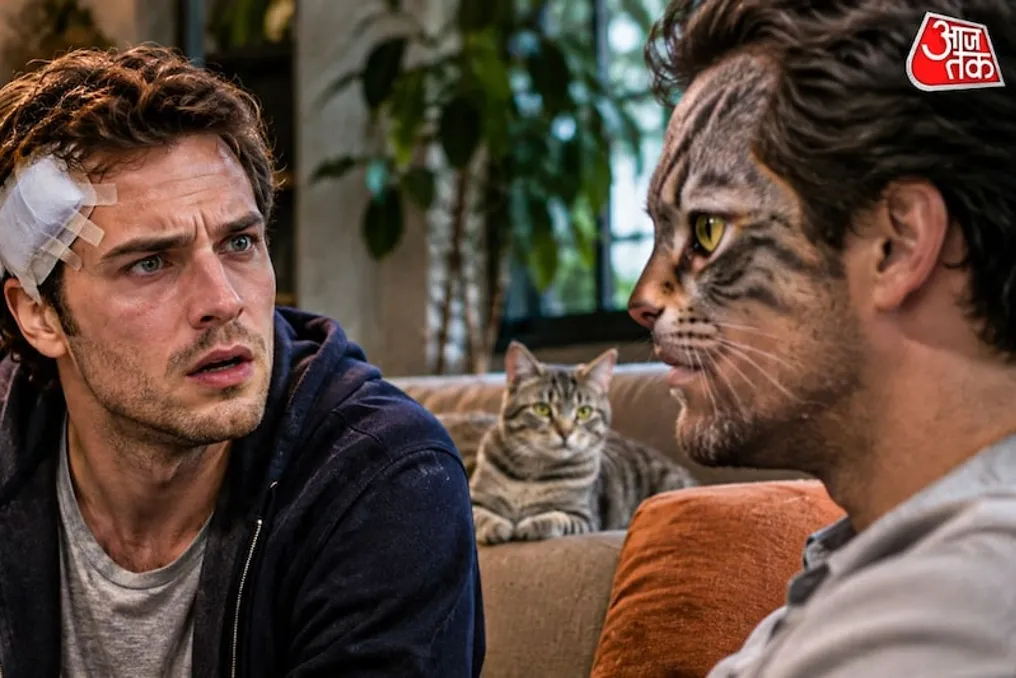
A 28-year-old man from America began experiencing an unusual phenomenon after brain surgery: he started seeing features resembling cat eyes and other characteristics on people's faces. Sometimes the reverse effect is observed—the person sees human features on a cat's face.

Scientists consider this rare case important for understanding how facial recognition works and how the human brain functions.

The study identified this individual only by the name Carl. He lives in the northeastern part of America and has a gray tabby cat named Luna. For several days, Carl first looks at his cat, and then, when looking at people, begins to notice some of Luna's features in them.

For example, he started seeing cat eyes, large pupils, and striped patterns on human faces. Notably, these changes are felt not only when looking at a person standing in front of him but also when viewing online facial images.

The most striking aspect of this case is that the influence is not limited to transferring features from the cat to the human. If Carl first looks at a human face, later the features of that person, such as eye shape and pupils, may appear on the faces of other people and even on Luna's face.

According to researchers, these changes do not look like one face superimposed over another; rather, different features of different faces organically blend into a general face, creating the impression that they are part of that face. These changes can naturally vary depending on distance and viewing angle.

Carl began experiencing these sensations about two years ago. Before that, he underwent surgery to remove part of the right temporal lobe. This area contained a network of AVMs—abnormally connected blood vessels between arteries and veins. Such a situation carries the risk of cerebral hemorrhage.

The right temporal lobe plays a key role in facial recognition and interpretation. Therefore, scientists paid attention to the possible change in visual processing associated with this area after the operation.

Scientists linked Carl's case to prosopometamorphopsia. In this condition, a face may appear completely different to the observer: facial features may seem stretched, reduced, or enlarged, shifted, or altered in other ways.

Carl also exhibits palinopsia. This means that previously seen visual information reappears in subsequent perception. Researchers believe that Carl's type of visual memory is related to facial distortions.

According to the report, these phenomena in Carl can last for many hours, and sometimes all day. Researchers suggest that the human brain stores detailed memories of familiar faces. In Carl's case, it is possible that some of these stored facial features are reactivated and influence the way the face is perceived. That is, the brain depends not only on information received through the eyes but also on memory, which influences this visual perception.

A similar case was recorded previously. Scientists compared Carl's case with an old case from 1986, where a woman saw a poodle sitting on the lap of a passenger on a bus. After this, she began to see the features of this dog's muzzle on the faces of other passengers. However, there are differences between the two cases: in the old case, the woman thought almost the entire poodle's muzzle was displayed on the faces of other people, whereas in Carl's case, the transfer mainly involves specific facial features from one face to another.

Another interesting point in this matter is that researchers used artificial intelligence to create images that better reflected Carl's experience. First, a sketch was created, and then it was made more realistic using generative AI. Carl reacted to these images, and the researchers adjusted them according to his experience.

According to researchers from Dartmouth College, Brad Dusen, AI can help in understanding such visual perceptions and in conveying patients' experiences to other people.

Carl's case is documented in a clinical report published in the journal Cortex. The article is titled 'Forty years after poodle-face palinopsia: Human-to-cat and cat-to-human facial feature transfer'. The authors are Brad Dusen, Antonio Melo, and Jeffrey L. Nosker.

Homemade De-tan Mask for Winter: A Recipe to Improve Dry and Dull Skin
Read more
www.aajtak.in

Homemade De-tan Mask for Winter: A Recipe to Improve Dry and Dull Skin

During the winter period, special attention must be paid to facial care. Due to cold winds and lack of humidity, the skin begins to lose natural moisture, leading to dryness, dullness, and a tired appearance. Furthermore, sun exposure can cause skin darkening (tanning).

Because of this, many people turn to salons for procedures or use expensive skincare products to achieve a radiant look. However, it is not necessary to spend money on expensive products; you can take care of your skin using simple ingredients available at home.

A recipe for a homemade de-tan mask is presented, which will help achieve glowing skin during the winter.

The following components are required to prepare the mask: one large spoon of besan, one large spoon of fresh yogurt, one small spoon of honey, half a small spoon of coffee powder, and a pinch of turmeric.

To prepare this mask, first mix the besan and yogurt in a bowl until a homogeneous consistency is achieved. Then add the honey, coffee powder, and a pinch of turmeric. Continue mixing all ingredients until a smooth paste is obtained.

Before applying the mask, the face should be thoroughly cleansed. Then, evenly apply the prepared paste to the face and neck. Leave the mask on for 10–15 minutes, after which gently rinse it off with warm water. Finish the care routine by applying a moisturizing cream to the face.

Important note: This information is provided for informational purposes only. Before making any changes to your skincare routine, it is recommended to consult a specialist.

Popular