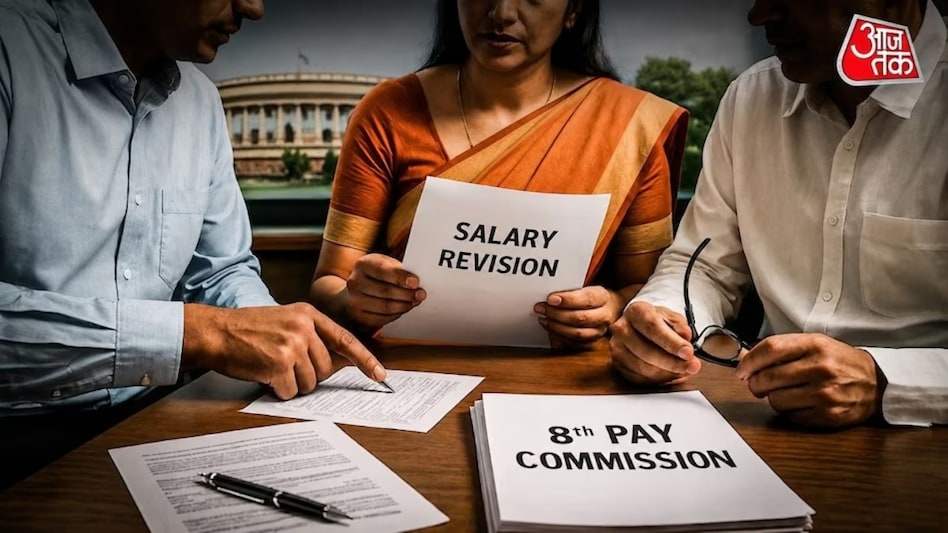
Central employees are eagerly awaiting the implementation of the eighth departmental commission council (8th Pay Commission). Six months have passed out of the allotted eighteen months for the commission to submit its report, bringing closer the time of the new council's introduction, although an official date has not yet been announced.
The main demand put forward under the eighth departmental commission council is to increase the fitment coefficient to 3.83. If the government agrees to this demand, the minimum salary of employees will significantly increase, rising by approximately 51000 rupees. The fitment coefficient plays a key role in salary increases.
The commission has held meetings with trade unions in all cities across the country to gather their proposals. Organizations have put forward a number of demands concerning the revision of salaries, pensions, and allowances. Among these is the key demand to increase the fitment coefficient to 3.83, which directly affects the increase in salary hikes. The fitment factor is an indicator used by the central departmental council to convert the previously adjusted basic salary (or pension) into a new, adjusted basic salary. A change in this factor causes significant fluctuations in the basic salary and pension.
The formula for calculating the fitment coefficient is quite simple: 'New basic salary: Current basic salary x CF'. Under the seventh departmental commission council, the fitment coefficient for central employees was 2.57, which led to the minimum basic salary increasing from 7000 to 18000 rupees compared to the sixth departmental council. If this coefficient is raised to 3.83, the minimum basic rate will reach 68940 rupees (18000 rupees x 3.83), ensuring an immediate salary increase of about 51000 rupees.
Below is an overview of data on the fitment coefficient and salary increases from the first to the seventh departmental commission council:
The first departmental council was introduced in 1946 before independence was gained. According to state sources, it set the minimum basic salary for civil servants at 55 rupees per month and the maximum basic salary at 2000 rupees.
The second departmental council came into effect in 1959, raising the minimum basic rate from 55 rupees to 80 rupees per month. As for the maximum basic salary, it increased by 1000 rupees, reaching 3000 rupees.
The third departmental council appeared in 1973, and upon its introduction, the minimum basic salary for employees rose to 196 rupees per month, while the maximum basic salary was again increased to 3500 rupees.
The fourth departmental council, introduced in 1986, raised the minimum basic rate for employees to 750 rupees per month. Furthermore, the government set the maximum basic salary at 8000 rupees per month.
The fifth departmental council appeared in the country in 1996, and the fitment coefficient applied then was 1.74. This caused the minimum basic salary of employees to jump to 2550 rupees per month, and the maximum basic rate reached 26000 rupees.
The sixth departmental council was introduced in 2006. The government increased the fitment coefficient to 1.86, leading to the establishment of a minimum basic rate of 7000 rupees. The maximum basic salary for central employees rose to 80000 rupees.
The seventh departmental council, presented in 2016, proved very beneficial for employees, as the government increased the fitment coefficient to 2.57. This resulted in the minimum basic salary growing from 7000 rupees to 18000 rupees, and the maximum basic salary reaching 2.5 lakh rupees.
It should be noted that the eighth departmental council was formed on November 3, 2025, and was given a period of 18 months to submit recommendations. Thus, more than 12 months have passed. According to the set deadline, the report should be submitted around May-June 2027, after which its adoption will depend on the government's decision.