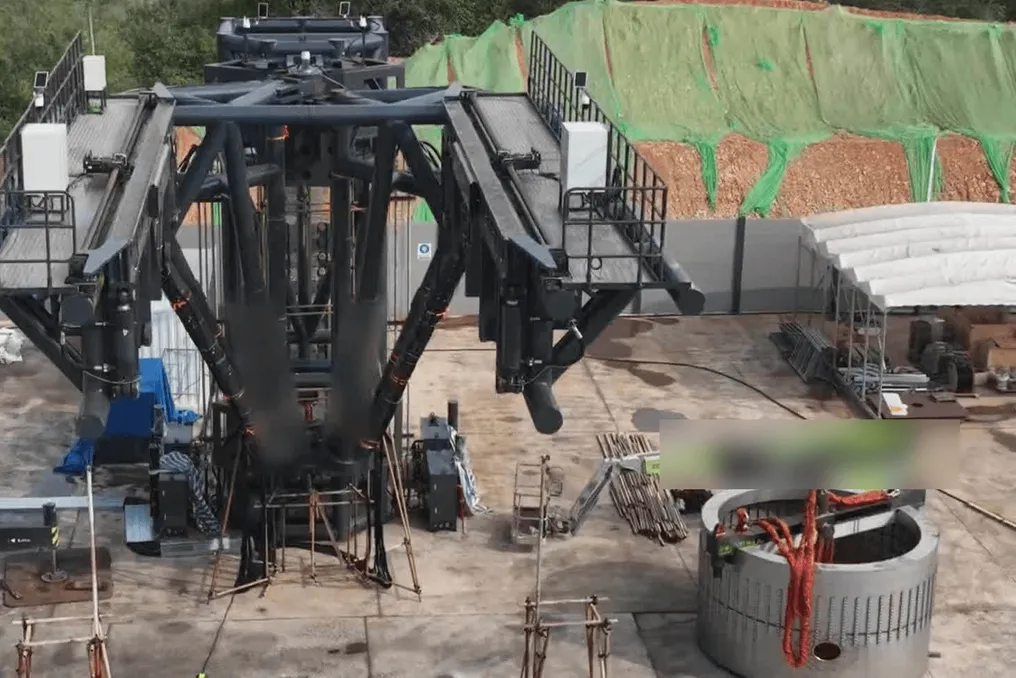
Astronstone announced on November 23 that it has completed joint tests of full-scale rocket capture mechanisms capable of withstanding a load of 100 tons. This achievement advances the engineering work on the planned reusable rocket system. It is important to note that this announcement pertains to ground equipment, not in-flight rocket recovery.
According to the company's report, published by IT Home and Phoenix Technology, the entire campaign, from the construction of the test platform to the completion of the tests, took over 100 days. This period covers the overall campaign and does not mean that the mechanisms maintained maximum load continuously for 100 days.
The tests were conducted under various environmental conditions, including rain, fog, high wind loads, and significant temperature fluctuations, as well as in bright daylight and low-light nighttime conditions. The company stated that these scenarios were necessary to assess the impact of environmental changes on the control system's performance. Additionally, separate dynamic load tests checked structural integrity when subjected to impact-simulating forces.
Astronstone used over 1100 high-precision sensors to collect data covering temperature, stress, displacement, acceleration, and high-speed observations. The synchronized data collection was intended to demonstrate the distribution of structural and control margins, helping to identify potential risks rather than just recording the overall test pass result.
The company noted that the tested cases met the planned requirements. However, the public report did not contain complete numerical tolerances, individual load histories, or an independent qualification assessment. Therefore, claims about the ability to operate in all weather conditions and at full load should be viewed in the context of this ground campaign, not as certification for every in-flight recovery scenario.
The collected measurements will be used to improve simulation models and optimize design and control parameters. Thus, this announcement represents an important milestone in engineering validation, as it provides data to enhance the recovery system before a significantly different task of intercepting a descending booster is undertaken.
The approach using capture mechanisms is part of Astronstone's AS-1 program, which involves a two-stage rocket utilizing stainless steel structures and liquid oxygen/methane engines. Planned reusability and payload capacity remain design goals, not results demonstrated during the mechanism tests. The November 23 announcement did not set a date for an in-flight interception nor did it demonstrate a completed recovery and reflight cycle.