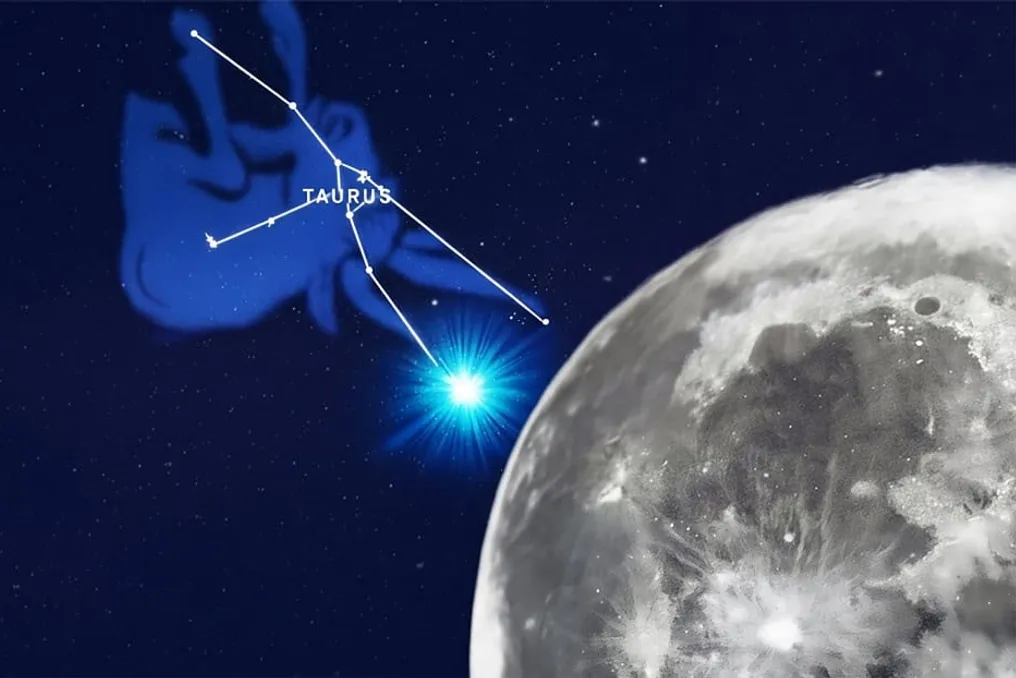
On Wednesday night, the 25th, the Moon will present a phenomenon described as a type of eclipse, passing in front of the star Beta Tauri, also known as Elnath. This star is recognized as the second brightest in the constellation Taurus, located at the end of one of the horns of the astrological symbol.
According to information provided by the Sky & Telescope platform, the name Elnath derives from Arabic and means 'the head' or 'that which pushes with horns,' directly referencing the star's position at the tip of the Taurus horn and highlighting the tradition of linking bright stars to the visual elements of constellations.
InTheSky.org reports that the lunar occultation of Beta Tauri will begin at 7:15 PM, but this event will not be visible from Brazil. The fact that lunar occultations are only visible in a small part of the Earth's surface is due to the large parallax of the Moon, which is very close to our planet, causing its position in the sky to change according to the observer's location.
The variation in the Moon's position seen from opposite points on Earth can reach two degrees, which is equivalent to four times the diameter of the full moon. This implies that if the Moon is aligned to cover a specific object for an observer on one side of the globe, it will appear up to two degrees away from that object on the opposite side.
A map illustrates the distinct areas where the disappearance of Beta Tauri can be observed (indicated in red) and where its reappearance can be witnessed (marked in blue). These regions are concentrated in the southern tip of Africa, including countries such as South Africa, Namibia, and parts of Botswana, Lesotho, and Eswatini, as well as oceanic areas of the South Atlantic and South Indian Oceans near this area.
The solid areas on the map show where the occultation is likely to be visible with binoculars at a reasonable altitude in the sky, covering this southern section of the African continent and the adjacent sea. The dotted outlines point to locations where the event occurs above the horizon, but may not be perceptible due to excessive sky brightness or the Moon's proximity to the horizon.
For those outside these outlines, including Brazil, the Moon will not pass in front of Beta Tauri at any time, or it will be below the horizon during the occultation.
Before the occultation, at 6:01 PM, the Moon will reach perigee, its closest orbital point to Earth. Since it enters this full phase coinciding with this approach, it is called a Supermoon.
According to the In-The-Sky.org platform, the distance of the Moon from Earth fluctuates because its orbit is not perfectly circular, being slightly oval and following a trajectory called an ellipse. By traversing this ellipse monthly, its distance oscillates between 356,500 km at perigee and 406,700 km at apogee (farthest point).