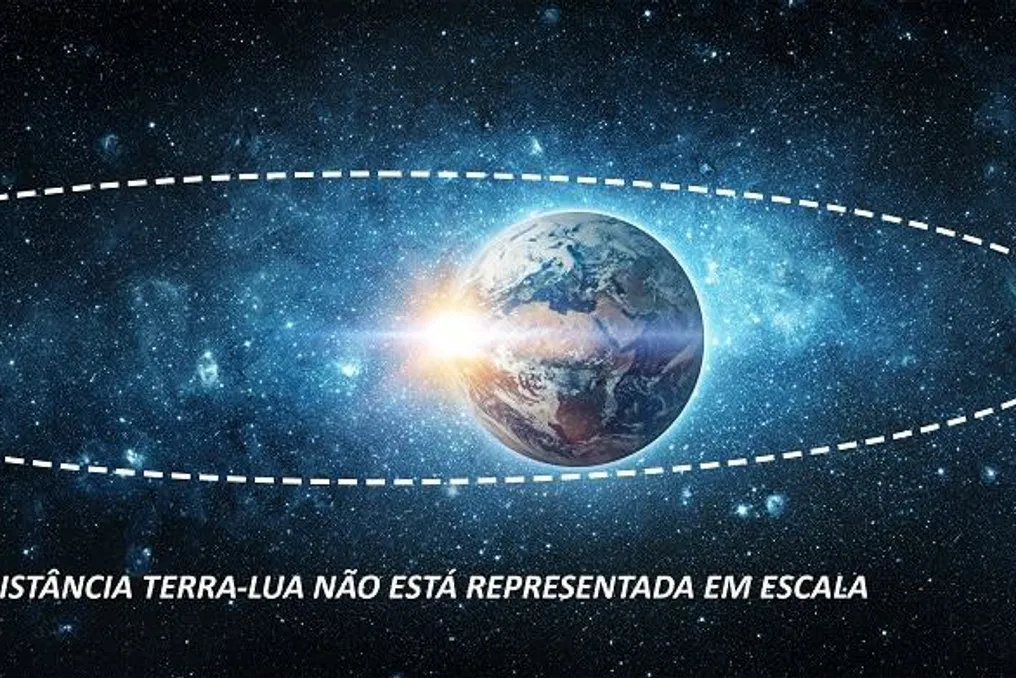
A notable celestial event will occur this week: the second-to-last Supermoon of 2026. On Tuesday night, the 24th, the satellite may show an increase of up to 14% in size and shine about 30% more intensely compared to a common full moon, due to its high proximity to Earth.
This phenomenon results from the fact that the lunar orbit is not a perfect circle, but rather an ellipse, which causes constant variations in the distance between the two celestial bodies. When the Moon is closest to Earth, this point is called perigee; conversely, the farthest point is called apogee.
The term Supermoon is used to describe a full moon that occurs when the satellite is at or very near perigee. According to data provided by the astronomical observation platform InTheSky.org, the Moon will reach the full phase at 11:53 AM on Tuesday (24), according to Brasília time. Perigee will be reached later, at 5:58 PM on Wednesday (25).
On average, the distance between the Earth and the Moon reaches approximately 356 thousand kilometers at perigee, potentially exceeding 406 thousand kilometers at apogee, representing a difference of about 50 thousand kilometers, which affects the apparent size of the lunar disk seen in the sky.
Despite the quantitative data, observing this variation directly on the Moon is not always simple. The effect becomes clearer when comparing photographs taken at different times, maintaining the same scale and camera configuration.
Astronomer Marcelo Zurita, who holds positions such as president of the Paraíba Astronomy Association (APA), member of the Brazilian Astronomical Society (SAB), technical director of the Brazilian Meteor Observation Network (Bramon), and columnist for Olhar Digital, emphasizes that without knowing the satellite's proximity, it is impossible to determine if a given full moon is a Supermoon.
Zurita mentions that there are efforts to create a more complete scientific definition for the phenomenon, but there is still no established consensus. Part of the complexity lies in the origin of the term itself, which originated in astrology and was only recently adopted by astronomy. He comments that while its application in astronomy helps popularize science, many doubt the term, considering it a marketing name to promote the Full Moon at perigee, which, in practice, does not have extraordinary scientific characteristics.
The November Supermoon is listed in both the century events list compiled by Fred Espenak, a former NASA astrophysicist, and in the predictions of Richard Nolle, the creator of the term. This November Supermoon will be the largest full moon of the year because the satellite will reach the full phase precisely at the moment of maximum proximity to Earth throughout the calendar.
According to the Old Farmer’s Almanac, a traditional United States publication focused on rural life, every monthly full moon has a specific name. The November Moon is known as Beaver Moon. This name is linked to the behavior of these animals during autumn in the Northern Hemisphere, a period when they prepare for winter by intensifying the construction and maintenance of their dams and accumulating food reserves.
Another reason for this designation involves hunters, who took advantage of this period to capture beavers and sell their pelts, used in making winter clothing. Various Indigenous peoples of the US attribute different names to this Moon, generally related to animal behavior and the changes imposed by winter.
For the Tlingit, it is called Digging Moon or Scratching Moon, referring to animals searching for fallen nuts and sprouts, as well as bears digging dens for winter. The Dakota and Lakota peoples use the name Fawning Moon, associated with the mating season of deer. Among the Algonquin, the designation Whitefish Moon refers to the spawning season of this species.
The arrival of cold also inspires other names. The Cree and Assiniboine peoples call the November full moon Frost Moon, while the Anishinaabe use the expression Freezing Moon. All these designations reflect the perception of seasonal changes and the connection between natural cycles and animal life.