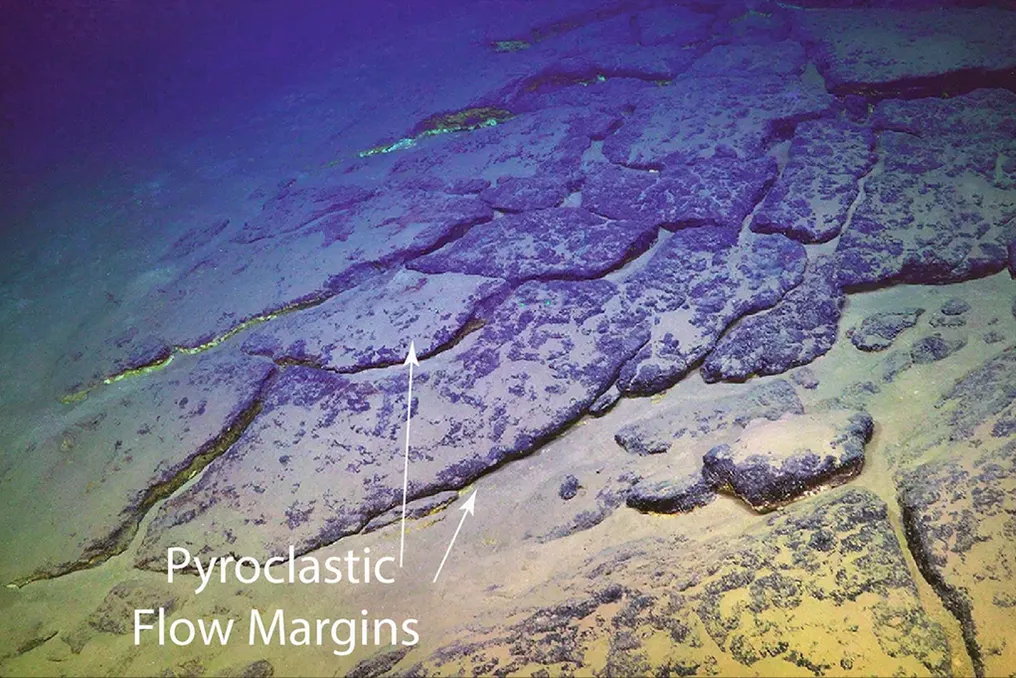
An expedition conducted in the Challenger Deep—the deepest known point on Earth's surface—led to an unexpected discovery. Researchers found deposits of pyroclastic flow at a depth of over 6,000 meters beneath the ocean surface, which was not anticipated by geologists in this location.
Pyroclastic flows are formed by the rapid movement of hot gas and volcanic material, such as ash and rock fragments, resulting from explosive eruptions. According to a study published in the journal Frontiers in Earth Science, this is the deepest recorded pyroclastic flow in the world.
Although volcanic activity on the ocean floor is not unusual—there are volcanic island chains and underwater mountains amidst tectonic plates, as well as numerous vents erupting lava along mid-ocean ridges—explosive volcanism as we know it (such as Mount Etna in Sicily, Italy) should occur at shallower depths.
Theoretically, if a volcano erupts in places like the Challenger Deep, it 'physically cannot explode and eject material outwards,' states Robert Stern, a professor at the University of Texas at Dallas and one of the study's authors. Nevertheless, this did happen: a research robot recorded a cluster of debris at a depth of about 6,150 meters, which is presumed to have resulted from some type of volcanic explosion.
Stern added that 'we have not yet determined the eruption sites.' He specified that these hot pyroclastic flows moved down the slopes but, in their opinion, did not travel long distances. They retained enough heat to re-coalesce and form relatively hard rocks; if the flows had traveled far, the heat would have dissipated.
The Challenger Deep is located in the Pacific Ocean approximately 2,400 kilometers south of Japan and is one of the planet's most mysterious points. Its deepest point reaches about 11,000 meters and is considered one of the deepest areas of the oceans and one of the least studied parts of the Earth.
At this depth, the pressure is about a thousand times greater than at sea level, the temperature is close to 0°C, and there is no sunlight or sufficient oxygen for human life. Mont Blanc could fit there vertically in its entirety: at an altitude of 8,849 meters, it would still be more than two kilometers below the surface.
Only a few people have visited this place and survived to tell the tale. Don Walsh and Jacques Piccard, the first to reach the Challenger Deep, did so in 1960, and only more than five decades later, in 2012, James Cameron, director of the film 'Titanic,' repeated this feat in a submersible costing about 10 million US dollars.
Despite being less adventurous, the safest way to study the Challenger Deep currently is by sending robotic probes. This is what happened at the end of 2024, when researchers sent a submersible built by the U.S. National Deep Submergence Center, known as Jason/Medea, into the area.
Jason is equipment with video capture and still image systems. Its images are transmitted via Medea, a support robot that remains at a slightly shallower depth and acts as a buffer to protect Jason from vessel movement on the surface.
Although Jason/Medea cannot reach depths exceeding 6,500 meters below sea level, it can collect samples from the wall of the ocean trench. Researchers focused their investigation on a 550 km segment, where the submersible made seven dives along this section and discovered the edges of the pyroclastic flow.
Overall, researchers found that the eastern part of this segment is deeper than the western part and has steeper walls. On this steeper side, they found ancient volcanic rocks arranged in a thin, flat layer. It is not precisely known where these rocks might have erupted from.
These findings also help explain the depth of the Challenger Deep. In subduction zones, at the boundary where tectonic plates converge, one plate sinks beneath another toward the Earth's mantle. In this case, because both plates are relatively weakly coupled, the lower plate descends more easily and at a steeper angle, which explains why the eastern side is also the deepest.