Recently, the author became a cycling enthusiast because he considers it a more interesting and beneficial exercise compared to running or strength training. Living in a small town in the state of São Paulo, he is relatively unconcerned about competition for space between bicycles and cars, which facilitates using a bicycle as transportation. He notes that a bicycle is a machine, and its mechanical components are admirable.
Like cars, bicycles have transmission systems. The principle is similar: the force applied to the pedals is transmitted to the rear wheel via a chain, and the ratio can be changed using sprockets at the front (chainring) and at the rear (cassette). In 2009, Shimano began offering electronic drivetrains for front and rear derailleurs, initially in the Dura-Ace line, replacing traditional mechanical cables with electronic commands. According to users, the advantages include shifting precision, the ability to make faster changes, and a cleaner look due to the reduction in visible mechanical cables. However, such systems are more expensive and require batteries.
On the other hand, more advanced braking systems on bicycles are hydraulic disc brakes. Although disc brakes appeared in the last century, they became popular mainly in the 1990s and 2000s, first on mountain bikes, and then in other disciplines. On road bikes, traditional rim brakes, which squeeze the rim with pads, are still used in some models due to their simplicity, efficiency, and lightness. Some fixed-gear bikes do not use brakes at all, as the cyclist can resist pedal rotation to slow down the wheel.
However, a fully electronic braking system without a mechanical connection between the levers and the brakes themselves does not yet exist on bicycles. This raises the question of why cars, being faster, heavier, and more complex, are beginning to implement this solution and how it works?
It is not just replacing a physical component with an electronic one; the process is much more complex. The brake-by-wire system is part of a broader transformation of vehicle architecture, where commands traditionally transmitted by cables, rods, and hydraulic circuits are now interpreted and executed electronically. This change opens up new possibilities for vehicle control, integration with driver assistance systems, and, above all, electrification. But it also raises many questions.
Termination of Physical Connection
In a typical car with disc brakes, the operating principle is quite simple: the driver presses the pedal, the piston moves the master cylinder, which pressurizes the brake fluid. This pressure travels through the hydraulic line to the calipers, where pistons press the pads against the discs. Friction converts the kinetic energy of the wheels (and thus the entire vehicle) into heat, reducing speed. Essentially, it is a thermodynamic process.
This is an efficient and reliable system that has undergone many evolutions over more than a century. For example, ABS introduced a significant level of electronic braking control by regulating hydraulic pressure to prevent wheel lock-up. Electronic Stability Control (ESP or ESC) systems can also actuate the brakes individually to correct the trajectory. In fact, cars have been using electronics for braking control for decades.
Brake-by-wire affects a fundamental aspect of this architecture: the connection between the pedal and the mechanism that actually creates the braking. Instead of a direct transmission of mechanical or hydraulic force, the pedal functions as an electronic command center. Sensors determine the rate and depth of pedal depression. They then transmit this information to an electronic module, which determines the braking intensity and sends a command to the actuators. Although this seems like a long process, all decisions are made and executed in milliseconds.
The driver continues to use a regular pedal, but its function is reduced to informing the system of the required deceleration rate of the vehicle. To maintain the familiar feeling of resistance and progression—which helps eliminate the psychological barrier of the lack of physical connection between the pedal and the brakes to some extent—most such systems are equipped with a 'pedal feel simulator.' This simulator artificially reproduces the expected resistance using passive elements (springs or elastomers) or active ones (electrohydraulic actuators), without relying on the hydraulic pressure usually generated in the master cylinder.
The path from the pedal to the brake depends on the chosen architecture. The electronic command can activate an electrohydraulic unit, which continues to use fluid to transmit pressure to the calipers, or electric motors installed directly on the wheels capable of generating braking force without any hydraulic circuit.
Thus, not every brake-by-wire system means a complete abandonment of brake fluid. Therefore, this technology is divided into three different levels or architectures.
Three Types of Brake-by-wire
The first level is wet brake-by-wire, where 'wet' literally means 'fluid'. This name relates to the retention of brake fluid in the system. In this case, the driver no longer has a direct mechanical connection to the braking system, but the necessary force to move the caliper pistons is still generated hydraulically. This is an intermediate solution that retains the main components of a traditional brake, such as calipers, discs, and hoses. The main change lies in how this pressure is generated and controlled: the electrohydraulic unit receives a command from the pedal and manages the pressure supplied to the brakes, and it can also perform functions previously dependent on separate systems, such as servo-braking and part of the stability system.
An example is ZF's Integrated Brake Control, or IBC. It combines electrohydraulic braking control with assistance and stability control functions without the need for a traditional vacuum servo-brake. The pedal is disconnected from the hydraulic circuit, and its request is interpreted electronically—the fluid remains in the system but is no longer used for the direct transmission of the driver's intent.
The second level is hybrid brake-by-wire. As the name suggests, it combines two different technologies in one vehicle. For instance, ZF uses hydraulic brakes in the front, while the rear axle uses electromechanical drives that press the pads against the discs using electric motors, requiring no hydraulic fluid. Choosing to retain the hydraulic system in the front and implementing an electric drive in the rear allows combining established components with newer technology, which is particularly suitable for heavy commercial vehicles and light pickups popular in the North American market. In this configuration, the rear drives can also function as the parking brake without needing a separate mechanism for this purpose.
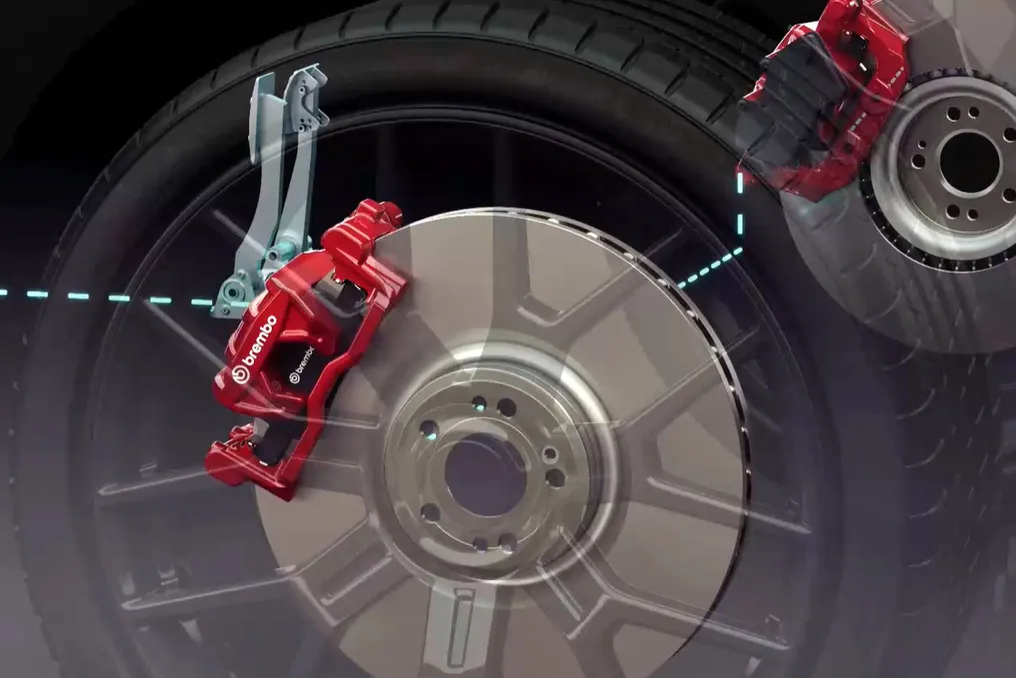
The third level is dry brake-by-wire, or the 'dry' system, representing the implementation closest to the original idea of completely eliminating the traditional hydraulic architecture. In this case, electric motors installed directly on the wheels drive mechanisms that press the pads against the discs. Each brake unit has its own actuator, and the distribution of braking force is determined by an electronically specialized module. There is no master cylinder, reservoir, or brake lines—the braking force is entirely independent of hydraulic pressure and is generated directly by the electric motors on the wheels. This reduces the number of hydraulic components in the vehicle and allows for greater design freedom, although it requires more powerful actuators, reliable power supply, and a very well-integrated electronic architecture.
The Sensify system, developed by Brembo, belongs to this category. The Italian company presents this technology as a platform that combines mechanical components, electronics, sensors, and software for independent control of each wheel, calculating the required force in real time. Sensify is not just a concept presented at innovation exhibitions. In May 2026, Brembo announced that the system had entered production for a 'global automotive manufacturer,' whose name was not disclosed. The company also reported signing contracts with other clients and plans to equip 'hundreds of thousands' of vehicles annually. This indicates that fully electromechanical braking is beginning to move out of the experimental sphere and closer to wider commercial application.
Why Change a Working System?
The question remains relevant: why abandon a hydraulic braking system that has functioned so well for decades? After all, it is not an outdated technology and is perfectly capable of meeting the needs of modern vehicles. On the contrary, traditional systems are efficient, relatively simple, and possess an established production and maintenance chain.
One of the main answers is the possibility of individual wheel control. With traditional braking, hydraulic pressure is distributed throughout the system and can be modulated by devices such as ABS and stability control. Brake-by-wire expands the capabilities of controlling this force, especially in architectures with independent drives on each wheel. The electronic unit can take into account data such as speed, steering angle, vehicle load, available grip, and dynamic behavior to determine how hard each wheel should brake.
Imagine emergency braking in a corner on a track, where the wheels on one side are on a surface with less grip than the wheels on the other. The system must manage deceleration without compromising the trajectory. With individually controlled drives, it is possible to dose the force applied to each wheel, utilizing the available grip and reducing the tendency to lose stability. Of course, a car with hydraulic brakes and ABS or ESC can also achieve this control, and modern systems already possess complex functions of individual modulation. The difference lies in the architecture: in the electromechanical system, the control of each brake unit can be carried out directly by its own actuator, without depending on the modulation of a centralized hydraulic circuit.
Another advantage is integration with electrified vehicles. In hybrid or fully electric models, the traction motor can operate as a generator during deceleration, converting part of the kinetic energy into...