deBlock 2026 Conference Opens Submissions for Blockchain, Web3, Cryptography, and AI with a 10 ETH Prize Pool
Read more
Tehran Times
www.tehrantimes.com

deBlock 2026 Conference Opens Submissions for Blockchain, Web3, Cryptography, and AI with a 10 ETH Prize Pool

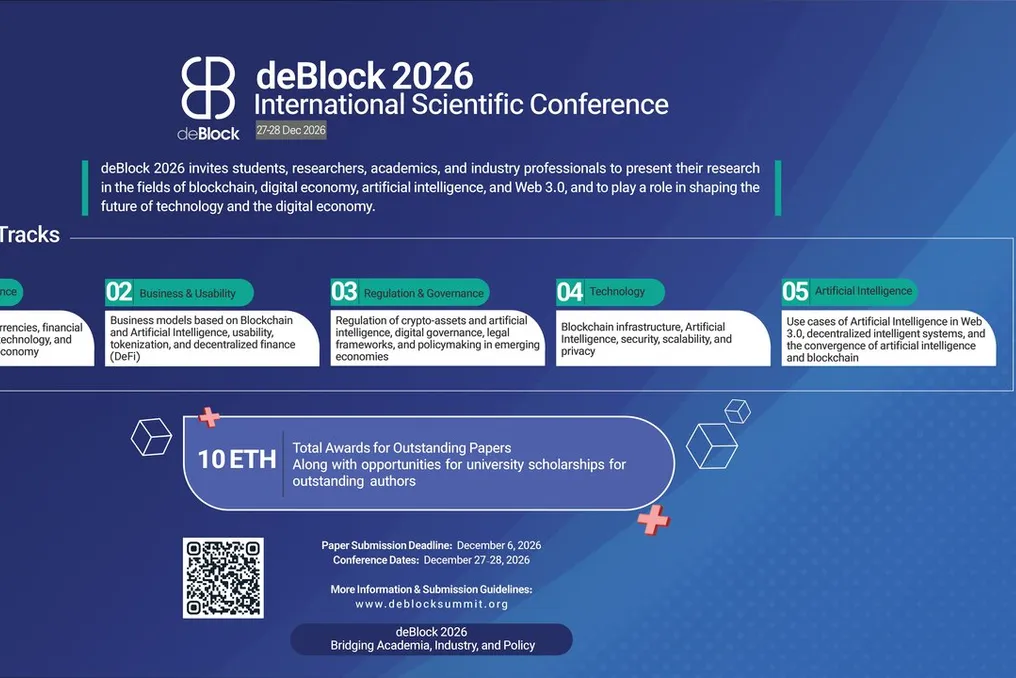
The international conference deBlock 2026 has announced the start of accepting scientific papers dedicated to blockchain, crypto assets, Web3, and artificial intelligence. The competition offers a total prize pool of 10 ETH, and accepted articles will be indexed by the Islamic World Citation Center (ISC). The deadline for submission is set for December 6, 2026.

The second edition of the deBlock conference will take place in Tehran on December 27–28, 2026. Concurrently, the first International Artificial Intelligence Exhibition is scheduled from December 26 to 29. The event program will combine scientific research with industry discussions and a startup competition, covering various aspects of the evolving digital economy.

Five Thematic Research Areas

The call for papers covers five main thematic areas. These areas include economics and finance, examining the impact of blockchain, tokenomics, and Web3; law and regulation, addressing legal frameworks and policies regarding crypto assets; artificial intelligence, focusing on AI technologies and applications; applications, such as blockchain-based solutions and dApps that combine AI and blockchain; and technologies related to blockchain software and hardware, cybersecurity, and scalability.

All submissions must be written in English and adhere to the official ISC template. Accepted works will receive ISC indexing, and selected materials will be included in the official conference proceedings. Organizers also noted that some articles may qualify for further international registration.

Prize Pool of 10 ETH Across Five Tracks

The competition allocates 2 ETH to each of the five research tracks. Within each track, awards are distributed as follows: first place receives 0.75 ETH, second place receives 0.5 ETH, third place receives 0.25 ETH, fourth place receives 0.25 ETH, and fifth place receives 0.25 ETH. Authors of selected papers will also receive official certificates in recognition of their achievements. Thus, the competition combines financial reward with academic recognition and publication opportunities.

Furthermore, the 2026 program includes a startup competition for innovative ideas and Minimum Viable Products (MVPs) in the fields of Web3, blockchain, crypto assets, and related AI. Five tax-exempt cash grants are provided to support selected early-stage ventures, expanding the event's focus beyond purely academic research to include practical application and new businesses.

Experience of the First Edition

The first deBlock conference took place on November 6–7, 2025, at the IRIB International Conference Center in Tehran. The event gathered researchers, media representatives, cryptocurrency companies, exchanges, economic experts, regulatory bodies, and diplomatic representatives to discuss topics related to blockchain and the digital economy.

According to organizers, the 2025 academic competition received 107 submissions across four thematic areas, with approximately 15–20% coming from outside Iran. Between 70 and 75 papers were accepted for final publication, and the top 20 papers received awards totaling 12 ETH. Accepted articles were published via the Civilica platform. The first edition also attracted international media, with TV BRICS serving as a partner. The 2026 conference builds upon this initial experience, expanding research themes by including artificial intelligence and adding a startup competition.

Conference and Exhibition Dates

The scientific conference will be held on December 27–28, 2026, in Tehran, coinciding with the International Artificial Intelligence Exhibition, which runs from December 26 to 29. The overall program aims to provide opportunities for research presentations, panel discussions, workshops, technology demonstrations, and networking among academic, entrepreneurial, and industry participants. The conference will be conducted in Persian and English, with online streaming available for those unable to attend in person. Additional information about the competition, the startup program, and the schedule is available on the official website: https://www.deBlockSummit.org

Similar stories

By 2027, identification documents will cease to be a sufficient means of verifying identity
Read more
techcentral.co.za

By 2027, identification documents will cease to be a sufficient means of verifying identity

It is projected that by 2027, fraud methods will become more sophisticated, rendering traditional identity verification methods obsolete. The main change lies in what will be considered adequate proof of identity. For a long time, simply copying an ID was enough, but this will no longer be the case in 2027, allowing companies that adapt first to onboard clients faster and with less risk.

Fraudsters will stop creating fake documents; instead, they will begin editing authentic ones. Some of the most convincing fraud cases in 2027 will rely on using real documents, where artificial intelligence changes only one detail, such as the document number, leaving the rest unchanged. According to the Entrust 2027 Identity Fraud Report, the overall level of document fraud decreased by 19% in 2026 because basic forgeries stopped working, while complex document fraud increased nearly 20fold.

Visual inspection will not be able to detect such changes, nor will liveness checks alone, as confirming a person is alive does not guarantee the authenticity of their document. The real test is how the document was obtained and whether its details match the person presenting it. An error in this check will lead either to approving fraud or rejecting a legitimate customer, harming business growth.

SIM card verification is moving down the chain, and so are the risks. Automobile dealers have already faced similar issues: in 2022, sellers of high-value goods began reporting to institutions under the Financial Intelligence Act (Fica). The Icasa rules project implementing biometric checks instead of just ID copies upon every SIM card activation, reactivation, and replacement, imposing fines from R2 million to R4 million for the most serious violations. These obligations will fall on network operators, but pressure is expected to spread to other participants. Smaller distributors are already conducting their own checks in accordance with the Communications Interception Regulation Act (Rica), and by 2027, networks will require this from every partner selling their SIM cards.

Digital identities will become a reality through payments, not political decisions. People adopt technologies based on what they allow them to do. For digital identification, this will be payment. According to Reuters, South Africa plans to allow licensed non-bank institutions to connect directly to the national payment system, with the first such services expected around March 2027. Operators, retailers, and fintech companies will attract customers that banks could not reach. Identity credentials are expected to follow this, authorizing the transaction itself.

Imagine an informal trader joining a new payment provider with verified credentials instead of documents they might not possess. This is where inclusive banking begins. It also turns digital identity into an IT project, as most existing systems were designed to work with paper documents.

Implementing self-sovereign identity shifts control over identity and consent to the customer. Regulated entities will continue to keep legally required records. Instead of collecting a fresh copy of every document, they will verify proof that the customer already possesses this data. The trade-off is reduced access to customer information. In return, customers will face fewer requests for re-submission of documents, and companies will have to store and protect significantly less data. Although full implementation will take years, design decisions will begin in 2027. Every unnecessary copy of an ID on a server represents a data leak risk that businesses have chosen to retain.

For additional information: AI query prices may continue to drop, but the overall cost will not decrease. AI providers are expected to consolidate and limit resource usage as investments recover. Since identity checks are increasingly performed using AI, a provider dependent on a public model may impose these limitations as slowed checks and higher costs. Companies will demand to know where their provider's AI operates and what the backup plan is in case of access restrictions. Local models and redundancy require funding, as does the lack of an alternative.

By 2027, the identification document will not disappear; it will simply cease to be the sole answer.

Self-enumeration of the population has begun in Noida; family data can be filled out until November 30
Read more
www.aajtak.in

Self-enumeration of the population has begun in Noida; family data can be filled out until November 30

As part of the upcoming 2027 population census, the self-enumeration campaign has started in Noida. At the beginning of the campaign, Deputy Dr. Mahesh Sharma and the CEO of the Noida administration entered information about themselves and their families independently through the portal.

They called on all city residents to actively participate in this national effort. According to the administration, the self-enumeration will be available from November 16 to November 30, 2026.

Citizens can independently fill in complete information about their families on the Indian government portal (https://se.census.gov.in). After completing the process, they will be assigned a 'Self Enumeration ID' (SE ID), which must be saved. This identifier will need to be provided to the census representative when they visit the home.

The responsible official of Noida, Indu Prakash Singh, reported that 2350 enumerators and 364 supervisors have been deployed in the city to ensure the smooth operation of regional census tasks. These employees will collect data by visiting homes from December 1, 2026, to January 4, 2027. During the self-enumeration period, these workers will also be in their assigned areas conducting information campaigns among the public.

The administration's goal is to ensure that no resident of Noida is left out of the count and that names are not registered twice. Furthermore, individuals who rent housing and work or run businesses will also be included.

The responsible official emphasized that according to Article 15 of the Census Act of 1948, citizens' personal information will be completely confidential. The administration strongly urges all citizens to complete their self-enumeration before November 30 and to fully cooperate with government representatives who visit their homes.

Moore Threads announces MDC 2026 for December 29-30 in Beijing, unveiling anticipated S6000 cards and Lushan GPUs
Read more
pandaily.com

Moore Threads announces MDC 2026 for December 29-30 in Beijing, unveiling anticipated S6000 cards and Lushan GPUs

Moore Threads has announced its MUSA Developer Conference 2026 (MDC 2026) to be held in Beijing on December 29th and 30th. The company made this announcement on November 11th, stating that over ten new products, technologies, and solutions will be presented at the event.

Founder, Chairman, and CEO Zhang Jianzhong will deliver a keynote speech on the company's plans for full-function computing based on so-called full-function GPUs, as well as on the architecture roadmap.

Anticipated New Products

Although Moore Threads has not yet confirmed the launch list, reports cited by Sina Tech and Jiemian indicate that an AI computing card, the S6000, and the 'Lushan' series of graphics GPUs built on the next-generation 'Huagang' architecture are expected to appear on the market by the end of the year. The S6000 is the successor to the S5000 series.

Chinese media describes the S6000 as a key element in the company's plans to create clusters of 100,000 accelerator cards, but the specifications for the S6000 have not yet been published by the company. Furthermore, the company demonstrated the C128 and C256 supernodes, with more details expected at the conference.

Lushan GPU Specifications

Regarding Lushan, reports reiterate data first presented by Moore Threads when introducing the Huagang architecture last December: 16 times higher geometric processing performance, 64 times higher AI computing performance, and 50 times higher ray tracing performance, along with improved texture filling, atomic memory access, and increased memory capacity. The base level of these multipliers was not restated in recent reports.

Lushan integrates generative AI rendering, a rendering architecture called UNITE, and a new hardware ray tracing engine, and is designed for high-performance AAA gaming and professional graphics work.

Event Scale

According to Shanghai Securities News and the industry site ijiwei, this year's event is larger in scale. It will feature 26 thematic forums across 11 areas, including 'factories' for model training and token and agent production, edge intelligence, supernodes, and AI infrastructure. The exhibition area has increased from 1,000 to 3,000 square meters, and over 4,000 developers are expected to attend, compared to more than 2,000 at the previous event. The conference website is available at mdc.mthreads.com.

Information regarding pricing, delivery times, and independent tests for both product lines remains unpublished. The romanizations 'Lushan' and 'Huagang' are Chinese names; Moore Threads' official English styling for them, as well as the full name of the S6000 product, could not be confirmed.

Popular