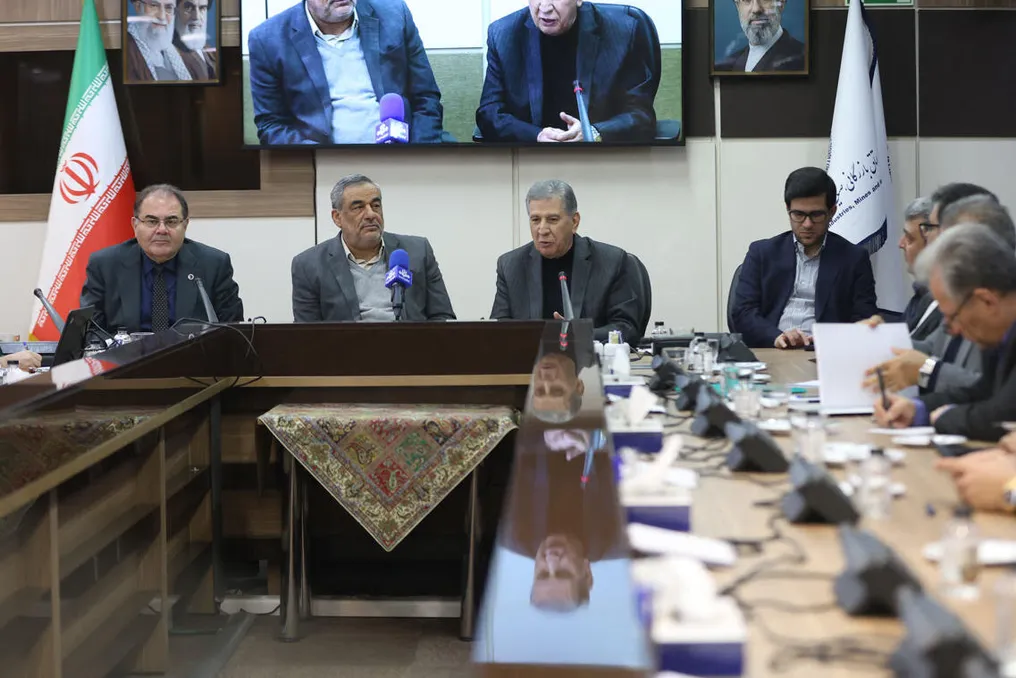
During a meeting with members of the Energy Committee and associations, the acting oil minister announced the preparation of 64 investment packages in the oil sector to be transferred to private businesses.
The parties also reached an agreement on creating a sustainable mechanism for interaction between the Ministry of Oil and the private sector. The meeting brought together high-ranking ministry officials, private sector representatives, industry associations, and energy experts to discuss issues of investment, production, contract signing, technology, energy diplomacy, and removing obstacles to private participation.
Samad Hassanzadeh, President of the Iranian Chamber of Commerce, Industry, Mining and Agriculture, stated that most private companies are interested in investing in all areas related to the petrochemical industry, especially in increasing production, improving efficiency, and developing oil infrastructure, provided suitable conditions are created for investors. He called for targeted measures to remove restrictions on private sector investments in oil projects. Hassanzadeh also mentioned past experience of cooperation between the private sector and the Ministry of Oil in the production and supply of specialized parts necessary for the oil industry during the tenure of Engineer Zanganeh as minister.
Hassanzadeh emphasized the importance of completing the value chain in the petrochemical industry. He added that defining clear investment packages and transferring development projects to the private sector is a necessary condition. He noted the potential of private companies in implementing oil production intensification projects as an opportunity for the growth of the country's oil industry and stressed the use of modern technologies to increase production. Furthermore, he pointed out that the private sector possesses sufficient competence to participate in projects for optimizing and modernizing refineries. He also mentioned the institutional potential of the Iranian Chamber, including 34 provincial chambers, 41 joint chambers of commerce, 20 specialized commissions, over 260 national economic associations, and a Research Center. He expressed hope for resolving the country's problems while maintaining the dignity of the Iranian people and the authority of the Islamic Republic of Iran.
Hamid Bavard, the acting oil minister, emphasized the need to strengthen ties between the Ministry of Oil and the private sector at a joint meeting with private sector activists. He reported that the ministry strives for constant, regular, and structured relations with economic entities. Mentioning the private sector's opportunities in investment, domestic production, and energy diplomacy, he noted that the Iranian Chamber can play an effective role in these areas. He added that the Ministry of Oil is ready to apply various investment models, from small projects to large plans.
Bavard stated that there are no technical limitations in the oil and gas extraction sector and referred to current infrastructure reconstruction programs. He also pointed out the possibility of saving about 20 percent in gasoline consumption and stressed that private sector cooperation is critical for managing consumption and reforming energy usage models. He described energy diplomacy as another aspect of the ministry's work and, referring to negotiations with neighboring countries, reported the continuation of cooperation in the Caspian Sea region and the application of a joint production model.
Hamid Hosseini, an expert in oil and energy, highlighted investment opportunities in the oil and gas extraction sector. He noted the significant economic potential of this sector, which can create additional value and ensure appropriate income from investments. However, he pointed out that many existing opportunities are not adequately presented to investors. He highlighted the use of internal financial resources, including microcapital and public funds, as one way to finance oil projects and stressed the need to develop appropriate mechanisms to attract such resources. Hosseini also called for reforming investment contracts, arguing that aligning contractual terms with investor needs can promote greater private sector participation in extraction projects. He described the development of oil trading on the Energy Exchange as a way to increase transparency and strengthen the presence of non-state companies in the oil market.
Erfan Afazeli, Secretary-General of the Petroleum Industry Federation and Advisor to the Energy Committee of the Iranian Chamber, addressed the issue of the private sector's ability to participate in oil and gas field development projects. He urged the Ministry of Oil to support the participation of economic entities in developing the provisions of paragraph (b) of Article 15 of the Seventh Development Law. He noted the recent decision by the National Iranian Oil Company to transfer the contract for the development and operation of the Zireh and Hartang gas fields. In his opinion, this step means that the private sector has effectively entered field development, especially gas fields, which is crucial given the country's gas shortage. He positively assessed the cooperation of the National Iranian Oil Company and its Deputy for Business in paving the way for private sector presence.
Afazeli explained that paragraph (b) of Article 15 of the Seventh Plan concerns the production potential of the non-state sector from the total volume of the country's oil and gas capacity. Accordingly, the private sector, through the Government-Private Sector Dialogue Council and the Business Support Committee, requested the development of executive regulations for this paragraph, taking into account the support for the presence and participation of non-state entities. He reported that meetings were held with representatives of the Ministry of Oil, including the Deputy for Planning, the National Iranian Gas Company, and the National Iranian Oil Company, but the regulatory development process stalled. He insisted that, given the private sector's interest, the ministry must support the continuation of work and the participation of economic entities in developing the regulations. He added that petrochemical companies and steel mills are also interested in investing in oil and gas field development, and that the simplification of issuing exploration and production (E&P) licenses by the Ministry of Oil has created a favorable basis for expanding participation. He called for the development of regulations for Article 15(b) with direct private sector involvement and ministerial support so that existing legal opportunities become real investment opportunities and production increases.
Afazeli also touched upon pressure boosting contracts. He called for clarifying their status and accelerating the implementation of long-unresolved contracts. Members of the Petroleum Industry Federation expressed a desire to speed up the determination of the status of pressure boosting contracts, particularly the Phase 19 pressure boosting project and the onshore section of the plan. He expressed hope that with ministerial support, regulations for private sector participation in oil and gas field development will be developed faster, and protracted pressure boosting contracts will be resolved. According to him, such measures could revive the activity of contracting companies, provide employment for engineers, and utilize domestic technical knowledge.
Nousratollah Saifi, head of the Dispute Resolution Council Optimization Committee, spoke about the potential of non-state companies in the energy sector. He noted that the private sector can play an effective role in restoring gas production capacity, developing energy trade, and expanding cooperation with neighboring countries. He considered the participation of private companies in energy exchanges with neighboring countries as one possible area and stressed the need to strengthen the country's energy resilience. Saifi also stated that the private sector's potential should be utilized in projects to improve productivity and reduce energy losses, emphasizing the sector's role in ensuring supply reliability and developing regional cooperation.
Ahmad Davoudi, a representative of the Oil and Gas Club, addressed the legal basis of the Seventh Plan and called for utilizing the provided instruments to attract domestic and foreign investors to oil industry projects. He stated the necessity of using the investment account opportunities under Article 14 of the Seventh Plan and the private sector's participation in implementing development plans. Davoudi also emphasized the importance of using joint venture contracts under Article 44, especially for developing joint oil and gas fields, describing this model as a way to increase investor participation in oil industry projects.
Ehsan Saghafi, head of the Association of Equipment Manufacturers for the Oil and Gas Industry, stressed the need to maintain the production capacity of domestic manufacturers. He stated that equipment manufacturers must have the ability to participate effectively in projects even under difficult economic conditions and restrictions in the oil industry. Referring to the technical and production potential of Iranian companies, he noted that their capabilities should be used in development, repair, and infrastructure reconstruction projects. Saghafi also emphasized the importance of continuous and structured communication between the Ministry of Oil and specialized associations. He proposed creating a special group within the ministry responsible for monitoring the implementation of agreements and directives made at joint meetings with the private sector. He stressed that simply holding meetings and voicing problems is not enough; a responsible employee and a clear path to results must be defined for each issue.
Hatam, another energy sector activist, focused on the opportunities for economic entities to achieve national goals. He stated that the private sector has high potential and the ability to serve the people and can play an effective role in advancing state plans and objectives. He noted that the private sector has significant opportunities and experience to influence various spheres and stressed that the government must utilize this potential optimally. By strengthening consensus and interaction with economic entities, the government must create conditions for their more effective participation in implementing plans. He noted that the private sector has developed numerous plans and projects for optimizing energy consumption levels that can be implemented with state support.
Farhad Golich-Khani, an advisor and energy activist, spoke about the potential of private companies in international markets. He stated that the private sector can play a role in developing energy exports, finding foreign buyers, and entering new markets. Emphasizing the need to utilize the experience and connections of private companies in regional and global markets, he considered cooperation with foreign buyers an important area for expanding energy exports. Golich-Khani also insisted that the oil industry must pay attention to global clean energy development and emissions reduction. He said that alongside traditional activities, the oil industry must take seriously the development of new technologies and clean energies.
Amir Mogisheh, Director of Investments and Business at the National Iranian Oil Company, announced the preparation of 64 investment packages to be transferred to the private sector. He reported that more than 30 contracts have been signed with non-state companies in the oil industry over the past two years. Referring to the National Iranian Oil Company's plans to increase investor participation, he stated that new investment packages have been prepared, but the publication of calls for proposals has been postponed to ensure financing and readiness for implementation. Mogisheh also announced...