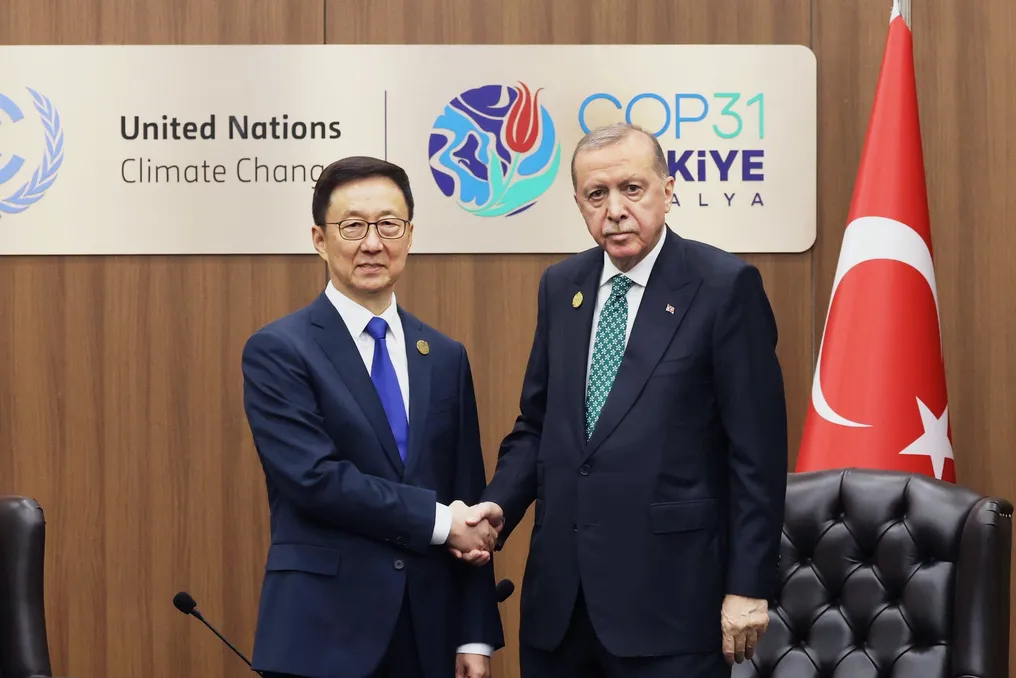
At the COP31 leaders' summit in Antalya, Vice President Han Zheng stated that China will continue to promote cooperation projects between Global South countries in the field of climate change. Following this statement, he opened a high-level forum on this issue.
He emphasized that President Xi Jinping has repeatedly stressed that China, as a member of the Global South, intends to strengthen interaction and provide all possible support to other nations. Han Zheng outlined three key areas: the country is interested in deepening cooperation in clean energy, green transport, and low-carbon industries. Furthermore, China aims to jointly raise ambitions for curbing climate change and enhance climate resilience, as well as increase work on training and capacity building in Global South countries.
Following Han Zheng's speech, several leaders and ministers from Global South countries affirmed China's significance in their approaches to climate change. Among them were Antigua and Barbuda Prime Minister Gaston Browne, Comoros President Azali Assoumani, and Ethiopian Foreign Minister Berhanu Tsegae.
The high-level forum also featured the presentation of the modernized MAZU weather monitoring and early warning system, which China previously promised to share with 30 Global South countries. It is worth noting that at the COP30 summit in Belém last year, Vice Premier Ding Xuexiang did not mention interaction with Global South countries, nor did his statement at COP29 in Baku, although there was an important reference to China's voluntary contributions to climate finance.
According to a Dialogue Earth analysis, since 2015, China has mentioned the concept of 'cooperation between Global South countries' only once at COP leaders' summits—in 2023. The term 'Global South' first appeared in China's speech this year, marking a recent addition to the country's diplomatic lexicon.
At the summit, besides high-level speeches, representatives of the International Coalition for Green Development of the Belt and Road (a platform established by China's Ministry of Ecology) actively discussed China's cooperation with the Global South. Chinese enterprises—both private and state-owned—as well as industry associations participated in these events.
Graduate student Gu Yuen from Bata University noted that China traditionally focuses its climate diplomacy on the Green BRI Initiative. However, at this COP, cooperation among Global South countries appeared to be a more prominent element in China's international climate narrative. She attributes this increased emphasis to three factors: firstly, cooperation among Global South countries may have broader international resonance than the BRI because it has its own history in international relations and is not solely a Chinese initiative; secondly, it allows China to demonstrate its growing contribution to global climate action voluntarily, without burdening itself with obligations like providing climate finance to developed countries; and thirdly, it aligns with the growing focus of climate negotiations on implementation issues, where China possesses experience and strengths, such as in implementing renewable energy.
Li Shao, director of the China Climate Hub at the Institute of Asian Society Policy, sees other reasons. He argues that there is 'no North with whom one could cooperate on climate change issues,' as the United States has withdrawn from the process, and Europe, at least at the Brussels level, seems less interested in substantive cooperation and more preoccupied with its own geopolitical problems. In his view, this has created both space and impetus for China to concentrate most of its diplomatic energy on the Global South.
According to Yao Zhe, global advisor to Greenpeace East Asia, the main offer China can make within such cooperation lies in its capabilities in green technology production. She believes that 'the biggest offer China can make lies in its industrial power in clean technologies.' Many Global South countries seek to capitalize on the opportunities arising from the transition to clean energy and wish to partner with China in shaping their economic and energy futures.
Parallel to COP, China and Turkey signed a $15 billion agreement on investments in solar and wind power plants, as well as transmission lines in Turkey. The deal reportedly includes arrangements for technology transfer.
Nevertheless, China faces difficulties in cooperating with Global South countries. Environmental and social performance indicators of Chinese companies in many regions have caused concern, protests, and even lawsuits. Gu Yuen points to 'the gap between successful national-level cooperation and the actual benefit received at the local level... A mutually beneficial outcome between countries does not necessarily mean a mutually beneficial outcome for local communities.'
Jennifer Morgan, a senior research fellow at Tufts University School of Law and Diplomacy, stated at an event in the China Pavilion that China's bilateral relations with Global South countries could lead to a repetition of North-South extractive dynamics, where wealthier countries export raw materials from developing countries and add value through secondary product manufacturing.
She emphasized that 'how China works with developing countries to create local value will be crucial for supporting green industrialization in partner countries and shared prosperity.' The Chinese government is likely aware of these tensions. For instance, in its relationship with Africa, documents from the China-Africa Cooperation Forum have long emphasized the importance of added value and industrialization on the continent. Last month, Xi Jinping issued a four-point statement on mining cooperation between China and Africa, which also highlighted the importance of added value and green technology transfer.
In Antalya, representatives of the Chinese industrial association presented overseas industrial parks with Chinese investment as opportunities to increase added value, some of which are low-carbon. This took place at a meeting between African civil society organizations and Chinese industrial associations, held under Chatham House rules.
Chinese companies are accelerating their investments in green technology production worldwide. According to the Net Zero Industrial Policy Lab, they invested $220 billion in 54 countries from 2022 to the first half of 2025. This rapid growth is a reaction to domestic market saturation, trade barriers in Western markets, and possibly concerns about 'extractive' relationships voiced by some Global South partners.
Next year will be a key moment for China in working with partners on these issues. COP32 in Ethiopia is expected to prioritize the agenda of added value, as is the 10th China-Africa Cooperation Forum to be held in the Republic of Congo.
Mandela Khadebe, Executive Director of Economic Justice Network, stated at an event during COP31: 'There is genuine value in our friendship with China. But true partnership requires mutual respect, shared prosperity, and accountability.'