Since the Middle Ages, Europeans have celebrated Christmas in vibrant street markets, a deeply rooted tradition. The oldest record of this type of fair, the Krippenmarkt, began in Vienna in 1298. Throughout the 14th and 15th centuries, these markets expanded across Germany, Switzerland, and the French region of Alsace, remaining among the most popular and flavorful in those areas.
Although they share characteristics, such as being predominantly outdoors, set up in large squares under typical European snow, and featuring wooden stalls adorned with large illuminated pine trees, each Christmas bazaar reflects local culture. The official drink is usually mulled wine, served in decorative mugs.
In Germany and Austria, the central figure is not Santa Claus, but Saint Nicholas, celebrated on December 6th. In Nuremberg, the highlight of the celebration is the arrival of the Child Jesus, represented by a child selected from the city's schools. Furthermore, mythical figures known as Krampus animate the fairs in Munich and Vienna, something exclusive to these regions.
Christmas enthusiasts travel long distances to experience these authentic festivities. Below, we detail the secrets of European Christmas bazaars.
The markets in Munich begin preparations shortly after the end of Oktoberfest. Although it has existed since the 14th century, the city's Christmas market was relocated to Marienplatz in 1972. There, along with adjacent streets, 138 stalls occupy about 30 thousand square meters. In the center of the square, a natural 22-meter fir tree is decorated with over 3 thousand LED lights.
Residents and tourists gather to taste warm pretzels and mugs of glühwein, which can be complemented with a shot of cognac or rum. On December 13th, the Krampus Run takes place, where more than 300 participants dress in costumes inspired by mythological beings, such as satyrs and fauns. The city also offers smaller markets, such as the Mittelaltermarkt in Wittelsbacher Square, illuminated by torches, and the Rindermarkt in Sternenplatzl.
For those who do not see snow in the Bavarian capital, a day trip to Garmisch-Partenkirchen is suggested, located an hour and a half from Munich, which has a ski resort and alpine cuisine restaurants.
The German capital combines its modern style with rich Christmas traditions, offering over 100 markets during the festive period. One of the most sought-after is the one at Gendarmenmarkt, where some stalls are run by renowned chefs, presenting simplified versions of their restaurant dishes. This event runs until December 31st, making it ideal for those planning New Year's Eve in Berlin.
The Spandau market, smaller and located in a historic district, is the oldest in the city, operating from November 23rd to December 22nd. It features a Ferris wheel, carousels, and a nativity scene with animated figures. Another notable attraction is the Berliner Weihnachtszeit, in Roten Rathaus Square (November 23rd to January 3rd), which includes an ice skating rink, a Ferris wheel, and a carousel. Winter World, located at Potsdamer Platz, offers a snow slide from November 23rd to December 26th.
In romantic Cologne, a small train connects four of the main Christmas bazaars. One of these markets is by the Rhine, near the Chocolate Museum, and will feature about 70 wooden stalls selling crafts and delicacies in 2026. A 48-meter Ferris wheel provides views of the river and the historic center.
The main, more classic market is located at the foot of Cologne Cathedral, an icon of Gothic architecture and one of Germany's most visited attractions. The surrounding stalls sell handicrafts and decorations. In the center of the square, a 25-meter Christmas tree is surrounded by approximately 50 thousand LED lights.
Due to its strategic location on the railway network, Cologne is a likely stop on trips across Europe, facilitating access to other German cities and European capitals such as Brussels, Amsterdam, and Paris.
Considered by several guides as the best Christmas market in Europe, the Christkindlesmarkt in Nuremberg strongly values tradition. Regional crafts are prioritized, and some wooden stalls date back to 1890. Common souvenirs include small nutcrackers and gingerbread, cookies enriched with marzipan.
The most popular snack is the weggla sandwich, composed of three small Original Nuremberg sausages covered with dark mustard. To accompany it, a steaming mug of glühwein is served, which, at the Gerstacker family stall, is flavored with blueberries. The Kinderweihnacht, the children's market next to the main square, features a carousel and Ferris wheel, with smaller stalls and cooking workshops for children to decorate cookies.
For history enthusiasts, Nuremberg preserves vivid (and dark) records of the Second World War, including the large rallies held by Hitler. During the bombings, brewery cellars were transformed into bunkers interconnected by tunnels, and these memories are displayed at the Germanisches National Museum, near the central station.
Although Dresden is often seen as a stop between Berlin and Prague, the city shines intensely in December. It is noteworthy that its buildings were almost completely destroyed by World War II bombings but were carefully reconstructed. Dresden offers an intense program of winter concerts and hosts the oldest Christmas bazaar in Germany, registered in 1434. The stalls of the Striezelmarkt are arranged in Altmarkt Square, in the old part of the city.
The most striking local symbol is the striezel (or stollen), a sweet bread made with dried fruits, butter, and almonds. This year, on December 5th, bakers prepared a giant stollen and held a parade featuring the Stollen Girl. The market named after the sweet is the largest, but there are other bazaars, such as the small Neumarkt, focused on artisanal products.
The Semper Opera, home to Wagner and Richard Strauss, will feature performances of The Nutcracker ballet from November 28th to December 25th. This Neo-Renaissance building from 1841 has been rebuilt twice: the first in 1878 after a major fire, and the second after World War II, only reopening in 1985.
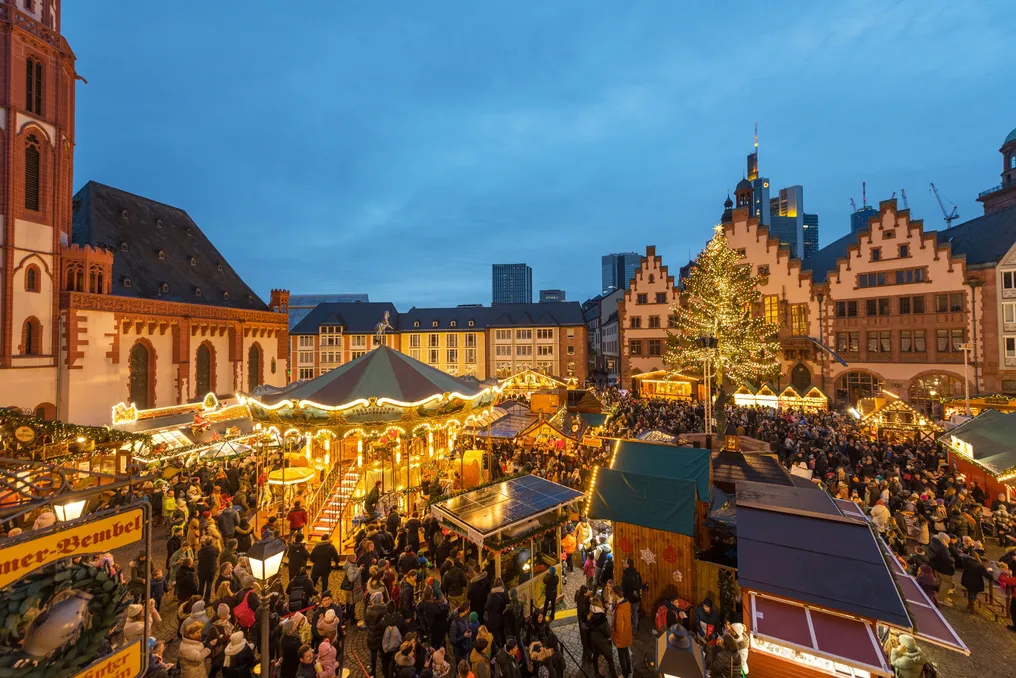
The Frankfurt market, one of the largest in Germany, has existed since 1393. About 250 stalls are set up in the Römerberg and Paulsplatz squares. In the Römerberg, an immense 27-meter Christmas tree, imported from Austria, stands out. The market is famous for serving regional delicacies, such as apple mulled wine and traditional almond and marzipan cookies, known as bethmännchen.
This city, situated between Frankfurt and Munich, celebrates tradition with a cultural market that attracts over 3.5 million visitors annually. In the Renaissance courtyard of Altes Schloss, choir and musical group performances take place. From Friday to Sunday, Christmas melodies resonate from the town hall balcony and the tower of Stiftskirche church, which also hosts organ concerts.
The stalls are concentrated on the cobblestone streets between Marktplatz and Schlossplatz, where an annual popular contest awards the best-decorated stall. Regional specialties come from the Black Forest, including felt slippers and fruit liqueur. The local glühwein is made with good wine produced nearby. Visitors enjoy käsespätzle, a type of potato pasta topped with cheese sauce.
Additionally, automotive enthusiasts can spend the day at the Mercedes-Benz Museum, a modern nine-story building on the eastern edge of Stuttgart, which exhibits the evolution of Europe and the automobile, created in 1886 by Gottlieb Daimler and Carl Benz. Those who prefer to drive can visit the Porsche Museum, where they can rent a brand car.
Only a 15-minute subway ride separates Stuttgart from Esslingen, whose Christmas market attracts a large flow of visitors. The village's commercial vocation dates back to the Middle Ages, when it was part of an important trade route. The central streets, interspersed with canals, feature half-timbered houses that reinforce the Christmas atmosphere. The products sold evoke the Middle Ages, such as natural soaps, board games, and caramelized and seasoned almonds.
In many stalls, costumed vendors demonstrate ancient crafts, such as forging knives or sewing leather. Children's activities include medieval games, archery, and candle-making workshops, as well as a small manually operated Ferris wheel. Gastronomically, roasted duck legs and hot beer punches are served, while stalls bake heurekaners, pastries filled with cheese, ham, and garlic cream. Many visitors use Stuttgart as a base to explore the markets of Esslingen.
The most charming medieval citadel in Bavaria evokes a fairy-tale setting. The Reiterlesmarkt, an extremely traditional market, transforms the area into a Christmas postcard. Its name refers to a sinister legendary figure, who, according to myth, could travel between dead souls, but who evolved over the centuries into a benevolent character who distributes gifts at Christmas, much like Santa Claus. This year, his arrival on horseback in the main square will take place on November 27th.
Visitors seek typical delicacies such as the schneeball, a fried dough sweet sprinkled with sugar, and abundant Christmas decorations in stalls and shops. The most desired items can be found at Käthe Wohlfahrt, which offers nativity scenes, pendants, snow globes, and enchanting music boxes. A journey of just 1 hour and 15 minutes by train connects Rothenburg to Würzburg, which houses one of Germany's largest Baroque buildings. The Würzburg Residence Palace, built in 1720, has about 400 rooms and currently houses government offices and a museum. The attached cellar, Staatlicher Hofkeller, offers tastings of excellent Rieslings.
In the Alsace region, which has been part of Germany, the most popular French Christmas markets are found. The nickname 'Christmas capital,' often associated with Strasbourg, is not accidental. Annually, the city receives at least 2 million visitors. About 300 bazaar stalls are spread across various streets and squares. Notable are the stalls selling flammekueche, a kind of pizza topped with bacon and onions, and those displaying a wide variety of bredeles, Alsatian biscuits. Between one tasting and another, the picturesque Petite France neighborhood, with canals lined with half-timbered houses, is unmissable. The Strasbourg Cathedral of Notre-Dame also stands out.