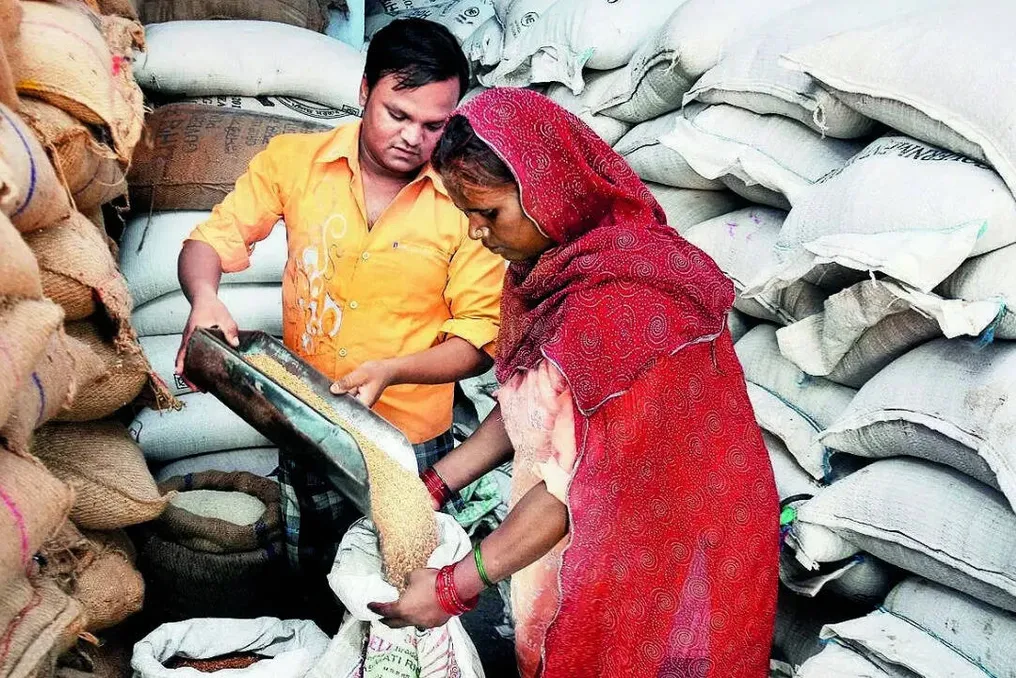
Cases of inclusion of ineligible recipients in the Central free ration program detected
Read more
The times of India
timesofindia.indiatimes.com

Cases of inclusion of ineligible recipients in the Central free ration program detected

According to a survey conducted by the Union's Ministry of Food, a small number of ineligible recipients may have been included in the centralized free ration program known as Pradhan Mantri Garib Kalyan Anna Yojana (PMGKAY). This program is primarily aimed at ensuring food security for low-income segments of the population.

The assessment covered 51,303 beneficiary households, 4,939 government-licensed Fair Price Shops, 2,036 members of the Oversight Committee, and 245 storage facilities in rural and urban areas across all 36 states and territories of the Union, as reported by PTI.

The report notes that the national inclusion error was 13.2% (moderate). Significantly higher inclusion error rates were recorded in West Bengal (39.5%), Tripura (39.2%), Tamil Nadu (38.7%), and Meghalaya (28.5%), according to the report published on the department's website.

According to the report, the inclusion error rate reached 12.5% in rural areas, while it was 15.6% in urban areas. It was also found that Antyodaya Anna Yojana (AAY) households had a slightly lower inclusion error percentage—12.2%, compared to 13.4% among priority households.

Despite the identified errors, the study showed that beneficiaries were generally satisfied with PMGKAY. The report adds that beneficiary satisfaction remains high: 90.6% are satisfied with FPS services, and 94.9% are satisfied with the quality of grains. Furthermore, nearly 99% of beneficiaries reported that the grain is consumed within the household, indicating strong utilization of the product to achieve food security goals.

Under the Pradhan Mantri Garib Kalyan Anna Yojana program, implemented in accordance with the National Food Security Act (NFSA), the Center provides 5 kg of free grains per person per month for eligible priority category households. Antyodaya Anna Yojana households are entitled to 35 kg of grains per household per month. In total, the food security act covers about 800 million people.

According to the NFSA, an inclusion error occurs when households that do not meet the eligibility criteria set by the states continue to receive subsidized grains.

The Department of Food and Public Distribution has directed a 'Joint Assessment and Monitoring of NFSA-PMGKAY' (2025-26) to evaluate the effectiveness, coverage, and operational efficiency of the NFSA 2013 and PMGKAY, as well as beneficiary experiences across all states and territories of the Union. The study examined various aspects of implementation, including targeting efficiency, service delivery, grievance redressal, digital systems, portability, infrastructure readiness, beneficiary awareness, and operational performance.


Similar stories

International #RememberMinab Campaign Draws Attention to Victims of School Attack in Minab
Read more
www.tehrantimes.com

International #RememberMinab Campaign Draws Attention to Victims of School Attack in Minab

In connection with Children's Day, the organization is conducting an international campaign under the hashtag #RememberMinab, which highlights the tragic story of students killed in Minab. This campaign has reached streets, subway stations, and public squares from London to Tokyo.

Supporters describe this initiative as a cultural and memorial event. The campaign included street exhibitions, photo presentations, artistic performances, commemorative gatherings, and symbolic actions in several countries. The main goal is to honor the memory of the victims, draw the attention of the international community, and prevent their names from being forgotten.

London: Empty Chairs and a Memorial Book

A street memorial exhibition was held in London. Empty chairs, along with school bags and photographs of students from Minab, were placed in a public space. Organizers explained that this symbolic installation aims to show the absence of children who will never return to the classroom. A memorial book was also installed on site, where passersby left messages of solidarity and sympathy, turning the exhibit into a space of human messages.

Pakistan: The Name Minab on the Seashore

In Pakistan, an activist advocating for resistance wrote the hashtag #RememberMinab on a seaside beach as a sign of symbolic support. Video footage of this action was widely circulated in Iranian media and social networks, becoming one of the most notable moments of the campaign. Writing the name Minab in the sand was a simple yet significant act that drew public attention to the memory of the children and spread the campaign's message beyond borders.

In Los Angeles, supporters held a memorial gathering in front of the Israeli consulate. Participants stated that the rally was organized to commemorate the students of Minab on Children's Day and to ensure their story was heard internationally and to hold those responsible accountable.

The Hague: Faces of the Victims in an Exhibition

In The Hague, Netherlands, a photo exhibition featuring students from Minab was organized as part of the campaign. The children's photographs were displayed in a public space to introduce visitors to their faces and memories, aiming to attract the attention of the European public through visual language.

From Tokyo to Paris: Minab's Eyes, Subways, and Candles

An artistic performance titled 'Minab's Eyes' took place in Tokyo. Images of the eyes of children from Minab were displayed on the city sidewalks, prompting Japanese passersby to reflect and sparking dialogue. A Japanese activist spoke at the event, condemning the attack and speaking about the suffering of the schoolchildren. Participants described it as a quiet, silent message about the need to remember such events; one stated that all people desire peace, while another expressed sorrow and hope that people in Iran and around the world could live in safety and peace.

In Berlin and Frankfurt, photographs of Minab's students were placed in subway stations, bringing their faces into everyday urban life and integrating their memory into the daily routine of the city. In Paris, a memorial ceremony was held in front of the Eiffel Tower. Participants lit candles, kept vigil, and displayed photos of the victims in one of the most recognizable locations in the French capital, emphasizing the need to keep their memory alive.

What Happened in Minab?

The campaign relates to an airstrike that occurred on February 28, 2026, on the Shajareh Tayeb Primary School in Minab, Hormozgan Province, southern Iran. The attack happened on the morning of the first day of the war between the US and Israel against Iran. As a result of at least three missiles hitting the school grounds and buildings, 168 people died, including students, teachers, school staff, and some relatives, as the attack affected neighboring facilities.

The Minab prosecutor later provided detailed statistics: 156 dead, including 120 students (73 boys and 47 girls aged 7 to 12), 26 female teachers, 7 parents, a driver, a clinic worker, and an unborn child. Iranian officials claim that about 300 surviving students continue to suffer from severe psychological trauma.

Amnesty International, using satellite imagery, video materials, and interviews, concluded that the school building was directly hit, and that over 100 children were among the deceased. Recently, a UN fact-finding mission stated there were sufficient grounds to believe that the strikes by American Tomahawk missiles, including the strike on the school in Minab, constitute war crimes. US Secretary of Defense Pete Hegseth stated that the investigation is ongoing.

The UN mission to Iran, the Iranian Red Crescent, and high-ranking military officials called for an independent and transparent investigation, as well as accountability and compensation, emphasizing that schools are protected under international humanitarian law as long as they maintain their civilian status.

Age of Men Marrying in Uzbekistan and Marriage Statistics
Read more
sputniknews.uz

Age of Men Marrying in Uzbekistan and Marriage Statistics

According to the National Statistical Committee, the majority of men forming families in Uzbekistan belong to the age group of 20 to 30 years old. There are also cases of marriage registration among individuals over 60 years old.

From January to September 2026, 172 thousand marriages were registered in Uzbekistan. The National Statistical Committee has released data on the age groups of men who entered into marriage.

According to the committee, the vast majority of men who married fall into the 20–30 age group. Furthermore, it is noted that people in older age groups, including those over 70 years old, also form families.

In recent years, the number of marriages in the country has shown a downward trend. For example, if 197 thousand marriages were registered in the first nine months of 2022, this figure was 177 thousand in the same period of 2025, and 172 thousand in 2026.

This year, registered marriages were distributed as follows: 88 thousand in cities and 84 thousand in rural areas.

Popular