ChatGPT learns to drive a car after being connected to a Toyota Corolla vehicle
Read more
Super Abril
super.abril.com.br

ChatGPT learns to drive a car after being connected to a Toyota Corolla vehicle

ChatGPT, along with other artificial intelligence models such as Gemini, Claude, and similar ones, is classified as a 'large language model' (LLM). This type of algorithm works by analyzing statistical connections between words to generate responses to queries.

It is important to note that this model fundamentally differs from the AIs used in autonomous vehicles, as the latter are specifically trained using images of traffic, pedestrians, and other automobiles.

Despite this structural difference, it has been demonstrated that ChatGPT possesses the ability to learn to drive autonomously. Three developers from Axion Math, a company based in the United States, integrated the GPT-6 Astra algorithm—the latest version of ChatGPT, accessible only through paid plans—into the main computer system of a Toyota Corolla.

With this connection, the artificial intelligence took control of the steering wheel and the vehicle's pedals. Subsequently, the programmers asked ChatGPT to drive the car along a route delimited by cones set up in a parking lot. After several attempts, ChatGPT succeeded in completing the route.

The other algorithms tested, specifically Claude Fable 5.1 and Grok 4.6, were unable to complete even half of the same circuit.

Similar stories

Robotic blacksmiths manufacture Toyota pickup body, excluding equipment over 20 tons
Read more
autopapo.com.br

Robotic blacksmiths manufacture Toyota pickup body, excluding equipment over 20 tons

The robots were able to form an individual body for the Toyota Tacoma pickup in approximately three weeks. This process, according to the company, would take up to six months using traditional manufacturing methods.

The Lassen vehicle, which was presented at the Los Angeles Auto Show this Friday (the 20th), is a demonstration of the new automotive division of Machina Rebellis, belonging to the California company Machina Labs. The Tacoma is a mid-size pickup that Toyota sells in the US and is comparable in size to the Hilux.

The project's design was developed by the British studio Callum, led by Ian Callum, who headed Jaguar's design for two decades. The hood, tailgate, front, and side fenders are inspired by California's volcanic national park and are exclusive elements.

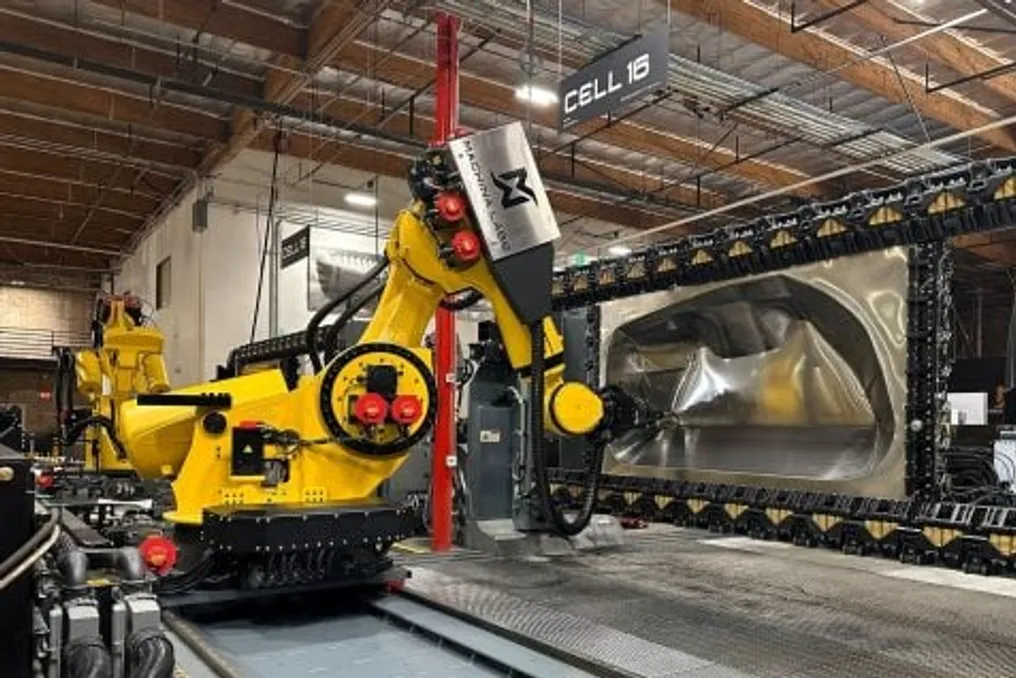
In traditional industry, body sheets are formed in press dies—tools that can exceed 20 tons in weight, and this is only economically viable when producing thousands of identical parts. However, the Machina platform, named RoboCraftsman, eliminates this stage: two robotic manipulators positioned on either side of the sheet press it point by point based on a digital file, mimicking the work of a blacksmith.

In the Lassen model, the hood and tailgate were created based on original Tacoma parts, onto which a topographic pattern and the Machina name were embossed. As for the aluminum fenders, which are 2.5 cm wider on each side, and the side panels, they were formed from smooth sheets.

According to the company, engraving the pattern on the finished part takes only a few minutes, whereas forming a new part requires several hours.

Machina Labs previously served mainly the aerospace and defense sectors but has already demonstrated Anvil—a Ford F-150 Lightning pickup with a robot-manufactured body. Investors include Toyota through its investment arm, Woven Capital.

The new division focuses on special editions, prototypes, and body kits for accessory companies. Furthermore, Machina plans to integrate its robotic cells, each valued at 5.9 million Brazilian reais ($1 million USD), directly into automakers' factories.

Regarding Lassen, CEO Edward Meier expects to deliver ten units to customers in 2027 as part of a pilot project.

IIT Guwahati researchers use drones to model the movement of 36 thousand vehicles on Indian roads
Read more
thebetterindia.com

IIT Guwahati researchers use drones to model the movement of 36 thousand vehicles on Indian roads

On Indian roads, where cars, buses, three-wheelers, and two-wheelers are often forced to share limited space, traffic can change drastically in mere seconds. For urban planning specialists and traffic engineers, understanding this dynamic is a complex task because many traditional models assume that vehicles strictly follow lanes and maintain predictable speeds, which rarely corresponds to reality on Indian roads.

Researchers from the Indian Institute of Technology (IIT) Guwahati are working to bridge this gap. They have developed mathematical models that better account for the unpredictable behavior of transport on Indian roads by combining drone video footage, automatic vehicle tracking, and machine learning.

Tracking the positions of nearly nine million vehicles

The research team, led by Professor Akhilesh Kumar Maurya from the Department of Civil Engineering, studied traffic movement on an eight-lane divided highway on the outskirts of Delhi. Using drones equipped with high-resolution cameras, they recorded about five hours of daytime traffic in 4K resolution. These videos were then processed using DataFromSky software, which extracts vehicle movements from aerial imagery.

The result was a dataset comprising 36,818 vehicles and 8,938,920 data points on vehicle positions, captured at a frequency of 10 frames per second. The researchers categorized the vehicles into six groups: two-wheelers, three-wheelers, cars, buses, heavy commercial vehicles, and light commercial vehicles. This allowed for a detailed picture of how different types of transport moved, how closely they followed each other, and how their speed changed as traffic density increased.

Professor Maurya emphasized the need to use India-specific data, explaining that 'road conditions in India differ from the conditions in many countries where existing traffic models were developed. We need traffic data that reflects the diversity and characteristics of Indian roads.'

Drone-based data collection provides the ability to observe a large number of vehicles and their movements on a road section with high spatial and temporal detail.

The researchers found that the distance between vehicles varied depending on traffic density. On relatively free roads, vehicles maintained larger intervals, but as traffic grew, these intervals decreased. However, under severe congestion, the arrangement patterns changed again.

This variability is important because two vehicles moving under seemingly similar conditions will not necessarily move at the same speed. To understand these differences, the team tested six traffic mathematical models, including established approaches such as Greenshields and Underwood. Additionally, they trained two machine learning models: Artificial Neural Networks (ANN) and Random Forest (RF).

The most interesting aspect was the creation of stochastic fundamental diagrams. Simply put, traditional traffic models usually estimate one speed for a given traffic density. Stochastic models go further by considering the range of speeds at which vehicles can actually move under those conditions. This allows the models to represent the randomness of Indian traffic more realistically, instead of smoothing out the differences between individual vehicles.

From improving forecasts to smarter road planning

The researchers found that the Underwood model showed the greatest stability among the tested mathematical models, achieving an R² value of 0.86. Both machine learning models showed approximately 0.83.

The results obtained can find practical application in assessing highway capacity, designing intersections, determining road speeds, and improving traffic modeling. The data can also help researchers calibrate car-following models that study how drivers regulate their distance and speed relative to the vehicles ahead.

Professor Maurya noted: 'Reliable traffic management starts with models that reflect how traffic actually behaves on Indian roads. High-detail trajectory data obtained via drones allows us to capture the interaction between different types of vehicles and the greater variability that traditional traffic models often overlook.'

Such India-specific models can support more realistic traffic simulation, improve road and intersection design, manage congestion, assess capacity, and develop intelligent traffic control systems adapted to Indian conditions.

For anyone who has spent time on the roads in India, the complexity of traffic forecasting is easily understood: a car slows down, a two-wheeler enters a narrow gap, an auto-rickshaw changes lanes, and the movement of hundreds of vehicles can change in seconds. By meticulously recording these interactions, the IIT Guwahati team hopes to make traffic models more reflective of what passengers experience daily. This research is a step toward understanding not only how many vehicles use the road, but also how they move relative to each other, which can ultimately help make the daily commute more predictable.
DiDi plans to integrate robotaxis and human drivers into the same transport application
Read more
tecnoblog.net

DiDi plans to integrate robotaxis and human drivers into the same transport application

The Chinese mobility giant, DiDi, intends for both autonomous vehicles and human drivers to provide services to passengers through a single ride-hailing application. Stephen Zhu, who is responsible for the company's international operations, which includes the 99 app in Brazil, explained that driverless cars will play a complementary role within a 'hybrid model' that unites robots and people.

Zhu demonstrated vehicles to foreign press, including Tecnoblog, at the company's headquarters in Beijing. He believes that robotaxis can be useful during peak periods. According to him, a fleet of car with drivers sized only for rush hour might sit idle during the middle of the day, while a fleet adjusted for calmer hours might suffer from a lack of vehicles during high demand times.

The executive raised several questions about implementing thousands of autonomous cars on the streets, arguing that the challenges go beyond simple driving. He questioned who would be responsible for cleaning the vehicles in case of dirt or liquid spills, as well as for maintaining these automobiles. Furthermore, Zhu pondered which entity would have the necessary capital to acquire and maintain a fleet of this magnitude.

To expand the service to other markets, Zhu highlighted the need to conduct local tests and obtain the necessary authorizations from regulatory bodies. Although he did not specify where commercial operations outside of China will begin, he emphasized that the launch of autonomous driving will be done progressively. In April, DiDi announced the United Arab Emirates as its first international destination for this technology, with tests and pilot initiatives scheduled for 2026.

DiDi has been developing its own autonomous vehicle technology since 2016. According to Zhu, the company began testing in Beijing without a safety driver on board in 2024. At one of the project facilities, it is possible to observe the evolution of the cars, from the first to the fourth generation. The most recent model, named R2, was created in collaboration with GAC Aion, which is the electric vehicle division of GAC, also Chinese and present in Brazil.

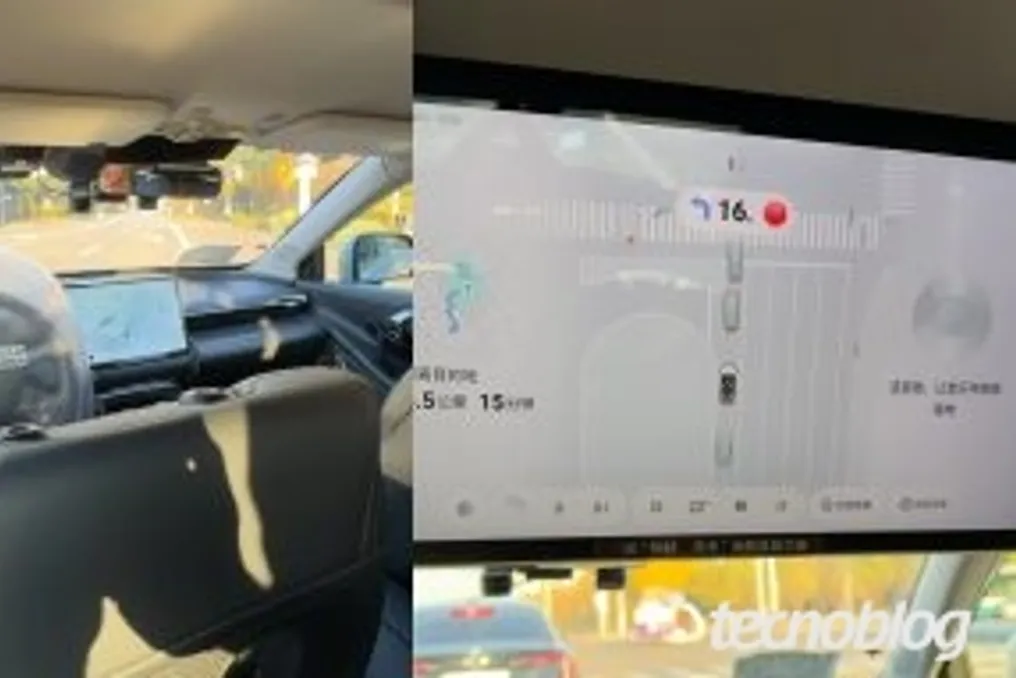
During a service demonstration, the report described a smooth boarding in a comfortable vehicle. A notable detail is that the steering wheel is protected by a plastic cover, preventing any physical access. DiDi reports that the R2 uses 33 sensors to interpret the environment, including radars and cameras, with LiDAR being one of them, which uses laser pulses to create a three-dimensional map of the surroundings. The trip lasted approximately 20 minutes, during which the car repeatedly traveled the same route. The two internal screens display a graphic representation of what the vehicle is perceiving, showing cars in front, behind, and on the sides. The system also recognizes common traffic elements, such as bicycles, cones, and traffic signs.

In the test conducted, the car maintained a cautious pace, described as monotonous, reaching speeds of 30 km/h on a road with a 70 km/h limit. During the demonstration, there was no option to select a riskier driving mode in case of urgency. Starting in August 2026, it will be possible to request the R2 via the DiDi app in test areas in Beijing and Guangzhou. Meanwhile, Waymo already offers passenger transport in 15 restricted markets in the United States, and the author of the text has personally used a company vehicle in San Francisco, California, with great comfort.

Popular