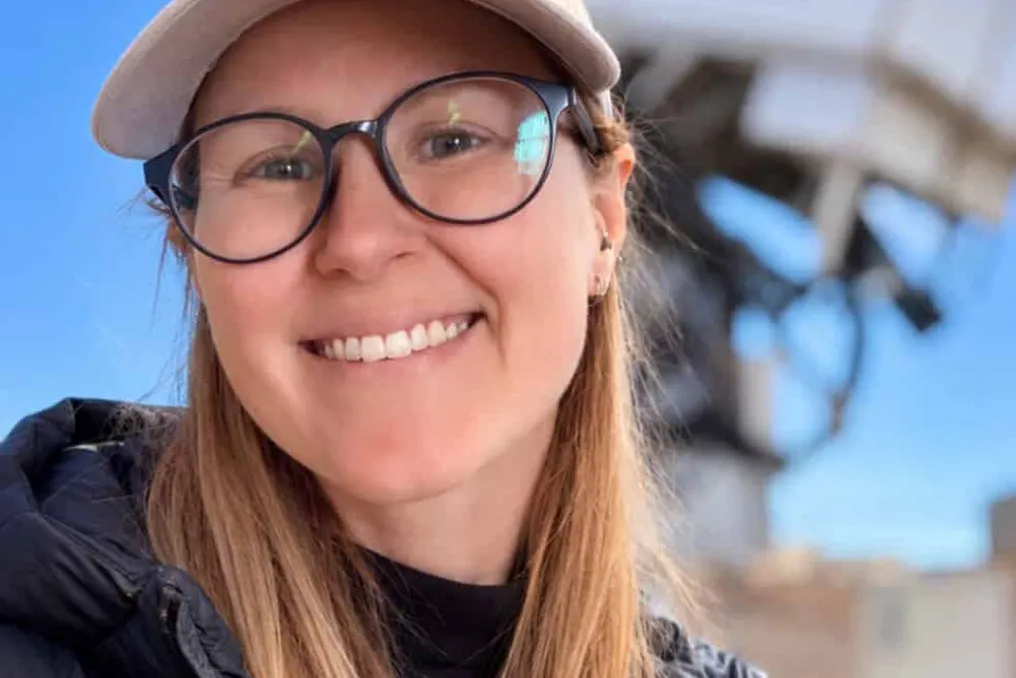
An international team of scientists is investigating how the Universe began and how the first stars and galaxies emerged in the Atacama Desert, Chile. Among the researchers involved is Jullianna Denes Couto, a natural astrophysicist from Minas Gerais and responsible for managing the scientific instrumentation of the CLASS telescope (Large Scale Angular Cosmological Survey), located atop Cerro Toco.
This equipment was designed to record cosmic microwave background radiation, which is a remnant of the Big Bang and has been traveling through space since the Universe was only 380 thousand years old. Analyzing the temperature variations and polarization of this radiation allows scientists to examine the conditions present in the early stages of cosmic history.
During her participation in the Space View program last Friday (13th), Julianna explained that the selection of this remote, high-altitude area is due to the need to avoid atmospheric humidity, which tends to absorb and interfere with the observed microwaves. She emphasized that the crucial factor is the low humidity of the desert, as water absorbs microwaves, making the drier environment ideal for collecting this terrestrial data.
The researcher's academic background began at the Federal University of Ouro Preto, where she completed both her undergraduate degree in Physics and her master's degree. Subsequently, she pursued studies in the United States, obtaining her doctorate from the Catholic University of America, focusing on supermassive black holes, and worked at a NASA research center. Since 2017, she has been part of the CLASS team.
At the observation station located in the Andean plateau, the routine demands great resilience and dedication given the harsh climatic conditions. Professionals must manage intense cold and thin air during detector checks and maintenance, a vital task to ensure continuous collection of scientific data and proper instrument functioning.
One of the main focuses of the CLASS telescope is studying the cosmic dawn, the period when light emitted by the first galaxies and stars transformed the gas filling space. According to Julianna, the light originating at that time, 380 thousand years ago, and which set out to travel through the cosmos, passes through the entire history of the Universe until it reaches Earth, encountering the first forming stars along the way.
In addition to mapping the cosmic background, continuous observations contribute to the study of neutrinos, dark energy, and galactic structure. Astrophysics also highlighted the role of artificial intelligence as a valuable tool to speed up the analysis of complex data, allowing scientists to focus efforts on new and innovative hypotheses for advancing research. The use of modern algorithms optimizes routine activities, freeing the team from repetitive tasks and enabling greater focus on interpreting astronomical findings.
Julianna added that artificial intelligence functions as a fantastic tool that aids in faster progress in the search for scientific goals, as it frees up human reasoning for other ideas.
Outside the technical context of the observatory, Julianna dedicates time to scientific outreach on social media, where she has hundreds of thousands of followers. Her purpose is to spark interest in exact sciences among new generations and encourage young people to pursue scientific careers. She mentioned that her outreach work focuses on reaching the general public, but her deepest desire is to encourage girls to achieve their goals, to dream big, and to believe in the possibility of realizing everything they wish for.
Understanding cosmic enigmas requires patience, international cooperation, and constant investment in cutting-edge technology adapted to extreme environments. The work carried out at CLASS constitutes a significant milestone in contemporary scientific exploration, uniting precise observations of the distant past of the Universe with the active search for answers about the future of our astrophysical understanding on a global scale.
Julianna stressed that mutual support among researchers and the exchange of experiences strengthen the scientific community dedicated to unraveling the most intricate spatial mysteries of today. Every new piece of data collected by the observatory brings humanity closer to understanding the fundamental laws governing the formation of everything, from the smallest particles to the largest known galactic structures.
Upcoming missions and astronomical surveys planned for this decade promise to further revolutionize the understanding of fossil radiation and cosmic inflation. The active participation of Brazilian scientists in these global projects demonstrates a high level of technical preparedness and the importance of national contribution to the progress of universal scientific knowledge.