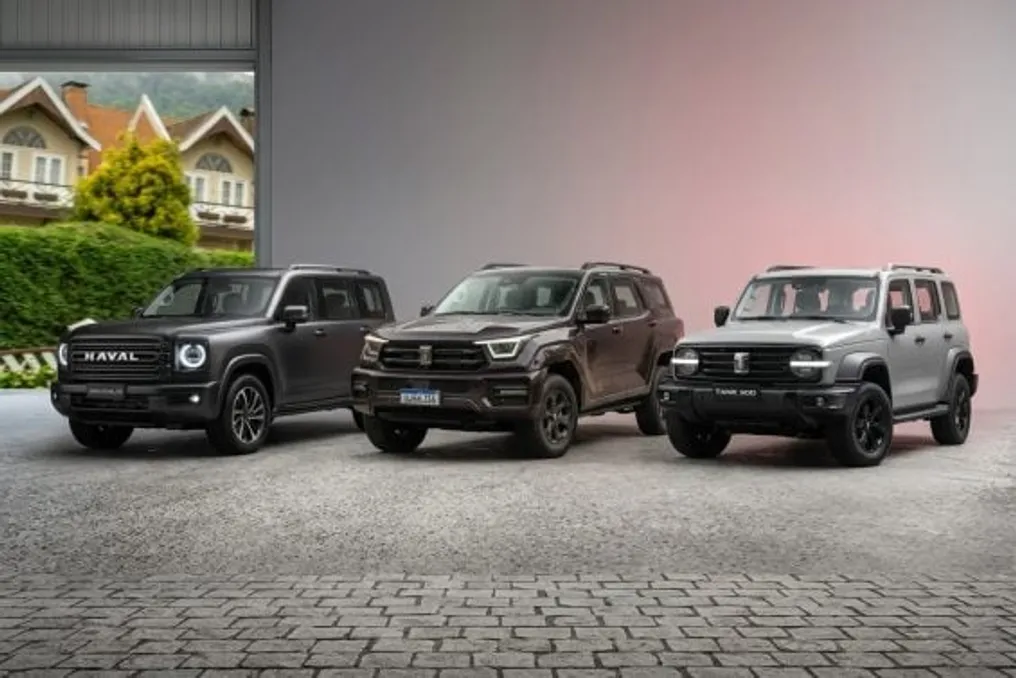
GWM has innovated in the segment of traditional ladder-frame SUVs with 4x4 traction, reduction gear, and a rigid rear axle by introducing the plug-in hybrid Tank 300, followed by the diesel-powered Haval H9, and more recently, the launch of the plug-in hybrid Tank 400.
Although they share a similar construction, these SUVs are distinguished by their proposals and the equipment packages offered. The Tank 300 is aimed at the off-road enthusiast, the Haval H9 targets the more traditional consumer who prefers diesel engines, and the new Tank 400 focuses on a more luxurious profile.
In terms of sales, the Haval H9 leads the trio, registering 9,805 units sold between January and October. The Tank 300 sold 4,119 units, almost half the volume of its counterpart. The Tank 400 is recent and is not yet in the sales ranking.
The Haval H9 is the most affordable model of the trio in terms of the GWM chassis, equipped with a 2.4L turbodiesel engine without electrification and a nine-speed automatic transmission. This engine generates 184 hp and 48.9 kgfm, allowing the vehicle to reach 100 km/h in 13 seconds.
The Tank 300 operates as a plug-in hybrid, combining a 2.0L turbo flex engine with an electric component integrated into the nine-speed automatic transmission. Together, they produce 394 hp and 76.4 kgfm, regardless of the energy source used.
Due to the integration of the electric motor into the transmission, it can drive the rear axle or all wheels through the transfer case. In the Tank 400, the mechanical setup is identical, and GWM reports that both achieve 0 to 100 km/h in 6.8 seconds.
Inmetro data indicates that the Haval H9 is the most economical traditional SUV from GWM. This classification is due to the testing methodology, which does not favor plug-in hybrids because it is conducted with the battery discharged. Nevertheless, the Haval H9 proves to be economical when compared to other turbodiesel models.
The difference in electric range between the two hybrid models is modest: the Tank 300 can travel 74 km on a full charge, while the Tank 400 reaches 71 km. This occurs because both share the same 37.1 kWh battery, with a fast charging capacity of up to 50 kW.
Differences between GWM Chassis SUVs
At this point, the three SUVs begin to show clear distinctions. The Tank line is more oriented towards off-road use, and the brand supports this vocation with specific accessories for this niche.
The Tank 300 features 4x4 traction with a reduction gear and locking differentials available on the front, center, and rear axles. Its ground clearance is 22.2 cm, the lowest in the group, but its smaller size gives it an advantage in trails.
The Haval H9 also offers 4x4 traction with a reduction gear and allows locking the front and rear differentials. Its ground clearance is slightly higher, measuring 22.4 cm.
GWM has equipped the Tank 400 with a distinct traction system, including an automatic 4x4 mode option. Its center differential can redistribute power between the axles, enabling use on asphalt as four-wheel drive. Furthermore, it has a reduction gear, 4x2 mode, and the ability to lock all three differentials.
Analyzing the specifications, it is noted that the Tank 400 surpasses the others in ground clearance, approach angle, and has larger tires. Its wading depth is equal to that of the Haval H9. All vehicles include useful trail features, such as Tank Turn (which reduces turning radius), 540° camera with transparent chassis, and off-road cruise control.
These attributes, combined with the more sophisticated traction system, suggest that the Tank 400 is the most suitable for those who practice off-roading. However, if the budget does not support the nearly R$ 400 thousand, the other brand SUVs also offer good options.
Currently, the Haval H9 is the only seven-seater SUV from GWM available in Brazil. To accommodate seven occupants, it needs to be larger, which is reflected in its dimensions.
The Tank 400 has a similar size and shares the 2.85m wheelbase, but it is configured with only five seats. The Tank 300 is the smallest in dimensions, as the H9 weighs more due to the lack of electrification.
GWM specifies the roof cargo space measurement, which is the only aspect where the Tank 300 exceeds its siblings, accommodating up to 863 liters.
Technology and Finish
Despite the traditional construction, the equipment package of these models is full of advanced technology. Features such as full-LED headlights, Level 2+ ADAS package, 540° camera, 50W wireless smartphone charger, heated front seats, powerful sound system, and other luxury items come standard.
The Haval H9 comes equipped with a 14.6-inch multimedia center and a 10.25-inch instrument panel, in addition to second-row seat ventilation, triple-zone air conditioning, retractable step, full-LED matrix headlights, panoramic sunroof, and a 220V outlet in the trunk.
Among the highlights of the GWM Tank 300, the dashboard with two 12.3-inch screens for the multimedia center, dual-zone air conditioning, sunroof, fixed step, driver massage function seat, analog clock, and winch preparation stand out.
The Tank 400 incorporates greater luxuries, such as the climate-controlled center console, 15.6-inch multimedia center, 12.3-inch instrument cluster, head-up display, panoramic sunroof, triple-zone air conditioning, active noise cancellation, two 50W wireless chargers, rear window blinds, and massage for both driver and passenger.
GWM has clearly established the positioning of its three chassis SUVs in the Brazilian market, managing to meet various consumer profiles without generating internal sales competition.
The Haval H9, with its diesel engine and three rows of seats, configures itself as a family alternative for those who do not want an electrified vehicle. Its engine is efficient and ensures great autonomy thanks to the 78-liter tank.
The Tank 300 is smaller and has a larger trunk. This feature, combined with excellent off-road capability, makes the model ideal for expeditions and adventures.
Finally, the new Tank 400 enhances the capabilities of its sibling, adding various luxury features inherited from the Wey 07, such as the climate-controlled console. Thus, GWM seeks to offer SUVs that please all tastes.