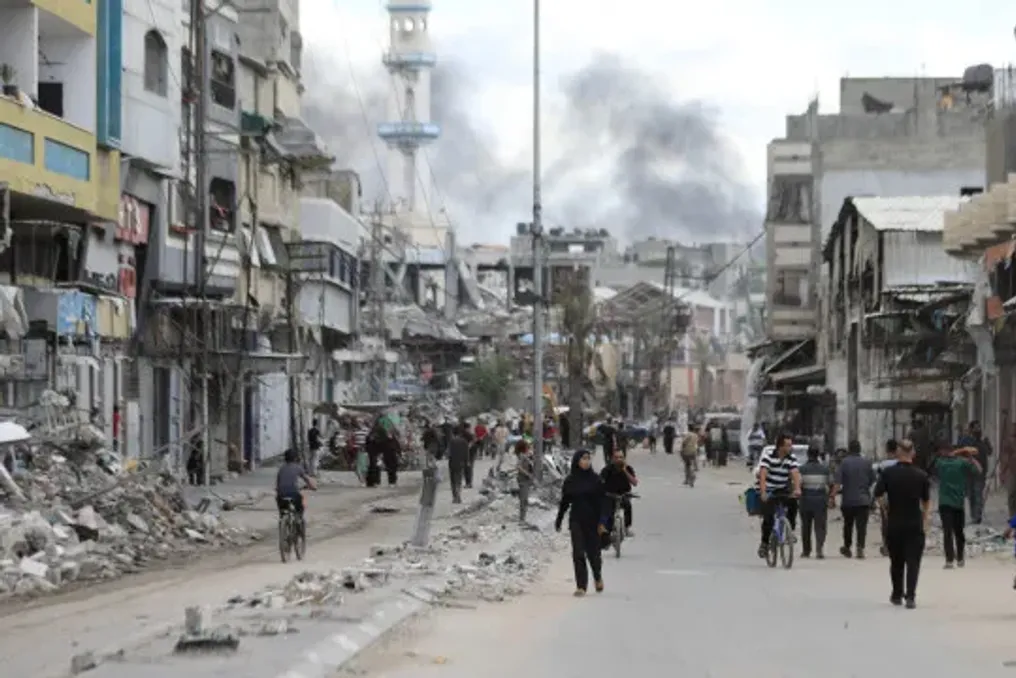
Report points to massive environmental contamination in the Gaza Strip following Israeli military offensive
Read more
Noticias ao Minuto
noticiasaominuto.com

Report points to massive environmental contamination in the Gaza Strip following Israeli military offensive

A report released by two organizations indicates that approximately 99% of the surface area of the Gaza Strip shows signs of environmental contamination. This situation is a direct result of the military offensive conducted by Israel against the Islamic movement Hamas.

According to Oxfam and the Observatory of Conflicts and Environment (CEOBS), the Israeli military action resulted in the pollution of air, soil, and water with various harmful agents, including heavy metals, explosive residues, asbestos, and biological contaminants.

The analysis, which utilized satellite imagery, scientific studies, and open data, suggests that military operations impacted approximately 78% of the territory of the Gaza Strip, although indicators of possible contamination extend throughout the Palestinian area.

The document warns that these substances pose a significant danger to public health, and their consequences may persist for several decades. Additionally, the report mentions that restrictions imposed on the entry of independent experts and analysis equipment are hindering a complete assessment of the actual extent of contamination on site.

The collected data revealed the detection of fecal coliforms in 19% of the 79 groundwater wells examined in July 2026, a considerable increase compared to the 2% recorded in 2021. In the sanitation sector, only 19% of sewage lift stations remain operational, and only 30% of the sewer network maintains any functionality.

As a result of this scenario, about 40,000 cubic meters of untreated sewage are discharged into the Mediterranean Sea daily, adding to another 15,000 cubic meters lost annually due to leaks and infiltration.

The regions identified with the highest potential risk of contamination include the cities of Gaza and Jabalia (located in the north), Khan Yunis and Rafah (in the south), as well as the Salah al-Din road area, which runs across the Strip from north to south.

The report also signaled a high risk of drinking water contamination in the northern and central parts of Gaza, and a generalized risk of respiratory problems throughout the territory, caused by dust and waste burning, particularly affecting children and pregnant women.

The organizations have requested that Israel authorize access for independent specialists to assess the damage, as well as provide the necessary funding for the cleanup and safe reconstruction of the territory, a process that, according to the NGOs, should be carried out by the Palestinians themselves.

Similar stories

Ecologist warns of long-term impact of war on the environment
Read more
www.tehrantimes.com

Ecologist warns of long-term impact of war on the environment

The military actions by the US and Israel against Iran could have far-reaching environmental consequences that will persist even after hostilities cease. These concerns relate to pollution, the state of water resources, as well as damage to wildlife and marine ecosystems in the region.

In an exclusive interview with Tehran Times, prominent ecologist and desert researcher Mohammad Darvish noted that fires at oil refineries, damage to protected habitats, and the loss of vessels transporting hazardous materials could cause repercussions beyond Iran's borders. Pollutants entering the Persian Gulf threaten marine life and food chains in neighboring countries, while smoke and particulate matter can travel hundreds or even thousands of kilometers.

Darvish also raised issues regarding the shortcomings of international mechanisms for protecting ecosystems during wartime and the difficulties in documenting environmental damage and holding perpetrators accountable. He believes that the development of renewable energy and shared use of natural resources can help Iran and its neighbors strengthen energy security, deepen regional cooperation, and find a path to peace.

He emphasized that war is one of the most destructive human activities, whose consequences manifest in the short, medium, and long term. Citing examples, he mentioned that the effects of the atomic bombings of Hiroshima and Nagasaki over 80 years later, as well as the consequences of using Agent Orange during the Vietnam War, remain evident in contaminated soil and water.

Despite the development of UN Conventions and protocols to prevent such actions, Darvish pointed to serious violations of these principles during the war between Israel and Palestinians in Gaza, as well as during the 12-day and 39-day wars waged against Iran. One of the most significant examples was the bombing of oil storage facilities in areas of Tehran, such as Shahran and Suhanak, which led to the formation of so-called black and acid rain.

To date, no detailed report has been compiled on what proportion of runoff from this rain entered the reservoirs of Latian, Mamlu, and Karaj dams, or what impact this had on aquatic organisms. Furthermore, explosions related to oil facilities and vessels occurred in the Persian Gulf and the Arabian Sea; according to official data, at least 200 vessels sank, some of which were carrying chemicals and hazardous substances.

Attempts by researchers from the Department of Environment to conduct investigations were blocked by American vessels, which warned them not to approach. This made it impossible to establish the full scale of the damage through reliable documentation checks. Darvish also noted that 17 coral islands in the Persian Gulf are valuable ecosystems that have been affected.

Moreover, since 2015, 'dead zones' have been developing in the Persian Gulf around desalination plants in Qatar, the United Arab Emirates, and Bahrain. Following the wars, the concentration of pollutants may have increased due to the discharge of ballast water from ships, which could lead to the expansion of these zones, the restoration of which will take many years.

The Department of Environment reported damage to 23 protected areas, as well as damage to environmental protection facilities and research centers along the coasts of the Persian Gulf and the Arabian Sea. Mangrove forests, including the Hara and Chandal forests, were also affected. Emissions of dead marine animals have been observed on the Persian Gulf coast, for example, on Kish Island.

Darvish called for more active participation from the United Nations to ensure that environmental protection protocols are not ignored for security or military reasons. He pointed out that UN member states, such as the US and Israel, have signed agreements prohibiting the use of chemical weapons, but in his opinion, the incident in Tehran on Esfand 14, 1404 (March 5, 2026) violates these obligations.

In a personal account, Darvish shared observations about social solidarity during the conflict, noting people's care for injured birds and acts of kindness, such as helping to pay for fuel or selling eggs at old prices. He also mentioned a campaign to save the endangered fish species Afanius in the Zayandeh Rud river basin, which he considers an indicator of social development.

Highlighting the interconnectedness of ecosystems, Darvish cites historical examples, such as the damage to the Mesopotamian ecosystem during the Iraq War and the impact of dust storms caused by projects in Turkey. He also explained how the reduction of Tigris and Euphrates runoff led to the loss of livelihoods for four million farmers in Syria and Iraq, contributing to poverty and instability.

Portugal and seven other countries insist on the entry into force of the new carbon market in 2028
Read more
noticiasaominuto.com

Portugal and seven other countries insist on the entry into force of the new carbon market in 2028

Portugal, along with seven other European Union member states, today advocated for the immediate implementation of the European carbon market, which will regulate emissions from buildings and road transport, despite objections from several countries regarding the application of this mechanism.

The Environment Ministers of Denmark, Finland, Germany, Luxembourg, the Netherlands, Portugal, Spain, and Sweden sent a letter to the European Commissioner for Climate, Wopke Hoekstra, expressing 'strong support' for the EU Emissions Trading System 2 (CELE 2).

CELE 2 represents an additional carbon market to the original CELE. While the original CELE covers emissions from electricity and heat generation, heavy industry, aviation, and maritime transport, CELE 2 focuses on new sectors such as emissions resulting from fuel use in buildings and road transport.

CELE 2 was established in 2023, and its initial entry into force was planned for 2028. However, some fossil fuel-dependent countries, such as Italy or Poland, demanded a postponement of this date or a softening of the system.

Under pressure from these countries, leaders of the European Council agreed at the October EU summit to assess the impact of CELE 2 before its entry into force in 2028. In the letter, initiated by Denmark, the eight ministers emphasized that CELE 2 is 'more important than ever,' especially given that 'the disruption of energy flows through the Strait of Hormuz has once again revealed Europe's vulnerability.'

The ministers argue that it is necessary to reduce dependence on imported fossil fuels to decrease exposure to geopolitical tensions and price fluctuations that negatively affect European competitiveness, businesses, and families, while also jeopardizing energy security and making Europe vulnerable to political pressure.

Therefore, they believe that CELE 2 'strengthens Europe's energy security by reducing dependence on fossil fuel imports and promoting electrification,' as it provides an economically viable way to accelerate the decarbonization of the transport and building sectors.

The ministers also insist that CELE 2 plays a key role in strengthening Europe's resilience and open strategic sovereignty. They remind that CELE 2 is an integral part of a broader commitment aimed at achieving a delicate balance between ambition, economic efficiency, and solidarity.

Addressing the Climate Commissioner, the ministers stated their readiness to cooperate constructively with the Commission to ensure CELE 2 enters into force 'according to the agreed schedule.'

Popular