NASA study demonstrates viability of growing potatoes in lunar soil
Read more
Olhar Digital
olhardigital.com.br

NASA study demonstrates viability of growing potatoes in lunar soil

Scientists with support from NASA have succeeded in cultivating nutritious and safe potatoes within a simulated lunar soil environment. This experiment has the potential to support food production for astronauts who will eventually work in established bases on the Moon.

To enable planting, researchers incorporated organic material into the artificial soil. The addition of this supplement in adequate quantity allowed the potatoes to achieve a yield comparable to that obtained in terrestrial soil.

The investigation, led by plant biologist Aymeric Goyer, affiliated with Oregon State University in the United States, was published in the scientific journal npj Microgravity. The tests were conducted using the Modoc variety, characterized as an early-maturing potato with red skin and white flesh.

The selection of this crop is due to its high nutritional value and productivity. Potatoes provide starch, vitamins, minerals, and fiber, in addition to generating more calories per cultivated area compared to several other crops. Goyer added that they have a higher potassium content than a banana, are rich in vitamin C, and contain high-quality proteins, while also presenting a high satiety index.

Understanding the cultivation challenge requires analyzing the properties of lunar regolith, the material coating the surface of the Moon. This regolith formed over billions of years due to meteorite impacts, consisting of crushed dust and rocks, whose particles can be sharp and glass-like.

Unlike terrestrial soil, regolith lacks organic matter and nitrogen, an essential component for plant development. For this reason, scientists mixed different proportions of vermicompost into the simulated material. Vermicompost is rich in nutrients and is generated by the decomposition of organic waste carried out by earthworms.

The observed results varied depending on the amount of supplement used. The trials took place in a greenhouse, under both solar and artificial lighting, maintaining a daytime temperature of 22°C and a nighttime temperature of 18°C.

Although they obtained results, the researchers did not conduct a consumption test of the potatoes; the harvest was destined for laboratory analysis, according to Goyer. Furthermore, the size of the pots used restricted the experiment, since the tubers, even those grown in terrestrial soil, generally weighed less than 10 grams.

The team has already started a second study, this time using larger containers. According to Goyer, these new tests resulted in potatoes with dimensions analogous to those commonly found in markets.

This research aligns with the plans of the United States and China to send astronauts to the lunar surface in the coming years and establish long-term bases. The ability to produce food locally is considered crucial to supply these crews, as transporting all necessary food from Earth would be unfeasible.

Similar stories

Japanese Space Mission MMX Plans to Collect Samples from Mars' Moon Phobos
Read more
super.abril.com.br

Japanese Space Mission MMX Plans to Collect Samples from Mars' Moon Phobos

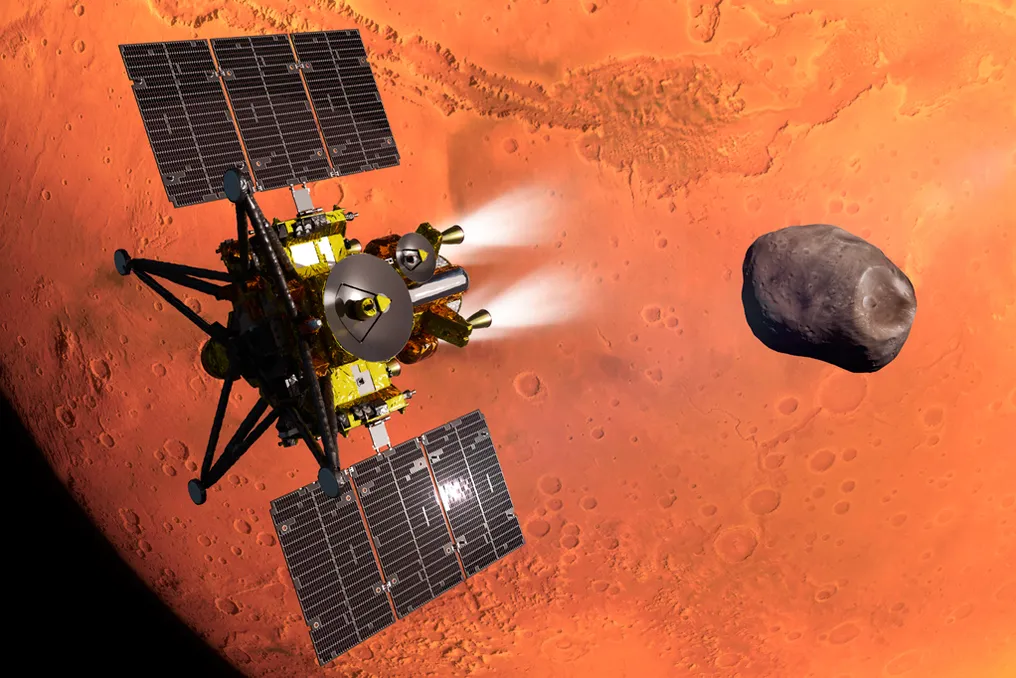
The Japanese space mission is heading towards Mars, but its objective is not to land on the planet itself. Instead, the Martian Moons Exploration (MMX) mission will focus on Phobos, the largest of Mars' two small moons.

The satellite was launched on October 19 at 16:41 Brazilian time using the H3 rocket from the Tanegashima Space Center in southern Japan. This marks the beginning of a five-year mission during which the spacecraft will orbit Phobos, explore it, and deploy a module for landing and collecting soil and small rocks. For the first time in history, these samples will be delivered to Earth for laboratory analysis.

MMX is led by the Japan Aerospace Exploration Agency (JAXA) in collaboration with the USA, France, Germany, and the European Space Agency (ESA). The overall scientific goal of the mission is to determine the origin of both Martian moons, including the smaller one named Deimos. Scientists also intend to study the broader evolution of Mars and its local space environment.

There is currently no clear understanding of how the Red Planet acquired its two natural satellites. These natural satellites could have been asteroids that passed by Mars and were captured by its gravity. Another theory suggests they formed as a result of an asteroid impact with Mars, ejecting rocky material into space, which gradually clumped together to form Phobos and Deimos. The chemical composition of Phobos, which the MMX mission will provide, will help determine which of these hypotheses is more likely.

However, collecting samples from Phobos will not be an easy task. Russia attempted this in 2011 with its Phobos Grunt mission. The spacecraft was successfully launched into low Earth orbit but failed to activate its engines to move toward Mars.

Nevertheless, JAXA is well-prepared for success. The Japanese space agency has already demonstrated the ability to deliver asteroid samples through its Hayabusa missions conducted between 2003 and 2010 (Hayabusa) and between 2018 and 2020 (Hayabusa 2).

MMX will test sophisticated sample collection methods specifically designed for Phobos' low gravity. The Martian moon has only about 0.1% of Earth's gravity, meaning a person on Phobos could make a horizontal jump of 1.5 km without much effort.

The mission will also serve as a test of communication between the spacecraft and a newly developed ground station. After the launch of MMX, it will take almost a year to reach Mars, with an expected arrival in August 2027. It will first fly around the Red Planet and then enter orbit around Phobos in about a month.

The spacecraft consists of three modules with different functions: a propulsion module to place MMX into orbit around Mars, an exploration module with equipment for landing and sample collection on Phobos, and a return module to deliver the sample to Earth.

The satellite is equipped with 13 scientific instruments to study Phobos. The high-resolution cameras Tengoo and Orochi map the surface of the Martian moon, while a laser altimeter (Lidar) creates an image of its contours using laser pulses to measure the distance between the spacecraft and surface features. The infrared spectrometer MIRS will analyze Phobos' minerals, while the gamma and neutron radiation detector Megane will determine the elemental composition of the moon. At greater distances, MMX will also collect data on Deimos, Mars' smaller moon.

The instruments will transmit data that mission controllers use to make decisions about the landing site and method on Phobos.

In early 2029, the MMX exploration module will release a small microwave oven-sized rover called Idefix, jointly developed by JAXA, the French space agency Cnes, and the German Aerospace Center (DLR). Idefix will descend onto the surface of Phobos from an altitude of 40 to 100 meters. The rover will then straighten up and move across the surface during an operational period expected to last about 100 days. It will use various sensors, including a Raman spectrometer and a radiometer, to finalize the landing site for the exploration module.

In 2030, the exploration module will descend and land on Phobos, remaining on the surface for about 2.5 hours. It will be able to collect samples from the surface once or possibly twice, landing in different locations. The ability to collect samples from multiple points on Phobos is vital for understanding the moon's composition.

The exploration module will use an instrument called C-sampler to drill a core sample or a P-sampler device that emits a jet of nitrogen gas to remove loose soil and gravel from the surface and deliver them to the sample collection chamber. The C-sampler can collect a sample up to 2 cm deep, providing the mission with a sample whose chemical composition has not been altered by solar radiation causing chemical changes on planetary surfaces over time. The P-sampler is a backup option but carries a small risk of the spacecraft falling into weak gravitational fields, such as those of Phobos.

After collecting at least 10 grams of material, the exploration module will leave the Martian moon, detaching from the landing strut. It will then head back to Earth, arriving in 2031. Upon approaching our planet, it will eject its sample capsule, which will then pass through the Earth's atmosphere. It will land via parachute in Australia, from where it will be retrieved and transported to Japan.

An additional potential benefit of the mission is that the Phobos samples may contain Martian material. Phobos orbits very close to the Red Planet, and it is believed to constantly collect Martian soil ejected regularly from the planet's surface due to asteroid impacts.

Thus, MMX can be seen as a simplified version of the Mars Sample Return (MSR) mission. MSR, a joint project of US and European space agencies, was intended to bring rock samples from the surface of Mars back to Earth. However, budget constraints led the US Congress to cancel this program.

If scientists obtain successful samples from MMX, they may receive a good consolation prize.
Astronomical images of the week highlight cloud on Mars and Jupiter's occultation by the Moon
Read more
olhardigital.com.br

Astronomical images of the week highlight cloud on Mars and Jupiter's occultation by the Moon

In the program Olhar Espacial, two notable astronomical images are presented weekly. Last week, photos of two interesting phenomena that occurred in the Solar System were shown.

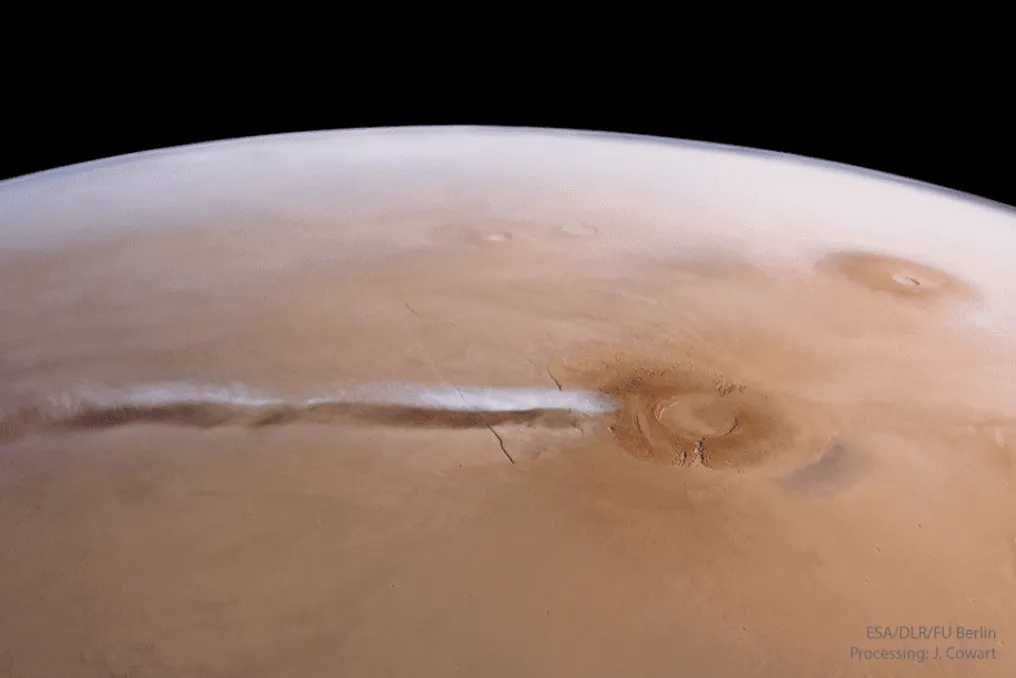
One of the images is a photograph of Mars that displays the Arsia Mons Elongated Cloud, a mystery of the Red Planet that is gradually being clarified. This phenomenon was first recorded by the Viking orbiter in 1977 and continues to fascinate scientists. During spring and summer mornings, this cloud develops over the Arsia Mons volcano, being carried by local winds until it reaches a remarkable length of 1500 kilometers.

It is known that the cloud is composed of ice crystals, although the detailed explanation of its formation has only recently emerged. The current theory suggests that Arsia Mons generates wind currents that cause a sharp drop in temperature above it, promoting the condensation of air moisture and the subsequent formation of ice crystals.

The second image illustrates the moment when Jupiter is obscured by the Moon, an event called the lunar occultation of Jupiter. This occurrence requires the perfect alignment between the planet, the Moon, and the Earth in space, resulting in the blocking of the Gas Giant for certain areas of the planet.

The occultation that occurred on November 3rd was observable in Southeast Asia and Oceania. It represents the third of a total sequence of eight occultations of Jupiter, which began in September and will only end in May 2027. Unfortunately, none of these occasions will be visible from Brazil; the next recording of this phenomenon in the country is only expected in December 2030.

NASA plans to establish permanent base in the lunar south pole region by 2032
Read more
olhardigital.com.br

NASA plans to establish permanent base in the lunar south pole region by 2032

NASA has plans to create a permanent facility in the lunar south pole area, with completion expected by 2032. This project involves various missions, both robotic and crewed, intended to deliver equipment, assemble structures, and prepare the site for astronauts' arrival.

The central objective is to convert part of the lunar surface into an outpost where people can reside, work, and conduct explorations. To realize this vision, the agency will divide the construction into phases and partner with private companies in developing energy systems, vehicles, and communication equipment.

Implementation will be progressive. The first phase, expected by 2029, will focus on sending robotic equipment, testing technologies, and proving that the necessary infrastructure can be transported and installed on the Moon. These missions will also serve to map terrain conditions and prepare for future human activities.

The second stage, scheduled between 2029 and 2032, will be dedicated to expanding the structure, aiming to install all essential resources for the base's operation. The third phase will only begin once the outpost is operational, although NASA has not yet set an exact date for this milestone.

To manage these missions, the agency has instituted CLPS 2, a new arrangement of long-term contracts with private companies. This program establishes a combined maximum ceiling of US$10 billion (approximately R$54.5 billion) over ten years, without this meaning that the entire amount has been contracted or will be spent immediately.

Eight companies have been selected to participate in this competition: Blue Origin, Firefly Aerospace, Intuitive Machines, ispace-U.S., Lockheed Martin, Northrop Grumman, SpaceX, and Voyager Technologies. This change also aims to increase flexibility in mission organization, as Jared Isaacman, NASA administrator, stated that the previous model was rigid, limited to one or two annual missions, and hindered scalability.

One of the first tasks will be to investigate the lunar south pole for vital resources to sustain human presence. For this, NASA will send PROMISE (Polar Rover for Observation, Mapping, and In-Situ Exploration). This vehicle will be powered by nuclear energy and is set to begin its explorations in late 2028, investigating the soil and searching for volatile materials, such as water ice, which is crucial for future operations.

The rover will be equipped with a drill and scientific instruments capable of analyzing both the surface and subsurface, allowing studies in areas inaccessible only through remote imaging. NASA intends to adapt an engineering model used in the Perseverance and Curiosity rovers, deployed on Mars, for lunar conditions. The transport of this vehicle will be done by the Blue Moon Mark 1 landing module, provided by Blue Origin.

In addition to rockets, cargo transport and equipment movement in orbit, as well as the development of terrestrial and inter-crew communication systems, will be fundamental. The VADR program, focused on commercial launch and space transport missions, will participate in these tests, with goals such as demonstrating cargo transfer between Earth and lunar orbit, testing navigation with the CAPSTONE 2 mission, and conducting surface reconnaissance with MoonFall drones.

Companies such as Arrow Science and Technology, Blue Origin, and Impulse Space will be involved in the operations. Launches will utilize rockets like New Glenn (Blue Origin), Falcon 9 (SpaceX), and Terran R (Relativity Space). Communication will be ensured by SpaceX's selection to launch satellites in 2028 using the Starship rocket, creating a lunar network similar to Starlink to maintain contact with astronauts and equipment.

Components of miniCAST, a tower intended to provide power and communication on the Moon, will be developed by other companies, including Honeybee Robotics, Redwire, and Yank Technologies. With all these actions, NASA seeks not only to ensure transport to the south pole but also to establish the necessary conditions for a more stable human presence in the region, transforming lunar exploration into a lasting presence.

Popular