
LightSprint.ai creates a multi-user software development factory, uniting product managers, designers, and engineers
Read more
YourStory [india, en]
yourstory.com

LightSprint.ai creates a multi-user software development factory, uniting product managers, designers, and engineers

At the beginning of the work week, it is often the case that a product manager faces an escalation from a client, a designer discovers a user drop-off point, and both know what changes are necessary. They formalize the task as a ticket that enters the backlog, awaiting instructions from engineers who are already overloaded. Several weeks later, the change goes into release, but often not exactly as planned.

Although AI coding agents have significantly increased the speed of individual engineers' work, the software creation process in most companies has practically remained unchanged. This is where LightSprint.ai comes in, developing a multi-user software development factory—a unified space where engineers, product managers, and designers collaborate on the existing codebase, with the engineer approving every merge.

Modern coding tools function in a single developer environment or terminal. One person manages the process, while others lose synchronization. Planning remains locked in documents, context is stored in one person's memory, and reviewers approve large volumes of AI-written code without a deep, shared understanding of why it was created.

Prototyping tools allowed non-engineers to create software, but only on a clean canvas. Real companies rely on complex codebases with years of established conventions and validation rules. A prototype may ignore all these limitations, whereas a change in the working version cannot, leading to the need to recreate the prototype and loss of speed.

The bottleneck is not the code development itself, but the coordination between participants. For large organizations, it is critically important that every change is traceable: where it came from (the requirement), what acceptance criteria it meets, and what tests confirm its functionality. Teams must follow approved packages and design systems, and security departments require knowing where the code and data are located and who gave their approval.

Granting access to AI tools to more people without proper structure creates risks, while restricting access leaves tasks in the backlog. LightSprint.ai integrates on top of the coding agents already used by teams, transforming them into a shared workspace for the entire product team. This system is based on three core principles.

The result is not a reduction in the number of engineers, but rather that engineers spend their time making decisions that require their professional judgment, while people closest to the customers release the changes they understand best.

Through participation in the NetApp Excellerator program, LightSprint.ai is collaborating with NetApp teams to assess the applicability of the multi-user software development factory in an enterprise environment. Aspects such as specification-driven development, traceability from requirement to test, adherence to approved packages and UI standards, and an enterprise-grade security model are being discussed.

Similar stories

How Artificial Intelligence is Changing International Strategy for Indian Startups
Read more
yourstory.com

How Artificial Intelligence is Changing International Strategy for Indian Startups

For two decades, India specialized in developing products for the domestic market. However, creating products in India for a global audience is now becoming a more significant opportunity.

This transition was a central theme at the TechSparks 2026 event by YourStory. During a fireside chat titled 'From Early Success to Global Scale: Decoding Cross-Border Trade,' Manish Maheshwari, Managing Director for India at Stripe, discussed with Shraddha Sharma, Founder and CEO of YourStory and The Bharat Project, the conditions necessary to turn foreign sales into sustainable growth.

Sharma began the conversation by asking about India's current position in the artificial intelligence race. Maheshwari expressed optimism, noting that AI is shaping a new way of doing business, allowing for the creation of minimum viable companies that can function like one-person businesses. For Indian entrepreneurs, this means the ability to 'think globally and become global from day one.'

Maheshwari provided examples to support this claim. The Indian startup Emergent achieved an Annual Recurring Revenue (ARR) of $100 million in just eight months, and Pocket FM recently exceeded half a billion dollars in ARR. Stripe data shows that the number of companies receiving payments from over 100 countries has quadrupled in five years. Furthermore, about 25% of businesses earning cross-border revenue receive the majority of their revenue outside the top ten markets.

Sharma raised the issue of compliance, which concerns many founders. Maheshwari advised that a founder in Koramangala or Pune should focus on the core product, while a partner should handle the checkout process, tax compliance, banking relationships, and cash flow through a limited set of APIs. He noted that Stripe was initially built on the idea of financial programmability, and 'the heart beats for the founder.'

Physical goods are also showing positive results. Maheshwari reported that 76% of customers prefer to pay in local currency, and offering local payment methods in addition to credit cards increases revenue by approximately 12%. He cited Purely Copper, an Indian D2C brand that produces copper bottles, accepts payments via Stripe, and ships them to customers in the US. Logistics, however, remains the seller's responsibility.

The discussion then moved to Stripe's acquisition of OpenRouter. Maheshwari explained that token costs are rising, and in some modern companies, they exceed salary levels. OpenRouter helps route every request to the appropriate model in real-time, balancing cost and latency so that teams do not use the cutting-edge model for every task. Stripe already supports the financial side through subscriptions, usage-based billing, and invoicing. With OpenRouter, it will help founders manage costs and the entire Profit & Loss (P&L).

Looking ahead, Maheshwari stated that India has gone through the SaaS wave, and the next wave will be AI-powered applications with global reach. He emphasized that 'what you create in India can have customers in Brazil, can have customers in Colombia,' and that founders can find the perfect customer across dozens of countries simultaneously. His message regarding location was simple: 'You can sit in India and sell to the whole world.'

For aspiring founders, Maheshwari outlined three paths. Startups supported by leading venture capital funds and accelerators automatically receive Stripe credits; Stripe's startup team directly engages with the ecosystem, conducting training sessions and webinars; and founders can connect via the website, although access in India is currently invitation-only.

Audience questions focused on the same theme—reach. When asked about China, Maheshwari replied that Stripe supports Chinese payment methods such as WeChat Pay and displays local options based on the customer's location and business compliance, without requiring a local office for payments. Regarding AI agents making purchases on behalf of users, he stated that Stripe Link can automate payments within a user-set limit and authorization, and retailers can re-engineer their websites to make them machine-readable.

The session demonstrated that the barriers that previously kept Indian startups confined to the domestic market are lowering. AI reduces development costs, payment infrastructure handles compliance and currency complexity, and new tools help founders control expenses as they scale. As Maheshwari put it, now is the perfect time to 'think even bigger, think beyond India, and think globally.' For founders with a portable product, the next step is not a question of entering the global market, but a question of timing.

Companies are moving to local AI: advantages of running models on devices instead of cloud services
Read more
yourstory.com

Companies are moving to local AI: advantages of running models on devices instead of cloud services

Artificial intelligence tools have significantly simplified document analysis, content generation, and task automation for businesses. However, many companies are not fully aware of where the data entered into these tools is going.

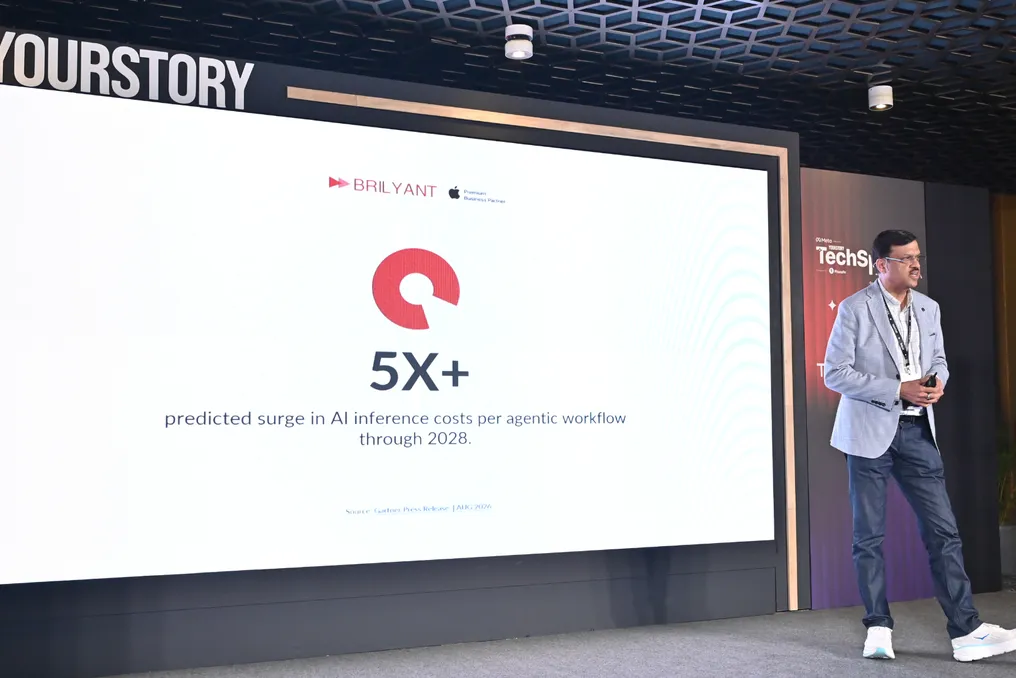
At the TechSparks 2026 conference, Akash Saksenaa, CEO of Brilyant, discussed the necessity of shifting routine AI workloads from the cloud to local devices. He argued that using AI on a device helps organizations control costs, ensure data protection, and reduce dependence on internet connectivity.

The economics of AI are changing. While the cost per token may decrease, Saksenaa noted that inference costs could rise as enterprises adopt more AI agents and consume more tokens. Citing Gartner, he mentioned forecasts of potential inference cost increases by more than fivefold.

Cost is only one aspect. When employees use cloud AI tools, confidential business information can leave the organization's internal environment. This raises issues regarding data protection, intellectual property preservation, and compliance with data protection regulations.

Saksenaa cited India's Digital Personal Data Protection Act (DPDP Act) as another reason for companies to review their AI infrastructure. He stated: 'If you look at 83% of Indian enterprises, they have not yet started comprehensive DPDP implementation, or they don't even know about it. What is the cost? 250 crore rupees. Now, if you are a large company with 5000 employees, it's a line item in the budget. But if you are an SME, it's an entire company.'

For small businesses, in particular, the financial consequences of non-compliance can be quite significant. Saksenaa's recommendation is to move the model to the data, not the data to the model.

Saksenaa compared cloud AI tools like ChatGPT, Gemini, and Claude to on-device AI, where models run locally. Cloud tools can incur ongoing input and output token costs, latency, and less direct control over where data is processed. On-device AI, conversely, can function without an internet connection and does not require regular charges for local inference tokens.

'Almost 60-70% of your workload can move to on-device AI. But you will have to use large, complex, cutting-edge AI frontend models for the remaining 30%,' said Saksenaa. He emphasized that these two approaches are not mutually exclusive; companies can use larger cloud models for complex tasks while migrating suitable daily workflows to local devices.

Saksenaa identified several areas where businesses can leverage on-device AI, including endpoint security, operational support, internal search, and finance. He noted: 'There are excellent use cases for on-device AI: look at endpoint security or operational support. All of this can be done on the device. Look at finance, local server, internal search, finance, operations. All of this can be done on the device.'

For software development teams, storing code on local devices reduces the risk of intellectual property leakage through cloud tools. In contact centers, on-device AI can support real-time call translation, note-taking, and product recommendations. These functions can operate locally, reducing reliance on network connectivity.

Saksenaa also highlighted devices equipped with Neural Processing Units (NPUs), which enable AI models to run locally. This can help reduce ongoing cloud expenses while maintaining data governance and operational resilience.

During his keynote presentation, Saksenaa presented a case study involving Tech Paramount Solutions to demonstrate how on-device AI can be applied in an industrial setting. The company's TP Smart Sol platform integrates visitor and vehicle management, asset management, energy monitoring, video surveillance, and workforce management.

With Brilyant's support, Tech Paramount Solutions explored using Apple Mac minis as peripheral computing devices for local video analytics processing, while its platform remained connected to the cloud for alerts, dashboards, and remote access. This system is capable of processing live AI video analytics from approximately 100 local cameras.

A co-founder of Tech Paramount Solutions reported that the implementation allowed them to reduce annual security overhead by over 12 lakh rupees, cut lifetime compute costs by over 11 lakh rupees per Mac mini compared to similar GPU-based solutions, and increase equipment uptime at the factory by over 240 hours per month.

Migrating AI workloads to local devices involves more than just installing a model. Companies must also consider device management, security, governance, and the infrastructure required for large-scale deployment. Saksenaa explained how Brilyant collaborates with partners like Apple and Jamf to provide device provisioning, AI installation, and lifecycle management. Leasing and financing options can help companies spread initial device costs over time.

For organizations managing hundreds of laptops, Brilyant also offers containerized runtimes and management measures designed to keep data within controlled environments. A more complex challenge is determining which AI workloads should run locally, which require cloud models, and how to manage data and devices across the entire organization.

On-device AI will not eliminate the need for the cloud. However, as more powerful models become available for local hardware, companies have more options for balancing cost, privacy, and performance. For Saksenaa, this transition is not about using AI everywhere the same way, but about deciding where workloads should be executed and where business data must remain.

Popular