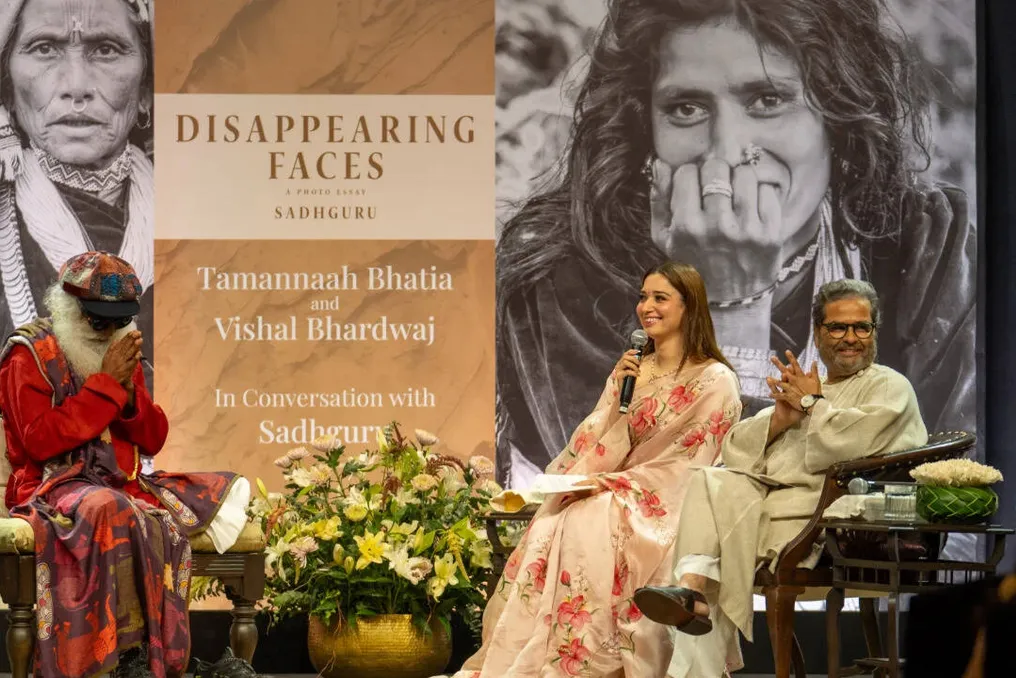
Actor Tamannaah Bhatia and film director Vishal Bhardwaj joined spiritual leader Sadguru to discuss his photo book, 'Disappearing Faces'. The conversation took place on November 22 at the Fairmont Hotel in Mumbai.
The discussion covered topics such as aging, individuality, education, devotion, and the changing lifestyles of people living in remote Himalayan regions.
The book is a collection of photographs taken by Sadguru over five decades of his travels through the Himalayas, particularly in Nepal and Tibet. These portraits capture people and communities whose lives have been shaped by interaction with the natural environment.
During the discussion, Tamannaah commented on the depiction of aging in the photos, contrasting the acceptance of visible signs of age among the people captured in the book with attitudes in urban settings. She asked, 'Why do we not accept what is most inevitable, namely the passage of time?' noting that the people in the photographs seem more ready to accept aging than city dwellers.
In response to her remarks, Sadguru stated that the attitude towards aging in India has changed recently. He suggested that this is a recent phenomenon in India, as men and women in the country previously aged gracefully. However, in his opinion, Western ideas have been adopted, according to which entire civilizations are governed by hormones.
He added that society has begun to place excessive importance on youth and age associated with peak hormonal activity. At the same time, Sadguru warned, 'But if you make one aspect of life everything, then your life will be very distorted.'
The conversation also touched upon the individuality of the people featured in the photographs. Tamannaah noted that despite having fewer resources, education, and experience compared to urban residents, these people demonstrated unique personalities and greater freedom of self-expression.
Sadguru linked this to the purpose of education, asserting that it is increasingly focused on preparing people for employment rather than encouraging the exploration of their interests and abilities. He emphasized, 'Education should be about expanding our horizons,' observing that many people are preoccupied with finding jobs, leaving little room to explore their inclinations or capabilities.
Vishal Bhardwaj, for his part, drew attention to the stillness noticeable in the faces in the book. He referenced Sadguru's observation that stillness embodies the highest level of intensity and asked how this relates to the devoted lives of saints like Meera and Kabir.
Sadguru explained that Meera's devotion to Krishna shaped her emotional experience, allowing her to approach everything with a sense of sweetness. As for Kabir, he said he sought to balance his inner experience with the practical demands of daily life. He also cited Krishna as an example of a person fully engaged in the world but not allowing external circumstances to disrupt his inner peace.
The book 'Disappearing Faces', launched in August, is a collection of pictures taken by Sadguru during his fifty years of travels through the remote regions of the Himalayas. It focuses on the communities of Nepal and Tibet, documenting their faces, way of life, and experiences. According to the book's description, the photographs reflect a way of life that is changing under the influence of modern development and the information age.