X Square Robot has introduced the WALL-OSS-1.0 model on November 23rd, accompanied by a vision and language-based foundation, the XR Harness coordination structure, and the WALL-API-1.0 interface for developers. The company asserts that preliminary training should be used to solve unfamiliar manipulation tasks, rather than fine-tuning for specific tasks.
Chinese reports and the company's technical presentation describe two training stages. In the first stage, action data along with multimodal materials are used to link language and vision understanding with physical behavior. In a later stage, an action expert is added to improve action generation. These descriptions are those provided by the developers, not an independent assessment of general intelligence.
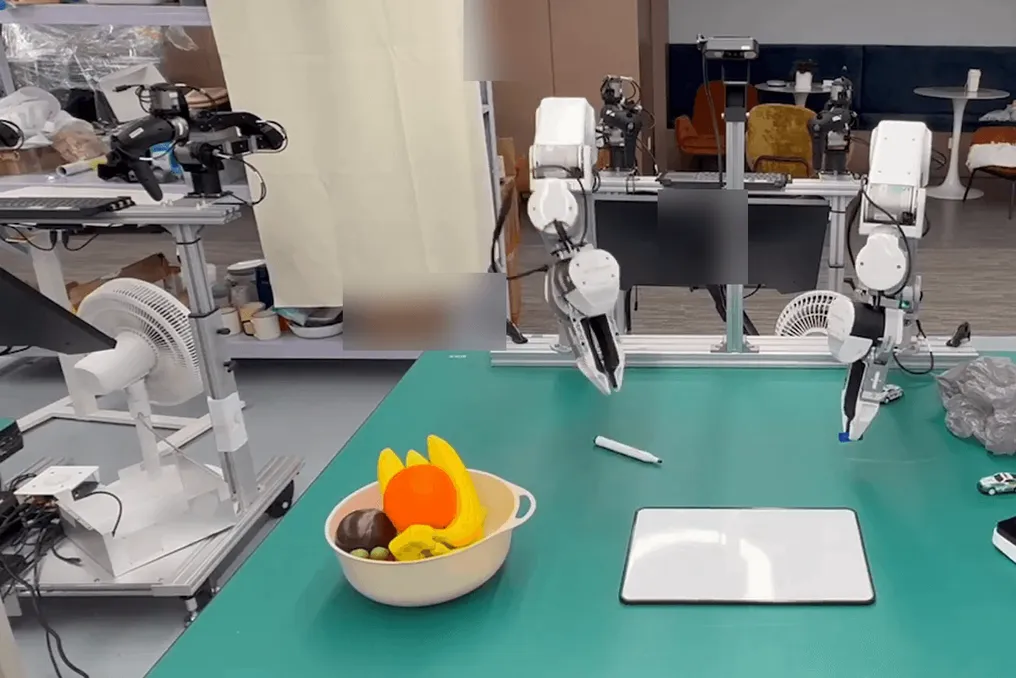
In an open evaluation involving 312 different real-world tasks selected by assessors, the company reported a zero-shot success rate of 55.1% without demonstrations or task-specific fine-tuning. Examples include working with unfamiliar objects, tool use, coordinated two-handed manipulation, and recovery from interruptions. This figure is a result stated by the provider within its evaluation conditions, not a guarantee of reliability in arbitrary conditions.
Separately, the company reported a score of 1101 out of 1500 in its physical robotics evaluation, ManipArena. The presentation explicitly emphasizes that this comparison differs from the 312-task evaluation because the task sets and protocols vary. These results should not be combined into a single benchmark or considered independently reproducible.
XR Harness divides longer tasks into planning, execution, and hardware interaction stages. The planning level adjusts steps based on observations and feedback; WALL-OSS-1.0 executes individual steps, while another level connects to the robot's controllers and sensors. This structure is designed for model coordination, not for ensuring readiness for uncontrolled deployment.
The public weights have a narrower scope. The company's Hugging Face organization lists wall-oss-1.0-lite-robodojo and the corresponding base repository, both marked with the Apache-2.0 license and containing available weight files. Their registered updates predated the announcement on November 23rd.
The first variant is based on the Qwen3.5 policy, fine-tuned for RoboDojo simulation; its card indicates it has not been tested on real robots. The base card is positioned as a preview that is not identical to the Lite release. These checkpoints do not confirm the full announced family of models, the API system, or the policy underlying the 312-task physical evaluation in the form of downloadable weights.