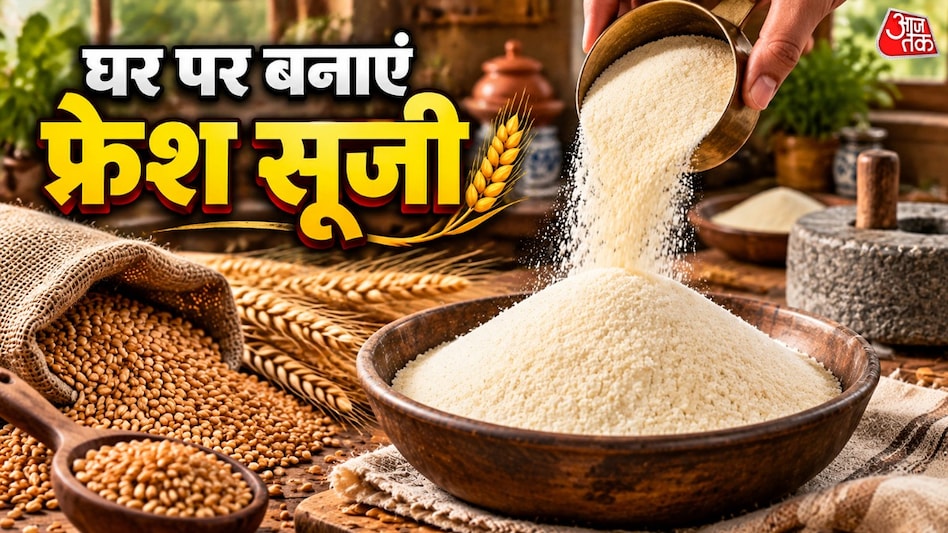
How to make suji at home: replace store-bought mix with pure, grainy wheat
Read more
Aaj Tak
www.aajtak.in

How to make suji at home: replace store-bought mix with pure, grainy wheat

If you frequently use suji at home and usually buy it in stores, it is recommended to stop doing so. This article presents a simple method for preparing fresh and grainy suji at home.

Suji (rava) is used in almost every Indian household to prepare dishes such as halwa, upma, chila, or uttapam. However, there is a risk that the packaged suji bought from the store may be old, contain impurities, or spoil. Therefore, it is suggested to prepare clean and fresh suji yourself. Homemade suji is not only clean but also gives dishes a richer taste and texture.

To prepare, you will need 1 kilogram of good quality, clean, and dry wheat; large or medium grain wheat is best. For storage, you can optionally use 2–3 bay leaves or 1–2 dried red peppers to protect against moisture and insects.

First, you must sort the wheat, removing stones, dust, or damaged grains. If the wheat was washed, it should be dried in the sun or in the shade until completely dry.

The dried wheat should be gradually added to the bowl of a food processor and ground in pulse mode to obtain coarse crumbs. It is important not to overload the processor or work too long, otherwise, fine flour will result. For large volumes, a grain mill can be used.

The resulting mixture should be sifted through a fine sieve. The grainy part that remains on the sieve is the suji/rava, while the finer part that passes through the sieve is regular flour.

If the grains seem too large, they can be lightly ground in pulses and sifted again to achieve the desired texture for halwa or upma. After this, the suji should be lightly roasted in a pan over low heat for 3–4 minutes, and then cooled. Once completely cooled, the suji should be transferred to an airtight container, adding bay leaves or dried red pepper, and stored in a dry place.


Similar stories

Recipe for Crispy and Spicy Muthi made from Chickpea Flour, served with Bread or Rice
Read more
www.aajtak.in

Recipe for Crispy and Spicy Muthi made from Chickpea Flour, served with Bread or Rice

If you are tired of eating dal or vegetable dishes every day, we suggest a recipe for delicious muthi made from chickpea flour, which is very easy to prepare and has an excellent taste. A distinctive feature of this dish is that it can be used not only as a side dish for vegetables but also enjoyed as a dry snack during tea time.

People often get bored with a monotonous diet consisting of dal, rice, and simple vegetables. In such cases, muthi made from chickpea flour is an ideal option because it turns out very tasty and spicy, while being quick to prepare and requiring minimal oil. This popular traditional snack from Gujarat is not only light and easily digestible for the stomach but also extremely simple to make. It can be served for breakfast, with evening tea, or instead of a main vegetable dish.

Below is a simple way to prepare soft and spicy muthi using just one cup of chickpea flour.

For the muthi dough:

Chickpea flour (Besan): 1 cup

Freshly chopped mint or dried mint (Kasuri Methi): half a cup (optional)

Yogurt: 2 tablespoons

Oil (for greasing): 1 tablespoon

Ginger and green chili paste: 1 teaspoon

Ajwain, cardamom, and white cumin: half a teaspoon each

Turmeric, red chili, and coriander powder: half a teaspoon each

Baking powder (sweet soda): a pinch

Salt to taste

For tempering (Tadka):

Oil: 1-2 tablespoons

Rai (mustard seeds) and white cumin: 1 teaspoon each

Hing (asafoetida): a pinch

Curry leaves: 8-10

Finely chopped green coriander and grated fresh coconut

Take a large bowl and pour in one cup of chickpea flour. Add the chopped mint, yogurt, 1 teaspoon of oil, ginger and chili paste, ajwain, cumin, all dry spices, baking powder, and salt. Mix, adding a little water (if necessary, 1-2 teaspoons) to form a soft dough (dough).

Grease your hands with a little oil and form long rolls (muthi), squeezing the dough in your fist. Heat water in a steamer or pot. Grease the sieve with oil and place the formed rolls on it. Steam covered for 12-15 minutes.

After the muthi cools down, cut them into round pieces using a knife. Heat 2 tablespoons of oil in a pan. Fry the rai, white cumin, hing, and curry leaves in it until fragrant. Then add the cut muthi and fry on low heat for 2-3 minutes until slightly crispy. Sprinkle with finely chopped green coriander and grated coconut on top.

The finished hot, soft, and spicy muthi is ready. It can be served with green chutney or tea.

Kadi Masala Recipe: How to Prepare a Special Spice Blend to Double the Flavor of Curry at Home
Read more
www.aajtak.in

Kadi Masala Recipe: How to Prepare a Special Spice Blend to Double the Flavor of Curry at Home

Spices play an important role in enhancing the flavor of curry. With the right combination of spices, even simple food can become very tasty. There is a curry masala that is made from ingredients such as green pepper, ginger, mango ginger, and curry leaves. It gives the dish spiciness, as well as a special freshness and aroma.

The good news is that preparing this blend does not require many ingredients or great effort. This masala is capable of doubling the flavor of curry, and it can be prepared very quickly. Below is a simple way to prepare curry masala at home.

This curry masala can be used to improve the taste of vegetables, legumes, and many traditional dishes. During cooking, it should be lightly fried in oil or ghee so that the aroma and flavor of the spices dissolve well into the food. The amount of spices can be adjusted according to personal preferences.

A small tip: when preparing the masala, all ingredients must be dry, without moisture. They should always be taken out with a clean and dry spoon. Since fresh components are used, this mixture should be stored in the refrigerator and prepared in small batches.

How to make clean and grainy suji at home from wheat, avoiding store-bought mixes
Read more
www.aajtak.in

How to make clean and grainy suji at home from wheat, avoiding store-bought mixes

Suji is used not only for making halva but also in many other dishes such as puri and idli. Although most people buy suji in stores, here is a way to prepare clean and fresh suji at home.

During cold seasons and holidays, suji is actively used to prepare halva, upma, idli, and dhokla. However, packaged suji available for sale is often old, and there is a risk of insect infestation or flour contamination.

If you want to feed your family suji that is 100% pure, fresh, and free from chemicals or polishing agents, it is very simple to make it from whole wheat at home. Homemade suji not only has a rich and grainy taste but also retains the natural nutrients of wheat. Below is the simplest method for preparing clean suji from wheat and secret tips for storage.

To prepare the wheat for grinding, it needs to be slightly moistened: lightly spray the wheat with water 10 minutes before grinding. This helps easily separate the outer husk (bran) and isolate the inner grainy part.

After preparation, the suji should be lightly roasted for 2-3 minutes over low heat without oil. This method ensures that the suji remains dry and will not be attacked by insects or beetles for many months.

First, you need to clean and wash the whole wheat, ensuring it is free from stones and gravel. Then, the wheat should be thoroughly dried in bright sunlight for 4-5 hours until it is completely hard and dry.

The dried wheat is placed in the bowl of a food processor. Instead of running the processor continuously, it should be pulsed 2-3 times to avoid producing fine flour and to ensure the grain cracks coarsely.

Next is the sifting process. First, the ground mixture is sifted through a fine flour sieve to separate the fine flour. Then, the remaining coarse mixture is sifted through a sieve for suji with medium holes. The clean, grainy suji will collect in a bowl, while the coarse husk and groats remain on the sieve.

The final step is dry roasting. The prepared suji is roasted in a pan over low heat for 2-3 minutes. After it cools, it should be transferred to a clean, dry, airtight glass jar.

Thus, your 100% pure, additive-free, homemade grainy suji is ready. You can enjoy the fresh taste by preparing hot upma or halva.

Popular