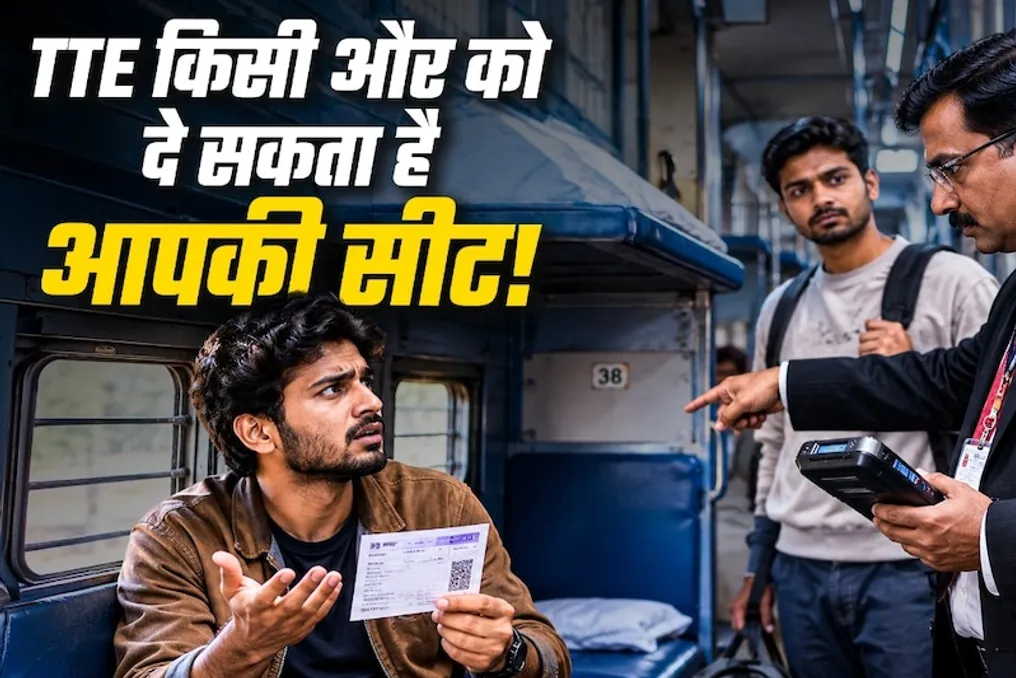
Even if you have purchased a confirmed ticket for a trip, your seat may be occupied. Imagine you booked a confirmed ticket and were assigned a lower berth in compartment B1 of carriage B1. However, after boarding the train, you start chatting with friends in carriage B12. You assume that since your ticket is confirmed, you can lie down in your seat whenever you want. But when you arrive at your seat at night, another passenger is already sitting there. You wonder how someone could sit in your seat if you have a confirmed ticket?
In reality, there is a rule in the railway related to this, called NT, or Not Turned Up. According to this rule, if a passenger does not arrive at their assigned seat or carriage on time, the controller (TTE) may consider the seat vacant and give it to another passenger. This is especially beneficial for passengers with RAC tickets or those on the waiting list. Therefore, having a confirmed ticket alone is not enough; it is crucial to arrive at your assigned seat on time.
NT stands for Not Turned Up, meaning the passenger did not show up at their assigned seat for the journey. Suppose you booked a ticket from Delhi to Patna and received seat number 25 in carriage B1. After the train departs, the TTE checks the passengers' tickets and sees that your seat is empty. In this situation, the TTE tries to find out if the passenger has boarded the train. If the passenger is not found at their seat and is not located during the journey, they may be registered as NT (Not Turned Up). Subsequently, according to railway rules, this vacant seat may be given to another eligible passenger.
How is information entered into the HHT TTE system?
Currently, the railway TTE has an HHT (Hand Held Terminal) device for checking passengers' tickets. This is a kind of digital apparatus containing information about the train's passengers and their seats. When the TTE checks tickets in a carriage, they see which passenger is in which seat. If a passenger's seat is empty and the passenger is absent, their status can be entered into the system after verification. This allows the TTE to know which seats are available and to which passenger they can be allocated.
Suppose a passenger on the train has an RAC category ticket. This means they are allowed to travel, but a full seat has not yet been allocated to them. Now, if the seat of a passenger with a confirmed ticket turns out to be empty and is assigned the NT status, then according to railway rules, the TTE may give this vacant seat to an RAC passenger. Thus, the RAC passenger can get a full seat. At the same time, if the passenger with a confirmed ticket arrives at their seat later, it may cause problems for them. Nevertheless, seat allocation is based on established railway rules and TTE verification. Simply being absent for a short time does not grant the right to give the seat to someone else in every case.
If you have booked a confirmed ticket for a train, pay attention to the following points. First, board the carriage indicated on your ticket. Second, arrive at your seat in the train on time. Do not think that you can move to your seat later while sitting in another carriage with friends or relatives after boarding. Third, inform the TTE if you cannot reach your seat for any reason, and do so as soon as possible. Fourth, keep your ticket and identification with you during the journey to present them if necessary.
Remember: a confirmed ticket gives you the right to travel in the assigned seat, but if you do not come to your seat after boarding the train, problems may arise. Therefore, make sure to monitor your carriage and seat during the journey.