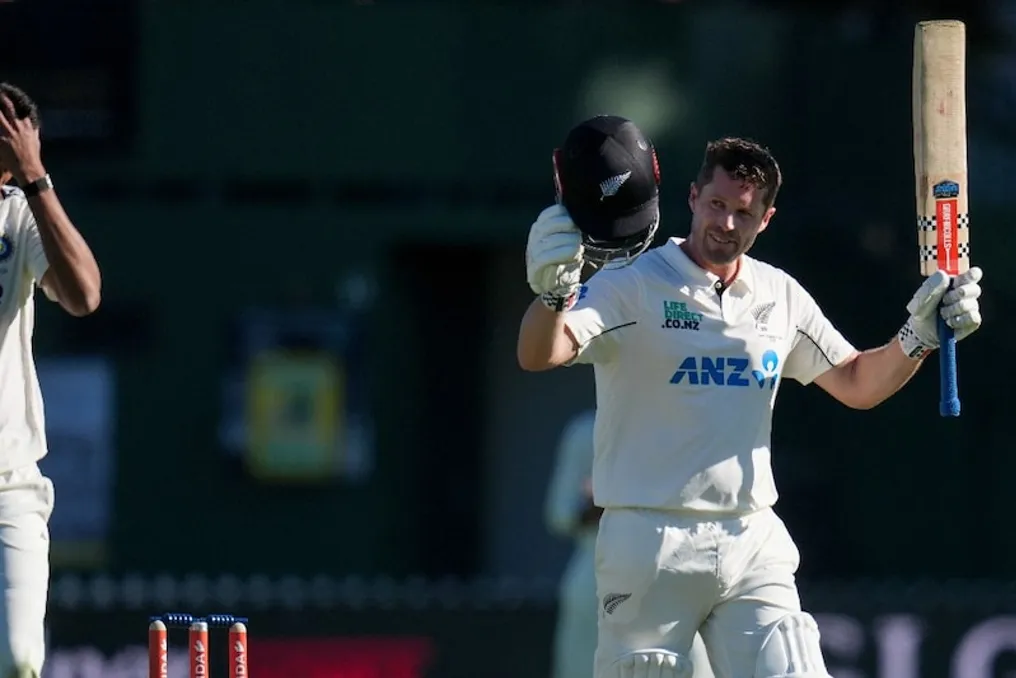
In the Wellington Test match, the Indian team failed to achieve its goal despite being close to victory. On the flat and lifeless Basin Reserve pitch, New Zealand players managed to hold their defense for the last 120 overs, resulting in a draw. India took the field on the final day with the intention of taking 8 wickets, but the pitch did not provide the bowlers with the necessary assistance. This outcome weakened India's chances of reaching the World Test Championship (WTC) final, and New Zealand dropped to third place in the standings.
Daryl Mitchell and Glenn Phillips played a key role in preventing India's victory during New Zealand's second innings. Both players batted for 43 overs, denying the Indian bowlers an opportunity to strike. Mitchell, batting 186 balls, remained unbeaten with 49 runs, and Phillips, having played 126 balls, was also not dismissed.
These two demonstrated exemplary defensive play, forcing the Indian bowlers to wait a long time for a chance to take a wicket. Before tea, there were eight consecutive overs without a run scored, and after the break, no runs were scored for 43 balls. New Zealand clearly signaled that preserving the match was their main priority.
On the final day, India needed to take 8 wickets for victory. New Zealand started its second innings trailing India by 233 runs. Nevertheless, the pitch did not favor the bowlers: the ball did not spin significantly, nor did the pitch offer sufficient bounce or deviation. Despite this, the Indian bowlers created opportunities. During a delivery, Devon Conway's inside edge touched the pad, and Rishabh Pant caught a fine ball. Following this, Prachin Krishna forced Rachin Ravindra to catch the ball in the gully. Ravindra attempted a powerful shot, but it went past the edge of the bat to a fielder.
Anshul Kamboz brought in the fifth successful attack for India, causing the ball to deflect off Tom Blundell's edge. Although Pant could not catch it, the DRS system confirmed that the ball had touched the bat, and India was awarded out. At that moment, there were three overs remaining before the next delivery.
India expected the new delivery to provide the bowlers with extra height and spin, but this did not happen. In the first seven overs of the new spell, the batsmen made only two errors. Prachin Krishna indeed created problems for Mitchell and managed to create a gap between his bat and the pad, but at that moment, India did not have a fielder in short leg. After this, Mitchell and Phillips resumed their defensive stance. The Indian bowlers continued to try, but the pitch did not give them the necessary support. One chance arose due to Mitchell's poor running, but India failed to capitalize on it due to Akash Deep's inaccuracy at mid-on.
The Indian team also monitored the workload on Jasprit Bumrah in this match. He was restricted to no more than three overs of spin. Nevertheless, this match became one of the five longest for him in his Test career. Bumrah bowled only 49 overs in this Test and took five wickets. Because of this, his Test career average reached 19.94.
In the last session, India also utilized Yashvi Jaiswal and Dhruv Jurel as bowlers instead of their primary bowlers. This showed that the team was prepared to accept a draw. The offer of a draw was made 15 overs before the scheduled time ended and was accepted by New Zealand. Mitchell was one ball away from completing a half-century, but he did not prolong the match.
This drawn result also impacted the World Test Championship standings. India lost points in the race for the final due to the lack of a victory over New Zealand. On the other hand, New Zealand managed to gain four points, spending 720 points, but still dropped to third place in the standings. The Wellington Test once again demonstrated that in Test cricket, the result is determined not only by the skill of the bowlers but also by the role of the pitch. India tried to achieve victory until the last day, but the Basin Reserve pitch gave New Zealand a full chance to avoid defeat.