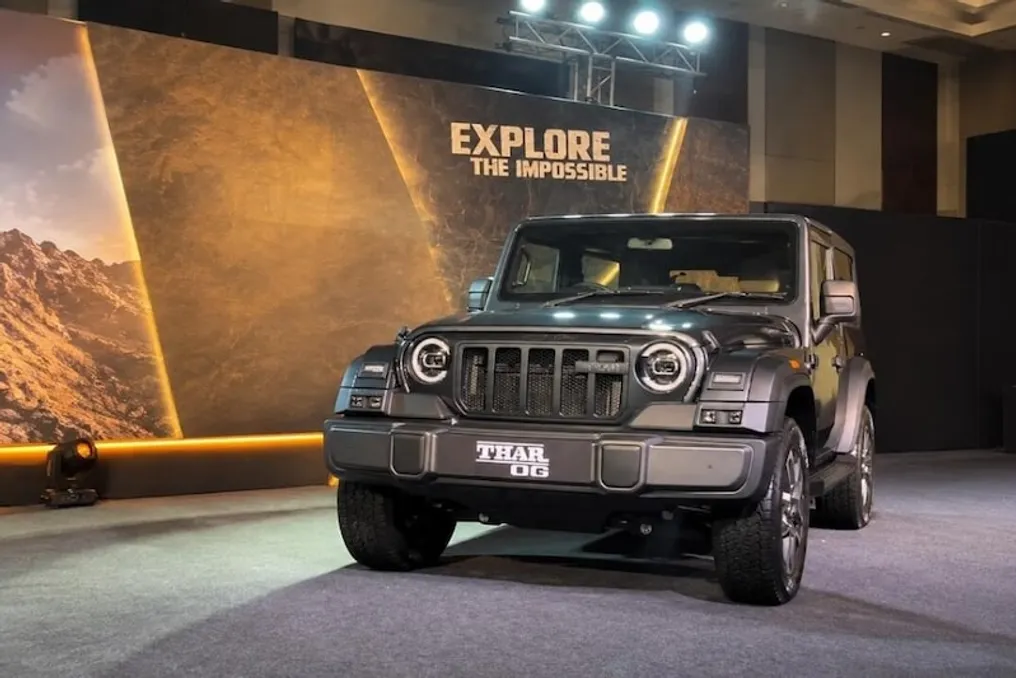
Festival sales exceeded expectations, 5.5 million cars sold in 42 days
Read more
Aaj Tak
www.aajtak.in

Festival sales exceeded expectations, 5.5 million cars sold in 42 days

Unlike last year, when GST discounts stimulated mass purchases, the market showed unexpected growth this year. Although sales slowed down during Navratri, the festivals of Dhanteras and Diwali drastically changed the situation, leading to the sale of 55.25 lakh cars in just 42 days. This figure is the largest in the history of the market.

A new significant factor was the sharp rise in electric vehicle sales, which increased by more than 52%. This indicates that consumers in India are changing not only the vehicle itself but also their approach to transport selection.

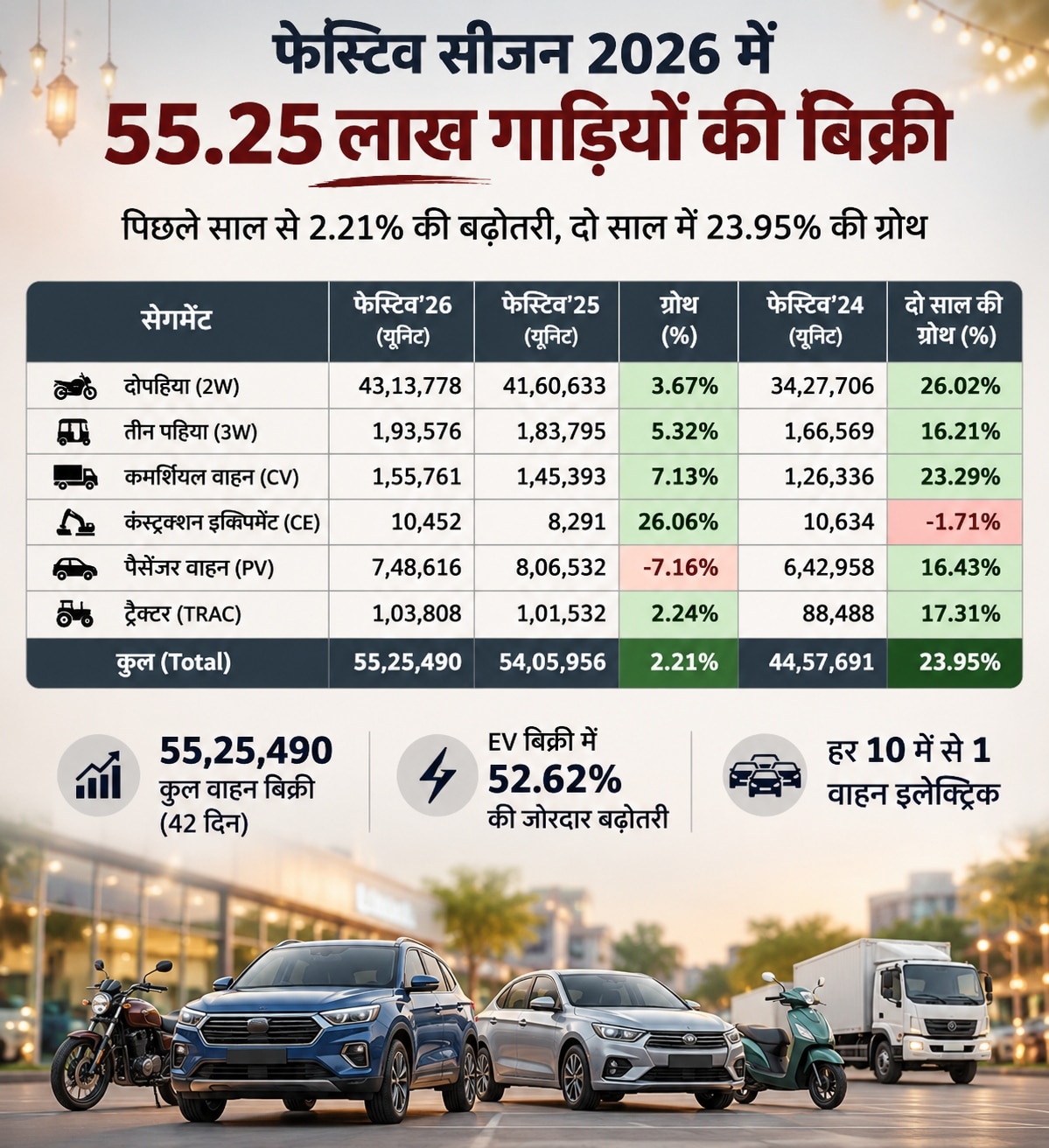
According to data from the Federation of Automobile Dealers Associations (FADA), 55,254,90 units of transport were sold during the 42-day festival season, setting a record. The growth in demand for electric vehicles was particularly noticeable: for the first time in one festival season, over 500,000 electric vehicles were sold.

FADA Chairman Sai Giridhar noted that the 42-day festival season of 2026 will be memorable for the Indian auto retail market. Despite impressive sales last year thanks to GST 2.0, this year saw an increase of 2.21% in retail car sales. Total sales reached 55,254,90 units, setting a new festival season record.

Compared to the 2024 festival season, the current period demonstrated an impressive sales growth of 23.95%, indicating sustained high consumer interest in purchasing cars after the introduction of GST 2.0, and now growing demand.

The start of this year's festival season was somewhat sluggish. The impact of last year's record sales was particularly noticeable during Navratri, which affected the market. Passenger vehicle sales decreased by more than 18% during Navratri. However, as Dhanteras and Diwali approached, buyer activity significantly increased.

This influenced the overall season figures: the initial decline in the passenger car segment was reduced by more than half. Furthermore, the overall auto retail market, which was in negative territory during Navratri, turned positive towards the end of the festival period as customers actively purchased cars in the final days.

Sales growth this season was not limited to one segment. Sales increased in most categories, including two-wheelers, commercial vehicles, three-wheelers, and tractors. According to FADA, two-wheeler sales grew by 3.67%. The commercial vehicle segment showed a growth of 7.13%, and three-wheeler sales increased by 5.32%. Tractor sales grew by 2.24%, while the construction equipment segment showed the strongest result with a growth of 26.06%.

The passenger car segment was the only major segment to record an annual decline during this festival season. Car and SUV sales fell by 7.16%. This is attributed to the implementation of GST 2.0 last year. Last year, when Navratri began on September 22, new GST rules came into force across the country, leading to a significant drop in vehicle prices and a buying boom. This did not happen this year, and prices for passenger cars continue to rise compared to last year.

Nevertheless, when compared to the 2024 festival season, passenger car sales still showed confident growth of 16.43%.

The main story of this festival season was electric vehicles. EV segment sales soared by 52.62%, and for the first time in one festival season, EV sales exceeded the 500,000 mark, setting a new record. Electric motorcycle sales grew by 61.10%, and electric passenger cars (cars and SUVs) by 72.91%. Sales of electric commercial vehicles doubled. Thus, approximately one in every ten cars sold this season was electric.

Analysis of data over two years shows a 67.55% growth in electric vehicle sales. This suggests that the demand for EVs no longer depends solely on government programs or subsidies; consumers are actively adopting electric vehicles due to low operating costs, improved range, and expanded market choice.
Similar stories

India's car sales volume in October 2026: Segment growth amid mixed brand results
Read more
www.aajtak.in

India's car sales volume in October 2026: Segment growth amid mixed brand results

October 2026 proved to be a favorable month for automotive brands in the Indian market, although this success was not universal across all companies. An analysis of the top 15 automotive companies showed that they sold 524,226 units over the past 31 days. Compared to October of last year, when 466,814 units were sold, the segment experienced a year-on-year growth of 12.3%. Furthermore, compared to September, October sales improved by 14.1%, as these 15 companies sold 459,457 units in September.

Nevertheless, not all companies demonstrated positive momentum; six out of fifteen companies showed negative growth, and a new brand appeared on the list. Maruti Suzuki leads in sales volume for the segment, while Jeep ranks at the bottom of the list. According to the Auto Pandit report, Maruti Suzuki sold 212,384 units in October 2026, achieving a year-on-year growth of 20.5%.

Tata Motors is in second place, having sold 73,894 units, showing an increase of 20.9% compared to October of last year. Mahindra sold 73,338 vehicles, demonstrating a year-on-year growth of 2.4%. Hyundai sold 62,799 units with a growth of 16.7%. Kia Motor was fifth, selling 33,462 units, increasing sales by 13.2%.

Meanwhile, Toyota sales declined: the brand sold 29,521 units, representing a drop in sales of 26.7% year-on-year. MG Motors showed a growth of 25.3%, selling 8,013 units. Skoda faced a decrease in sales of 5.4%, selling 7,805 units in October 2026. Honda increased sales by 19%, selling 7,609 vehicles, while Renault recorded a decline, selling 4,577 units.

Nissan demonstrated significant sales growth of 37.4%, selling 3,594 units. VinFast is a new player on this list and sold 3,023 vehicles, with the entire portfolio of this company consisting of electric vehicles. Volkswagen sales fell by 28%, totaling 2,913 units. Citroen sold only 1,008 units in October. The lowest figure on the list was Jeep, which managed to sell only 286 units in October.

Over 300 thousand electric vehicles sold in India: Demand growth and company leadership
Read more
www.aajtak.in

Over 300 thousand electric vehicles sold in India: Demand growth and company leadership

The demand for electric vehicles in the Indian market is showing steady growth, reflected on the roads where significantly more electric cars can now be seen, especially in major cities. Sales have reached record levels.

In 2026, sales of electric passenger vehicles exceeded the 300,000 unit mark for the first time. Notably, this figure was achieved just one and a half months before the end of the year, surpassing the results of the entire previous year. Tata Motors maintained its lead in this race, while Mahindra secured second place, overtaking MG Motor.

According to VAHAN data, from January 1 to November 9, 2026, a total of 304,701 electric vehicles, including SUVs and MPVs, were sold in the country. This volume exceeds the figures for the same period last year by 66%. In 2025, 195,571 electric passenger cars were sold for the full calendar year, meaning that as of now in 2026, 109,130 more units have been sold, representing an increase of about 56%.

The growth in demand for electric vehicles this year accelerated starting in June, when monthly sales first exceeded 30,000 units, and this trend continued for the following five months. Sales set a new record in September.

The growing demand for electric passenger vehicles is influencing the entire electric vehicle market in India. To date in 2026, 29.7 million electric vehicles have been sold in the country, of which 304,701 are electric cars, SUVs, and MPVs. Consequently, the share of passenger vehicles in the total electric vehicle sales volume has increased to 10%, up from 8% last year.

Nevertheless, two-wheeled models lead the electric vehicle market, with 18.5 million units sold, accounting for 62% of the market. Next are three-wheeled electric vehicles, with 785,965 units sold, making up 26% of the market. Commercial electric vehicle sales amounted to 28,865 units, corresponding to approximately 1% of the market.

In the electric passenger vehicle segment, Tata Motors remains the largest company. From January 1 to November 9, 2026, the company sold 120,895 electric cars, which is 58% more than the 76,644 units sold in 2025. Tata Motors' share in the total volume of electric passenger vehicles sold this year is about 40%.

Tata Motors has the largest portfolio of electric vehicles. Among the company's six models, the Nexon EV is the best seller. Additionally, there is increased interest in the updated Tiago EV and Punch EV models.

The most significant change this year occurred in the battle for second place. Mahindra & Mahindra managed to secure the second position, surpassing MG Motor. The company sold 69,660 electric SUVs in 2026, which allowed it to increase its market share to 23%.

MG sold 56,988 electric cars so far. Its market share is 19%, placing it in third place. Last year, the company sold 57,239 electric cars for the full calendar year, holding a market share of 29%. The most popular MG model became the Windsor EV.

Vinfast, a Vietnamese electric vehicle manufacturer that entered the Indian market about a year and a half ago, has also made progress. To date, the company has sold 15,867 electric cars, ranking fourth with a 5% market share.

Mahindra achieves record SUV sales, surpassing 600,000 units
Read more
www.aajtak.in

Mahindra achieves record SUV sales, surpassing 600,000 units

October proved to be an outstanding month for Mahindra as the company set a new record for total wholesale sales of SUVs in its history. In October, the company sold 73,338 units of vehicles, thereby exceeding the annual threshold of 600,000 SUV sales. This marks the second consecutive year the brand has reached this milestone.

From January to October 2026, the company sold 615,280 SUVs, which is 19% more compared to the same period last year when 518,321 cars were sold. Despite November having begun, Mahindra trails last year's total sales by only 10,323 units.

In 2025, the company sold 625,603 SUVs throughout the entire year, and it is expected that it will surpass this figure in November. Following the introduction of GST 2.0, only October 2026 and October 2025 have been months where Mahindra's monthly sales exceeded 70,000 units.

Recently, Mahindra launched its first CNG SUV—the XUV 3XO CNG. According to the brand, this model has received excellent feedback from buyers and is advertised with a mileage of 24.7 kilometers per kilogram.

Analyzing sales for the first 10 months of 2026, it is noted that the best result was achieved in the first quarter (January-March), when 183,800 units were sold, representing a 23% increase compared to last year. In the second quarter (April-June), 174,745 units were sold, demonstrating a 15% growth relative to 2025.

The third quarter (July-September) showed sales of 183,397 SUVs, which is 40% higher than the third quarter of last year. The fourth quarter started with sales of 73,338 units. The company has a good chance of approaching 200,000 units in this quarter and exceeding the annual sales volume of 700,000 for the first time in its history, possibly reaching 750,000.

Popular