The Mahab-Mela held on the banks of the Sangam in Priyaganj is known not only for the camps of sadhu-saints, alpaavas, and water immersions, but also for the pontoon bridges, which are considered the heart of this festival. These bridges connect different banks of the Ganges and Yamuna and serve as the main route for millions of pilgrims during the Mahab-Mela, Ardha Kumbh, or Maha Kumbh. The question arises as to how these bridges are built in the middle of the river, how many workers are required, how long the process takes, and why they do not drift away with the current.
Preparations for the 2027 Mahab-Mela in Priyaganj have intensified. Work is underway to level the Mela area, and tents and canopies are being prepared. Simultaneously, the construction of pontoon bridges on the Ganges River begins to ensure convenient movement for pilgrims. Bridges are being erected in various locations within the Mela so that pilgrims can reach the Sangam without hindrance from one bank to another. The construction of these bridges is particularly important for connecting the Jhansi area with Nainhi through the Sangam zone.
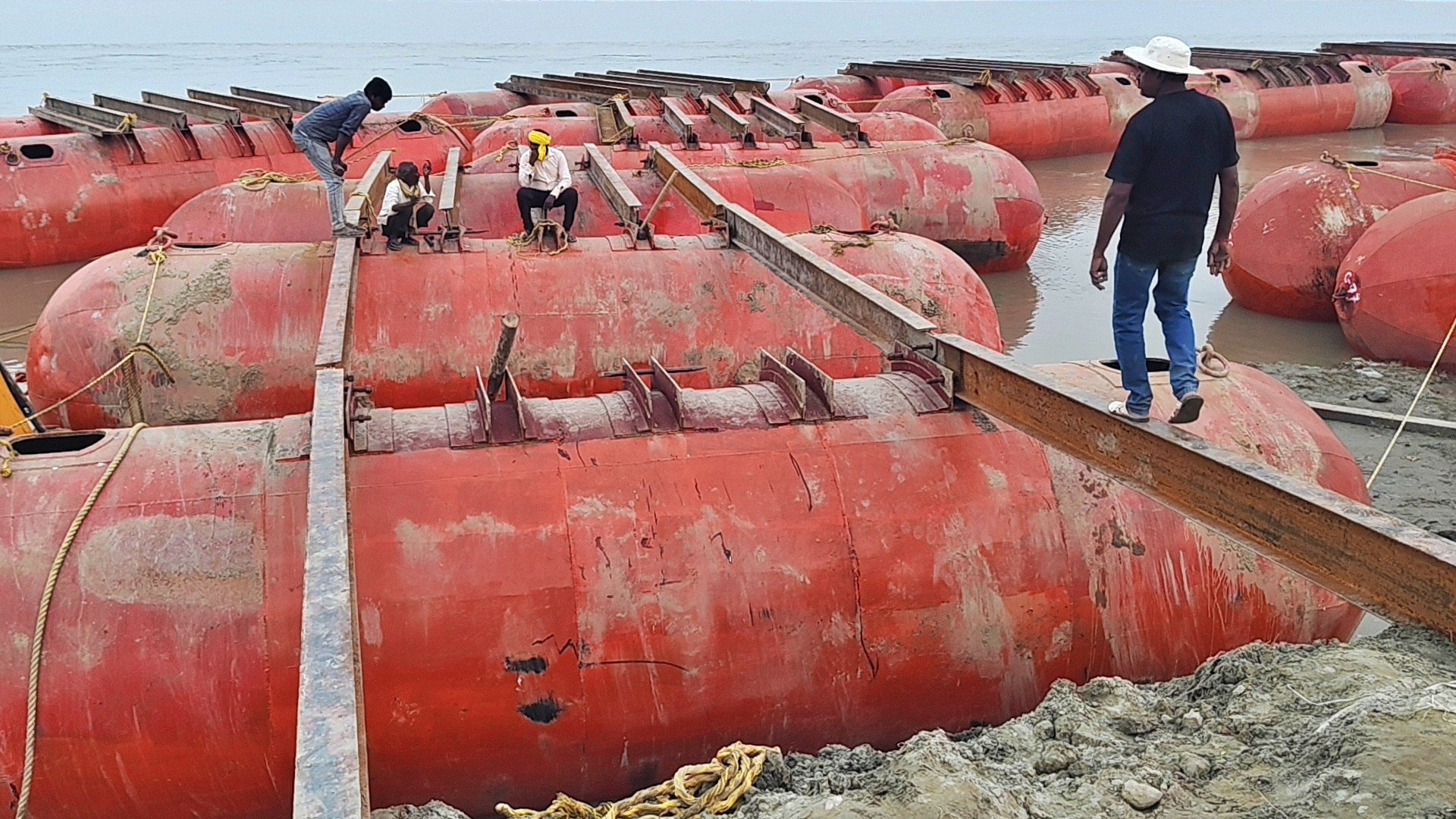
Creating a pontoon bridge is not an easy task. First, a location is chosen, taking into account the water level and current in the river. Then, the process begins with lowering the pontoons into the river, connecting them to each other, and laying metal plates on them. According to Sandeep Nishad, a pontoon bridge construction specialist, creating one such bridge takes about 20 days, and more than one hundred and fifty workers and craftsmen are involved in this work. Each worker performs a specific task: some handle the lowering of pontoons, others connect them, and a third lays iron plates on the bridge and installs railings on both sides.
As part of this year's Mahab-Mela, the pontoon bridge connecting the Sangam zone with the Jhansi area uses about 110 pontoons. Approximately five thousand circular plates will be laid on these pontoons so that pilgrims and transport can move easily according to established schemes. To ensure safety, about a thousand railings will be installed on both sides of the bridge. These railings are fastened with steel wires, which ensures safety along the edges of the bridge and support for people while moving. Regarding the pontoon bridge connecting Nainhi with Jhansi, the number of pontoons increases to approximately 150 or more, depending on the width of the river and the length of the bridge.
The main feature of a pontoon bridge is that it is created not on land, but directly over the water. Large iron pontoons float on the water, and metal plates are laid on them to form the roadway. The pontoons are placed at a certain distance and securely connected to each other. After this, plates are laid on them, and railings are installed on the sides. Thus, a strong temporary path floating on the water is created.
An important question arises: why does a bridge floating on water not get swept away by the strong river current? To prevent this, the bridge is anchored to the river using strong anchors. Master Sandeep Nishad explains that special wooden anchors are made, into which sand is poured to increase weight. These anchors are then connected to the bridge with strong ropes. The anchors are brought to the middle of the river by boats and installed there. After this, the pontoon bridge is tied to these anchors with ropes. This helps keep the bridge in its designated position despite the river current. That is, a pontoon bridge consists not only of pontoons and metal plates but also requires a system of anchor installation in the river to ensure its safety.
To prepare the pontoon bridge, large pontoons are first transported to the riverbank by trucks. Then, they are lowered into the water one by one. Next, they are connected to each other according to the specified design and distance. After this, the work of laying plates, installing railings, and anchoring is completed. Throughout this process, workers must take into account the water level, current, and weather conditions in the river. It is important to note that it is easier to lower the pontoons and prepare the bridge where there is enough water in the river, whereas in areas with low water levels, the pontoons...