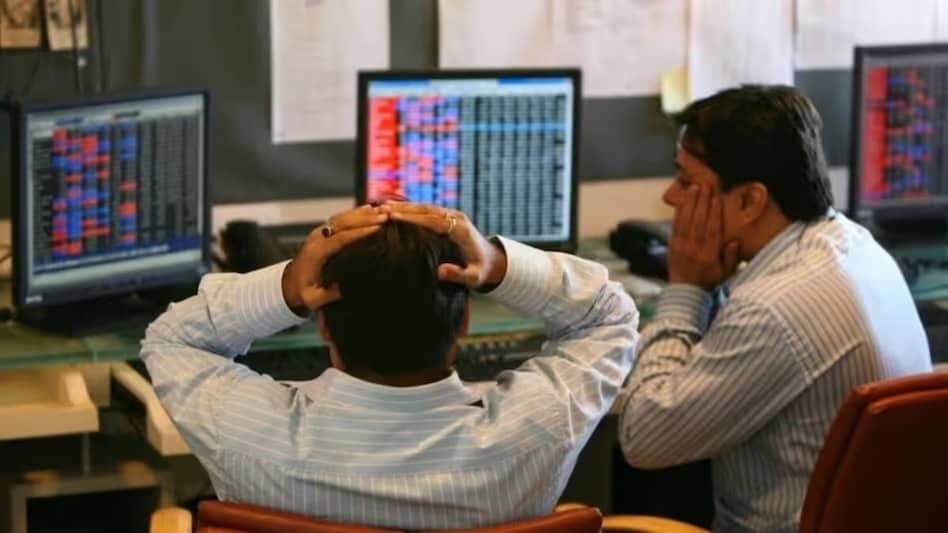
Indian stock market collapses after sharp rise, influenced by declines in US, Japanese, and Korean markets
Read more
Aaj Tak
www.aajtak.in

Indian stock market collapses after sharp rise, influenced by declines in US, Japanese, and Korean markets

The start of the trading day in the Indian stock market on Monday was impressive for investors; however, their joy lasted only a few minutes as the Sensex-Nifty index suddenly fell sharply. An analysis of the initial market movement shows that, on one hand, the Sensex of the Bombay Stock Exchange (BSE) jumped by more than 700 points immediately after opening, and the Nifty Index of the National Stock Exchange (NSE) also reached around 26,000 at the opening.

However, just 10 minutes later, the situation changed drastically: the initial rise of the Sensex-Nifty was abruptly replaced by a sharp decline, and both indices crashed. The Sensex lost over 650 points. This occurred under the influence of significant drops in the stock markets of America and Asia, including Japan, Hong Kong, and South Korea, which had already collapsed during the start of trading.

Examining the start of trading, the Sensex BSE, composed of 30 stocks, opened at 84,421, significantly higher than the previous close of 83,919. It then showed a strong jump of 743 points, reaching the mark of 84,662. But immediately after reaching this level, the direction of the Sensex changed, and it began to fall rapidly, resulting in a drop of 658 points to reach 83,210.

As for the NSE Nifty, it moved synchronously with the Sensex, opening in the green zone at a high speed. This index of 50 stocks started trading at 25,929, exceeding the previous close of 25,800, and then reached 25,992. However, following the decline of the Sensex, it also began to decrease suddenly and sharply, dropping to the level of 25,567.

It should be noted that on Monday, the Indian stock market received mixed signals due to foreign markets. On one hand, the rise of Gifty Nifty by 150 points indicated a potential rise in the Sensex-Nifty, and this indeed happened. Nevertheless, the negative impact of the collapse of the markets in Japan, America, and Korea, including Hong Kong, led to a sudden sharp decline.


Similar stories

Sharp stock market collapse leads to loss of 600 billion rupees for investors; Sensex drops by 600 points
Read more
www.aajtak.in

Sharp stock market collapse leads to loss of 600 billion rupees for investors; Sensex drops by 600 points

On Wednesday, the Sensex and Nifty indices began trading sluggishly, but as the session progressed, both indices started to fall sharply. Around noon, the Sensex index, comprising 30 shares from the Bombay Stock Exchange (BSE), showed a drop of more than 600 points, while the Nifty index of the National Stock Exchange (NSE) fell by more than 200 points.

The sudden stock market crash dealt a serious blow to investors. The total market capitalization of companies listed on the BSE decreased to 5.05 lakh crore rupees, equivalent to a loss of 600 lakh crore rupees in one moment.

Analyzing the performance of Sensex and Nifty on Wednesday, it is evident that the BSE Sensex started trading at 82,376, which was lower than its previous close of 82,532. However, the initial sluggishness quickly gave way to a sharp decline. By the time this material was written, the BSE Sensex had fallen by more than 600 points, reaching the level of 81,780.

The NSE Nifty followed the example of the Sensex. This index of 50 stocks opened at 25,323, which was a slight decrease compared to Tuesday's close of 25,387. Nevertheless, the speed of its decline quickly accelerated, and it dropped by more than 200 points, reaching the mark of 25,141.

Due to this significant decline in the market, investors incurred substantial losses. The total market capitalization of companies on the Bombay Stock Exchange (BSE MCap) decreased from 5,11,71,121.57 crore rupees on the previous trading day to 5,05,71,089.33 crore rupees. Thus, investors lost 6,00,032 crore rupees in the stock market.

Among the stocks that suffered the most during the stock market crash, the following can be highlighted: in the large-cap category of BSE, there were Titan Share (down 4.10%), Bajaj Finance Share (down 2.30%), Eternal Share (down 2.25%), and TCS Share (down 2.20%). In the mid-cap category, there was a decline in National Aluminium Share (4.60%), Dixon Share (3.40%), KEI Share (3.10%), AU Bank Share (2.50%), and MPhasis Share (2.40%).

Stock market started the week with sharp growth: Exchange indices showed significant rise
Read more
www.aajtak.in

Stock market started the week with sharp growth: Exchange indices showed significant rise

The stock market opened on Monday with a very energetic start. Both market indices began trading in the green zone, showing growth compared to the previous day's closing figures.

On the Bombay Stock Exchange (BSE), the Sensex index, which consists of 30 stocks, immediately jumped by more than 600 points. At the same time, the Nifty-50 index of the National Stock Exchange (NSE) also started trading with a noticeable increase, exceeding 130 points.

During the market opening, shares of major companies such as Bharti Airtel, Asian Paints, and Trent showed impressive dynamics.

During this vigorous opening, the BSE Sensex opened at 81,810, which is 200 points higher than its close on the previous day, which was 81,592. In mere seconds, it gained momentum, and by the time of writing, it was showing a rise of more than 639 points, trading at 82,231.

Not only the BSE Sensex, but also the Nifty index of 50 NSE stocks demonstrated its strength on Monday. This NSE index opened at 25,206, which is higher than its close last Friday, which was 25,144. Continuing the pace of the Sensex, it sharply surged and traded at 25,310.

Among the leading stocks during the initial trading period in the large-cap category were: Bharti Airtel Share (growth of 2.70%), Asian Paints Share (growth of 2.40%), Eternal Share (growth of 1.50%), SBI Share (growth of 1.35%), and Kotak Bank Share (growth of 1.30%).

Market fell by 200 billion rupees amid rising inflation and oil prices
Read more
www.aajtak.in

Market fell by 200 billion rupees amid rising inflation and oil prices

The Indian stock market experienced a significant decline as retail inflation in India reached 6.09 percent in October, the highest figure in two years. Following the sharp rise in inflation, there was a strong downturn in the Indian stock market.

The Nifty index fell by 155 points, closing at 25,144, while the Sensex dropped by 318 points or 0.39 percent, ending trading at 81,592. The decline also affected the banking sector, where Nifty Bank lost over 480 points.

This drop led to a significant reduction in the BSE's market capitalization, which shrank by 2.25 trillion rupees to 510 trillion rupees. Among the top 30 companies on the BSE, only seven stocks recorded growth; the other 23 stocks fell by up to 2 percent. The largest decline was observed among BEL shares. Pressure was felt across all sectors, with the biggest fall in industries such as cement, automotive, and metallurgy. The Nifty Realty index also closed down by 1.70 percent.

V2 shares, in particular, faced significant pressure, falling by more than 12 percent. Jeevan Seekho Life Care shares decreased by 7 percent, and Piccadilly Agro shares also lost up to 7 percent. Manappuram Finance shares declined by approximately 4 percent, while Ola Electric shares fell by 3 percent. Furthermore, Tata Motors Commercial shares dropped by more than 4.32 percent, and Shriram Finance shares lost 3.37 percent.

The reasons for today's stock market slump are twofold. Firstly, retail inflation in India exceeded the RBI's target of 6 percent in October, signaling rising inflation and reduced incomes, which triggered sell-offs in the stock market. Secondly, crude oil prices rose again. Crude oil increased from $91 to over $95 per barrel. This rise in oil prices followed recent statements by Trump regarding Iran.

Popular